Aufgabe NT 3 - Aufgabe 3.2 · Abitur NRW Englisch GK · Nachtermin · Weiterbildungskolleg 2022
Thema: Adressatenbezogenes Schreiben: Artikel, Rede, Blog, Leserbrief · Aus der Prüfung GK · Nachtermin · Weiterbildungskolleg (2022)
Aufgabenstellung
Klausurteil A
Pamela Druckerman
Parlez-Vous Anglais? Yes, of Course.
The hundreds of thousands of Americans descending on Paris during this year’s tourist season
are in for a shock: The city’s waiters, bakers and taxi drivers – and practically anyone else
they encounter – will mostly speak to them in eager, serviceable and occasionally even
near-perfect English.
5 It’s not just France. In recent years the number of Europeans who speak English – and speak
it well – has soared. The EF English Proficiency Index, whose online test rates adults around
the world, has found annual gains since it began in 2011. Of the 27 countries it ranks as highly
or very highly proficient, 22 are in Europe. The French are still among Europe’s worst English
speakers, but they are desperate to improve.
10 English has been Europe’s lingua franca since World War II, of course. But younger people
in particular, from Stockholm to Slovenia, increasingly speak a nuanced English that can rival
native speech. And it’s only getting better: About 80 percent of primary school students on
the Continent study it (up from about 60 percent in 2004), and 94 percent of high school
students take English, far more than all other foreign languages combined.
15 Europeans have long watched English-language TV shows and movies, but in bigger countries
like Germany and France these were usually dubbed. Now, they all binge-watch Netflix in
subtitled English, a virtual English-immersion course. […]
Never mind Brexit; earlier this year the Netherlands opened an all-English commercial court.
Gone, it seems, are the regional conferences conducted in “Globish” – the stilted, simplified
20 version of English that used to be the norm. At the Paris co-working space where I rent a desk,
my 20-something neighbors – a Colombian, a German, an Italian and a Frenchman – converse
in nearly flawless English, a scene replicated in Copenhagen, Berlin and many other cities.
All this sounds like good news for native English speakers, but it may also be a threat. […]
Universities in the United States should watch out. It won’t be long before Americans realize
25 that top European schools offer a fast-growing number of bachelor’s and master’s degrees,
taught entirely in English, for a fraction of the price of many American schools, even if you
add on overseas airfare. (In 2009, there were about 55 English B.A.’s offered in Continental
Europe; by 2017, there were 2,900.) […]
America’s and Britain’s most elite schools still top the global rankings, but after that it’s
30 harder to justify the cost.
We’re a target. When the world speaks excellent English, English-speaking societies become
easier to decode and manipulate. Before the 2016 American elections, the Kremlin recruited
young Russians whose written English was so good that they mostly passed for Americans
on social media.
35 But good ideas can spread faster, too. Scientific papers have long been published mostly in
English; now social movements are Anglophone. This spring, a 16-year-old English-speaking
Swede inspired kids around the world to protest climate change. (From Lisbon to Istanbul,
their homemade signs were in English.)
Native English may cease to be the gold standard. Most people now learn English to
40 communicate with other nonnative speakers – and even many of their teachers aren’t native –
so they acquire few expressions and idioms. The linguist Jennifer Jenkins describes a
British TV interviewer asking a perplexed Italian opera singer whether his trip to England
is “going swimmingly.” She writes that, at European Union conferences, nonnatives who
can easily understand each other’s English switch on their translation headphones when
45 someone from Britain or Ireland takes the stage.
English will mutate. A recent Irish conference on “World Englishes” included sessions on
“Egyptian English as a new English variety” and “English in the linguistic landscape of
Kazakhstan.” The linguist Marianne Hundt of the University of Zurich says common errors
like “we need to discuss about this” or “I want some advices” could enter native speech.
50 Natives are losing their competitive edge. A few jobs still require perfect English, but in the
corporate world good English has become a basic requirement, not a personal selling point.
“You just have the same skill as other people – it’s like using Excel,” says Kate Bell, of the
EF English Proficiency Index.
Crucially, the ubiquity of English lulls us Anglophones into thinking that it’s O.K. to be
55 monolingual. It’s not. I’ve been at Amsterdam dinners where everyone is speaking brilliant
English, but the minute I leave the table they switch back to Dutch. If all we know is English,
we won’t know what the rest of the world is saying about us.
Annotations:
6 EF English Proficiency Index – index ranking countries based on their inhabitants’ results in an English language test
18 commercial court – a court that deals with international business disputes
20 co-working space – office space in which people working in different jobs can rent a desk
27 overseas airfare – here: price for a plane ticket from the USA to Europe
27 B.A. (Bachelor of Arts) – an academic degree
32–34 Kremlin – here: the Russian government; reference to the claim that the Russian government was involved in the manipulation of the 2016 US Presidential Election
36–37 16-year-old English-speaking Swede – reference to the environmental activist Greta Thunberg
43 to go swimmingly (informal) – to go very well
54 ubiquity – the fact that someone or something seems to be everywhere
Klausurteil A: Leseverstehen und Schreiben integriert
Select one of the two tasks below (3.1 or 3.2):
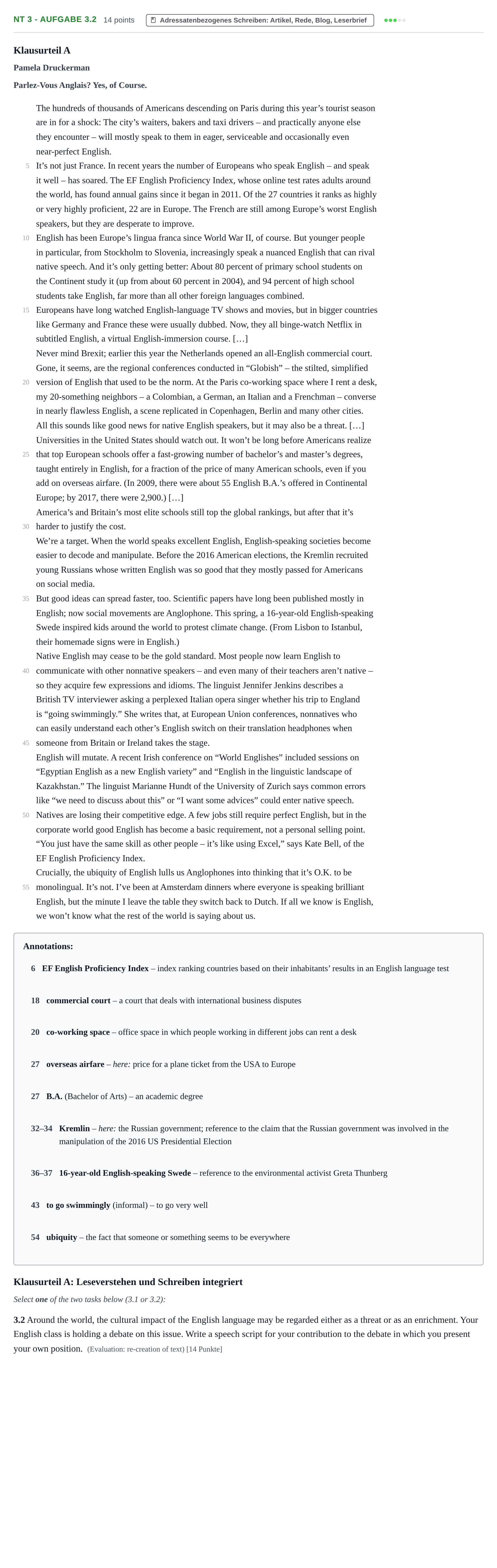
3.2 Around the world, the cultural impact of the English language may be regarded either as a threat or as an enrichment. Your English class is holding a debate on this issue. Write a speech script for your contribution to the debate in which you present your own position. (Evaluation: re-creation of text) [14 Punkte]
Lösung
Nach den offiziellen Korrekturhinweisen
3.2 Around the world, the cultural impact of the English language may be regarded either as a threat or as an enrichment. Your English class is holding a debate on this issue. Write a speech script for your contribution to the debate in which you present your own position.
Lösung: Musterstruktur des Redeskripts (Debattenbeitrag): 1. Einleitung des Redebeitrags (2 Punkte): - Adressaten- und situationsgerechte Begrüßung der Mitschülerinnen und Mitschüler bzw. der Lehrkraft (z. B. 'Dear classmates, ladies and gentlemen...'). - Einführung in das Thema der Debatte und klare Nennung der Redeabsicht/Intention sowie Darlegung der eigenen Ausgangsposition. 2. Hauptteil: Entwicklung einer begründeten Position (8 Punkte): - Sprachlicher und kultureller Einfluss als Bereicherung: Ermöglichung weltweiter Kommunikation und interkulturellen Austauschs; Verbreitung von Wissen, wissenschaftlichen Erkenntnissen und sozialen Bewegungen (wie Fridays for Future); weltweite Vernetzung durch das Internet. - Sprachlicher und kultureller Einfluss als Bedrohung: Gefahr der Verdrängung lokaler Sprachen und sprachlicher Homogenisierung; Verlust regionaler Identitäten und kultureller Diversität; sprachlicher Imperialismus und Dominanz westlich-angelsächsischer Kulturmuster. - Ausgewogene Diskussion mit persönlicher Schwerpunktsetzung und fundierten Argumenten. 3. Schluss des Redebeitrags (4 Punkte): - Zusammenfassung der wesentlichen Argumente. - Pointierte Schlussbemerkung (z. B. Appell für einen verantwortungsvollen Umgang: Englisch als Brücke zur Welt nutzen, ohne die eigenen sprachlichen Wurzeln aufzugeben) sowie Dank an das Publikum für die Aufmerksamkeit.
Die ausführliche Erklärung Schritt für Schritt (mit KI) gibt es mit Premium. Premium
Löse sie direkt hier: automatische Korrektur, Hinweise und Lösung Schritt für Schritt.
‹ Aufgabe NT 2 - Aufgabe 3.2 · GK · Nachtermin · Weiterbildungskolleg 2022 · Aufgabe HT 2 - Task 3.2 · LK · Haupttermin 2022 ›
Mehr Aufgaben zu Adressatenbezogenes Schreiben: Artikel, Rede, Blog, Leserbrief
- Aufgabe HT 2 - Aufgabe 3.2 · GK · Haupttermin · Weiterbildungskolleg 2022
- Aufgabe HT 3 - Aufgabe 3.2 · GK · Haupttermin · Weiterbildungskolleg 2022
- Aufgabe 3.2 (NT 2) · GK · Nachtermin 2022
- Aufgabe 3.2 (NT 3) · GK · Nachtermin 2022
- Aufgabe NT 2 - Aufgabe 3.2 · GK · Nachtermin · Weiterbildungskolleg 2022
- Aufgabe HT 2 - Task 3.2 · LK · Haupttermin 2022
- Aufgabe HT 3 - Task 3.2 · LK · Haupttermin 2022
- Aufgabe HT 2 - Aufgabe 3.2 · LK · Haupttermin · Weiterbildungskolleg 2022
- Aufgabe HT 3 - Aufgabe 3.2 · LK · Haupttermin · Weiterbildungskolleg 2022
- Aufgabe NT 1 - Aufgabe 3.2 · LK · Nachtermin 2022