Aufgabe NT 2 - Aufgabe 3.2 · Abitur NRW Englisch GK · Nachtermin · Weiterbildungskolleg 2022
Thema: Adressatenbezogenes Schreiben: Artikel, Rede, Blog, Leserbrief · Aus der Prüfung GK · Nachtermin · Weiterbildungskolleg (2022)
Aufgabenstellung
Klausurteil A
Joseph Harker
The British press isn’t racist, say the editors. That just shows how long the problem will endure
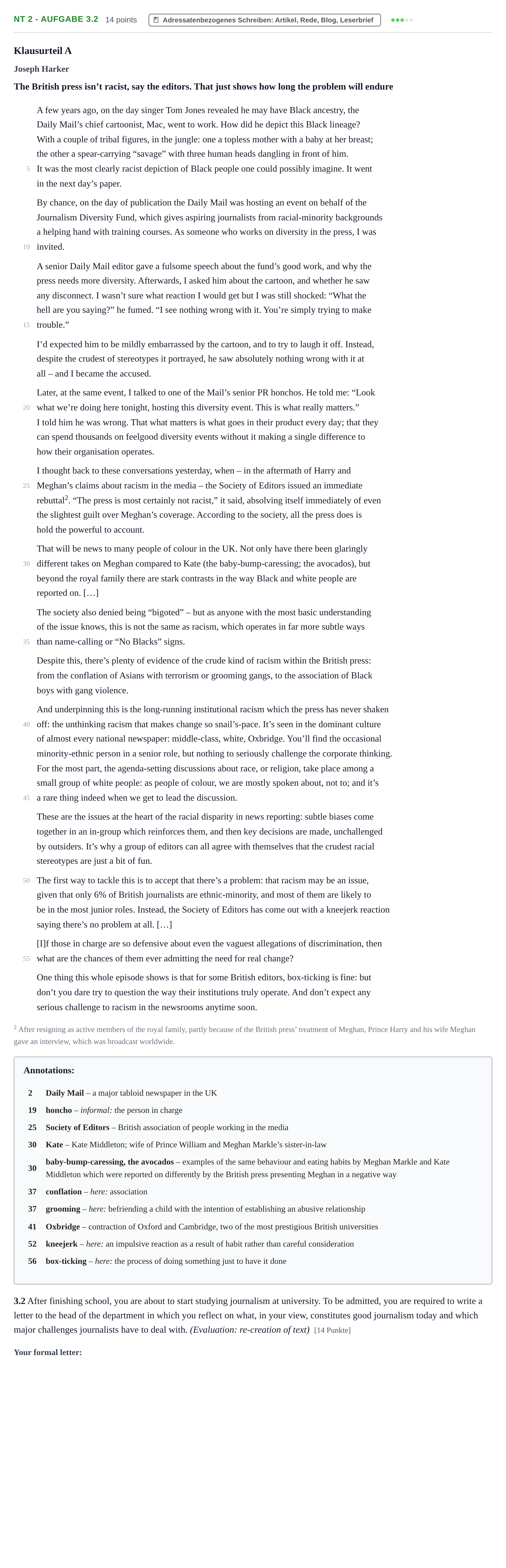
A few years ago, on the day singer Tom Jones revealed he may have Black ancestry, the
Daily Mail’s chief cartoonist, Mac, went to work. How did he depict this Black lineage?
With a couple of tribal figures, in the jungle: one a topless mother with a baby at her breast;
the other a spear-carrying “savage” with three human heads dangling in front of him.
5 It was the most clearly racist depiction of Black people one could possibly imagine. It went
in the next day’s paper.
By chance, on the day of publication the Daily Mail was hosting an event on behalf of the
Journalism Diversity Fund, which gives aspiring journalists from racial-minority backgrounds
a helping hand with training courses. As someone who works on diversity in the press, I was
10 invited.
A senior Daily Mail editor gave a fulsome speech about the fund’s good work, and why the
press needs more diversity. Afterwards, I asked him about the cartoon, and whether he saw
any disconnect. I wasn’t sure what reaction I would get but I was still shocked: “What the
hell are you saying?” he fumed. “I see nothing wrong with it. You’re simply trying to make
15 trouble.”
I’d expected him to be mildly embarrassed by the cartoon, and to try to laugh it off. Instead,
despite the crudest of stereotypes it portrayed, he saw absolutely nothing wrong with it at
all – and I became the accused.
Later, at the same event, I talked to one of the Mail’s senior PR honchos. He told me: “Look
20 what we’re doing here tonight, hosting this diversity event. This is what really matters.”
I told him he was wrong. That what matters is what goes in their product every day; that they
can spend thousands on feelgood diversity events without it making a single difference to
how their organisation operates.
I thought back to these conversations yesterday, when – in the aftermath of Harry and
25 Meghan’s claims about racism in the media – the Society of Editors issued an immediate
rebuttal 2. “The press is most certainly not racist,” it said, absolving itself immediately of even
the slightest guilt over Meghan’s coverage. According to the society, all the press does is
hold the powerful to account.
That will be news to many people of colour in the UK. Not only have there been glaringly
30 different takes on Meghan compared to Kate (the baby-bump-caressing; the avocados), but
beyond the royal family there are stark contrasts in the way Black and white people are
reported on. […]
The society also denied being “bigoted” – but as anyone with the most basic understanding
of the issue knows, this is not the same as racism, which operates in far more subtle ways
35 than name-calling or “No Blacks” signs.
Despite this, there’s plenty of evidence of the crude kind of racism within the British press:
from the conflation of Asians with terrorism or grooming gangs, to the association of Black
boys with gang violence.
And underpinning this is the long-running institutional racism which the press has never shaken
40 off: the unthinking racism that makes change so snail’s-pace. It’s seen in the dominant culture
of almost every national newspaper: middle-class, white, Oxbridge. You’ll find the occasional
minority-ethnic person in a senior role, but nothing to seriously challenge the corporate thinking.
For the most part, the agenda-setting discussions about race, or religion, take place among a
small group of white people: as people of colour, we are mostly spoken about, not to; and it’s
45 a rare thing indeed when we get to lead the discussion.
These are the issues at the heart of the racial disparity in news reporting: subtle biases come
together in an in-group which reinforces them, and then key decisions are made, unchallenged
by outsiders. It’s why a group of editors can all agree with themselves that the crudest racial
stereotypes are just a bit of fun.
50 The first way to tackle this is to accept that there’s a problem: that racism may be an issue,
given that only 6% of British journalists are ethnic-minority, and most of them are likely to
be in the most junior roles. Instead, the Society of Editors has come out with a kneejerk reaction
saying there’s no problem at all. […]
[I]f those in charge are so defensive about even the vaguest allegations of discrimination, then
55 what are the chances of them ever admitting the need for real change?
One thing this whole episode shows is that for some British editors, box-ticking is fine: but
don’t you dare try to question the way their institutions truly operate. And don’t expect any
serious challenge to racism in the newsrooms anytime soon.
2 After resigning as active members of the royal family, partly because of the British press’ treatment of Meghan, Prince Harry and his wife Meghan gave an interview, which was broadcast worldwide.
Annotations:
2 · Daily Mail – a major tabloid newspaper in the UK
19 · honcho – informal: the person in charge
25 · Society of Editors – British association of people working in the media
30 · Kate – Kate Middleton; wife of Prince William and Meghan Markle’s sister-in-law
30 · baby-bump-caressing, the avocados – examples of the same behaviour and eating habits by Meghan Markle and Kate Middleton which were reported on differently by the British press presenting Meghan in a negative way
37 · conflation – here: association
37 · grooming – here: befriending a child with the intention of establishing an abusive relationship
41 · Oxbridge – contraction of Oxford and Cambridge, two of the most prestigious British universities
52 · kneejerk – here: an impulsive reaction as a result of habit rather than careful consideration
56 · box-ticking – here: the process of doing something just to have it done
3.2 After finishing school, you are about to start studying journalism at university. To be admitted, you are required to write a letter to the head of the department in which you reflect on what, in your view, constitutes good journalism today and which major challenges journalists have to deal with. (Evaluation: re-creation of text) [14 Punkte]
Lösung
Nach den offiziellen Korrekturhinweisen
3.2 Write a letter to the head of the department in which you reflect on what, in your view, constitutes good journalism today and which major challenges journalists have to deal with.
Lösung: A formal letter meeting the conventions and task requirements: 1. Format and tone: - Formal letter conventions (appropriate address, date/subject, formal salutation, professional tone, formal sign-off). - Clear statement of motivation and intention for applying to study journalism. 2. Quality of journalism: - Addressing socially relevant issues and holding the powerful to account. - Rigorous fact-checking, thorough research, and accurate target-group orientation. - Independent, multiperspective, and balanced reporting. - Awareness of the media's vital democratic responsibility and ethical duty. 3. Current challenges: - Rapid news cycles and information overload in the digital age. - Proliferation of fake news and disinformation on social media platforms. - Fierce commercial competition for clicks, views, and audience attention. - Political pressure, external bias, economic constraints, and intimidation or physical hostility towards reporters. 4. Conclusion: - Personal outlook/aspirations as a future journalist and a plea for strong, independent journalism in democratic societies.
Die ausführliche Erklärung Schritt für Schritt (mit KI) gibt es mit Premium. Premium
Löse sie direkt hier: automatische Korrektur, Hinweise und Lösung Schritt für Schritt.
‹ Aufgabe 3.2 (NT 3) · GK · Nachtermin 2022 · Aufgabe NT 3 - Aufgabe 3.2 · GK · Nachtermin · Weiterbildungskolleg 2022 ›
Mehr Aufgaben zu Adressatenbezogenes Schreiben: Artikel, Rede, Blog, Leserbrief
- Aufgabe HT 3 - Aufgabe 3.2 · GK · Haupttermin 2022
- Aufgabe HT 2 - Aufgabe 3.2 · GK · Haupttermin · Weiterbildungskolleg 2022
- Aufgabe HT 3 - Aufgabe 3.2 · GK · Haupttermin · Weiterbildungskolleg 2022
- Aufgabe 3.2 (NT 2) · GK · Nachtermin 2022
- Aufgabe 3.2 (NT 3) · GK · Nachtermin 2022
- Aufgabe NT 3 - Aufgabe 3.2 · GK · Nachtermin · Weiterbildungskolleg 2022
- Aufgabe HT 2 - Task 3.2 · LK · Haupttermin 2022
- Aufgabe HT 3 - Task 3.2 · LK · Haupttermin 2022
- Aufgabe HT 2 - Aufgabe 3.2 · LK · Haupttermin · Weiterbildungskolleg 2022
- Aufgabe HT 3 - Aufgabe 3.2 · LK · Haupttermin · Weiterbildungskolleg 2022