Aufgabe 2 - Stoffkreisläufe und Einfluss des Mens… · Abitur NRW Biologie GK · Haupttermin · bilingual Englisch 2021
Thema: Stoffkreisläufe und Einfluss des Menschen · Aus der Prüfung GK · Haupttermin · bilingual Englisch (2021)
Aufgabenstellung
Material A: Sense of Smell in Lobesia botrana
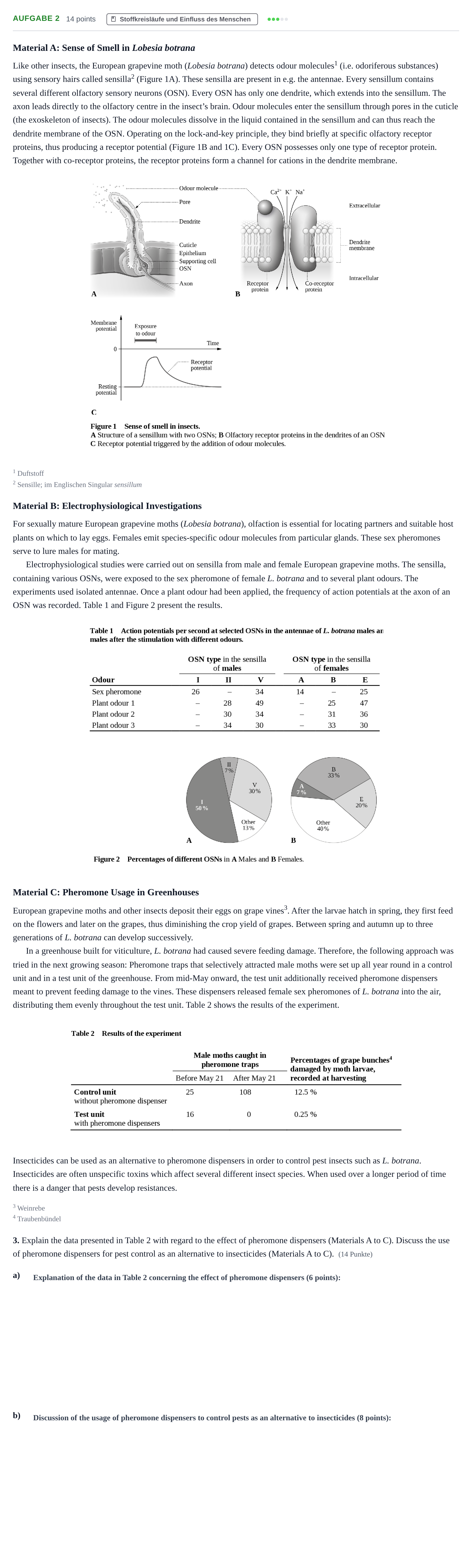
Like other insects, the European grapevine moth ( Lobesia botrana) detects odour molecules 1 (i.e. odoriferous substances) using sensory hairs called sensilla 2 (Figure 1A). These sensilla are present in e.g. the antennae. Every sensillum contains several different olfactory sensory neurons (OSN). Every OSN has only one dendrite, which extends into the sensillum. The axon leads directly to the olfactory centre in the insect’s brain. Odour molecules enter the sensillum through pores in the cuticle (the exoskeleton of insects). The odour molecules dissolve in the liquid contained in the sensillum and can thus reach the dendrite membrane of the OSN. Operating on the lock-and-key principle, they bind briefly at specific olfactory receptor proteins, thus producing a receptor potential (Figure 1B and 1C). Every OSN possesses only one type of receptor protein. Together with co-receptor proteins, the receptor proteins form a channel for cations in the dendrite membrane.
1 Duftstoff
2 Sensille; im Englischen Singular sensillum
Material B: Electrophysiological Investigations
For sexually mature European grapevine moths ( Lobesia botrana), olfaction is essential for locating partners and suitable host plants on which to lay eggs. Females emit species-specific odour molecules from particular glands. These sex pheromones serve to lure males for mating.
Electrophysiological studies were carried out on sensilla from male and female European grapevine moths. The sensilla, containing various OSNs, were exposed to the sex pheromone of female L. botrana and to several plant odours. The experiments used isolated antennae. Once a plant odour had been applied, the frequency of action potentials at the axon of an OSN was recorded. Table 1 and Figure 2 present the results.
Material C: Pheromone Usage in Greenhouses
European grapevine moths and other insects deposit their eggs on grape vines 3. After the larvae hatch in spring, they first feed on the flowers and later on the grapes, thus diminishing the crop yield of grapes. Between spring and autumn up to three generations of L. botrana can develop successively.
In a greenhouse built for viticulture, L. botrana had caused severe feeding damage. Therefore, the following approach was tried in the next growing season: Pheromone traps that selectively attracted male moths were set up all year round in a control unit and in a test unit of the greenhouse. From mid-May onward, the test unit additionally received pheromone dispensers meant to prevent feeding damage to the vines. These dispensers released female sex pheromones of L. botrana into the air, distributing them evenly throughout the test unit. Table 2 shows the results of the experiment.
Insecticides can be used as an alternative to pheromone dispensers in order to control pest insects such as L. botrana. Insecticides are often unspecific toxins which affect several different insect species. When used over a longer period of time there is a danger that pests develop resistances.
3 Weinrebe
4 Traubenbündel
3. Explain the data presented in Table 2 with regard to the effect of pheromone dispensers (Materials A to C). Discuss the use of pheromone dispensers for pest control as an alternative to insecticides (Materials A to C).
(14 Punkte)
a)
b)
Lösung
Nach den offiziellen Korrekturhinweisen
Explain the data presented in Table 2 with regard to the effect of pheromone dispensers (Materials A to C).
Lösung: Anders als in der Kontrolleinheit (Anstieg von 25 auf 108 Falter) wurden in der Testeinheit nach dem Einsatz der Pheromonspender ab Mitte Mai keine Falter mehr mit Pheromonfallen gefangen (Rückgang von 16 auf 0). Durch die gleichmäßig verteilten Pheromone konnten die Männchen keine Duftfahnen und somit weder Fallen noch Weibchen orten. Die Paarung und anschließende Eiablage wurden verhindert, weshalb der Schaden an den Weintrauben zur Erntezeit von 12,5 % auf 0,25 % sank.
Discuss the usage of pheromone dispensers to control pests as an alternative to insecticides (Materials A to C).
Lösung: Pheromonspender bieten ökologische Vorteile: Sexualpheromone sind artspezifisch, wirken selektiv auf L. botrana und schonen Nützlinge sowie andere Insekten. Zudem wird das Risiko einer schnellen Resistenzbildung vermieden. Nachteilig ist, dass Pheromone präventiv vor der Paarungszeit ausgebracht werden müssen und bei bereits erfolgter Eiablage/Larvenbefall wirkungslos sind, während Insektizide auch kurativ gegen Larven wirken können, jedoch toxisch und unselektiv sind.
Die ausführliche Erklärung Schritt für Schritt (mit KI) gibt es mit Premium. Premium
Löse sie direkt hier: automatische Korrektur, Hinweise und Lösung Schritt für Schritt.
‹ Aufgabe 2 (3) - Stoffkreisläufe und Einfluss des… · GK · Haupttermin 2021 · Aufgabe 2 - Teilaufgabe 3 · GK · Haupttermin · Weiterbildungskolleg 2021 ›
Mehr Aufgaben zu Stoffkreisläufe und Einfluss des Menschen
- Aufgabe HT 1 - 3: Stoffkreisläufe und Einfluss des Mensch… · GK · Haupttermin · Weiterbildungskolleg 2022
- Aufgabe 3 (Teilaufgabe 4) - Stoffkreisläufe und E… · LK · Haupttermin 2022
- Aufgabe 3 - Teilaufgabe 4: Stoffkreisläufe und Ei… · LK · Haupttermin · Weiterbildungskolleg 2022
- Aufgabe 3 - Stoffkreisläufe und Einfluss des Mens… · LK · Nachtermin 2022
- Aufgabe 2 (3) - Stoffkreisläufe und Einfluss des… · GK · Haupttermin 2021
- Aufgabe 2 - Teilaufgabe 3 · GK · Haupttermin · Weiterbildungskolleg 2021
- Aufgabe 1 - 4 · LK · Haupttermin · Weiterbildungskolleg 2021