Aufgabe 1 - Teilaufgabe 1 · Abitur NRW Biologie GK · Haupttermin · bilingual Englisch 2022
Thema: Nahrungsbeziehungen und Populationen · Aus der Prüfung GK · Haupttermin · bilingual Englisch (2022)
Aufgabenstellung
Material A: The Biology of the Avian Vampire Fly
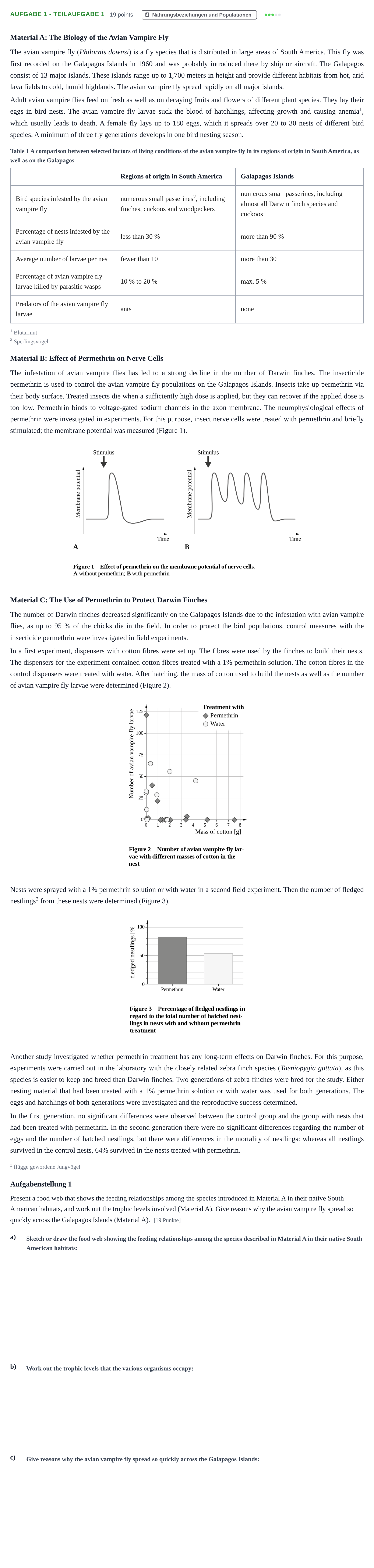
The avian vampire fly ( Philornis downsi) is a fly species that is distributed in large areas of South America. This fly was first recorded on the Galapagos Islands in 1960 and was probably introduced there by ship or aircraft. The Galapagos consist of 13 major islands. These islands range up to 1,700 meters in height and provide different habitats from hot, arid lava fields to cold, humid highlands. The avian vampire fly spread rapidly on all major islands.
Adult avian vampire flies feed on fresh as well as on decaying fruits and flowers of different plant species. They lay their eggs in bird nests. The avian vampire fly larvae suck the blood of hatchlings, affecting growth and causing anemia 1, which usually leads to death. A female fly lays up to 180 eggs, which it spreads over 20 to 30 nests of different bird species. A minimum of three fly generations develops in one bird nesting season.
Table 1 A comparison between selected factors of living conditions of the avian vampire fly in its regions of origin in South America, as well as on the Galapagos · Regions of origin in South America · Galapagos Islands
Bird species infested by the avian vampire fly · numerous small passerines 2, including finches, cuckoos and woodpeckers · numerous small passerines, including almost all Darwin finch species and cuckoos
Percentage of nests infested by the avian vampire fly · less than 30 % · more than 90 %
Average number of larvae per nest · fewer than 10 · more than 30
Percentage of avian vampire fly larvae killed by parasitic wasps · 10 % to 20 % · max. 5 %
Predators of the avian vampire fly larvae · ants · none
1 Blutarmut
2 Sperlingsvögel
Material B: Effect of Permethrin on Nerve Cells
The infestation of avian vampire flies has led to a strong decline in the number of Darwin finches. The insecticide permethrin is used to control the avian vampire fly populations on the Galapagos Islands. Insects take up permethrin via their body surface. Treated insects die when a sufficiently high dose is applied, but they can recover if the applied dose is too low. Permethrin binds to voltage-gated sodium channels in the axon membrane. The neurophysiological effects of permethrin were investigated in experiments. For this purpose, insect nerve cells were treated with permethrin and briefly stimulated; the membrane potential was measured (Figure 1).
Material C: The Use of Permethrin to Protect Darwin Finches
The number of Darwin finches decreased significantly on the Galapagos Islands due to the infestation with avian vampire flies, as up to 95 % of the chicks die in the field. In order to protect the bird populations, control measures with the insecticide permethrin were investigated in field experiments.
In a first experiment, dispensers with cotton fibres were set up. The fibres were used by the finches to build their nests. The dispensers for the experiment contained cotton fibres treated with a 1% permethrin solution. The cotton fibres in the control dispensers were treated with water. After hatching, the mass of cotton used to build the nests as well as the number of avian vampire fly larvae were determined (Figure 2).
Nests were sprayed with a 1% permethrin solution or with water in a second field experiment. Then the number of fledged nestlings 3 from these nests were determined (Figure 3).
Another study investigated whether permethrin treatment has any long-term effects on Darwin finches. For this purpose, experiments were carried out in the laboratory with the closely related zebra finch species ( Taeniopygia guttata), as this species is easier to keep and breed than Darwin finches. Two generations of zebra finches were bred for the study. Either nesting material that had been treated with a 1% permethrin solution or with water was used for both generations. The eggs and hatchlings of both generations were investigated and the reproductive success determined.
In the first generation, no significant differences were observed between the control group and the group with nests that had been treated with permethrin. In the second generation there were no significant differences regarding the number of eggs and the number of hatched nestlings, but there were differences in the mortality of nestlings: whereas all nestlings survived in the control nests, 64% survived in the nests treated with permethrin.
3 flügge gewordene Jungvögel
Aufgabenstellung 1
Present a food web that shows the feeding relationships among the species introduced in Material A in their native South American habitats, and work out the trophic levels involved (Material A). Give reasons why the avian vampire fly spread so quickly across the Galapagos Islands (Material A). [19 Punkte]
a)
b)
c)
Lösung
Nach den offiziellen Korrekturhinweisen
Present a food web that shows the feeding relationships among the species introduced in Material A in their native South American habitats
Lösung: Food web diagram: - Plants (fruits, flowers) Avian vampire fly (adults) - Bird species (blood of nestlings) Avian vampire fly (larvae) - Avian vampire fly Ants (predators) - Avian vampire fly Parasitic wasps (parasitoids)
Work out the trophic levels involved (Material A)
Lösung: - Plants are producers synthesizing organic substances via photosynthesis. - Adult avian vampire flies are primary consumers (1st order consumers), feeding on fruits and flowers. - Avian vampire fly larvae are secondary consumers (2nd order consumers) as parasites feeding on the blood of birds. - Ants and parasitic wasps are secondary consumers (or tertiary depending on the link) feeding on the fly larvae.
Give reasons why the avian vampire fly spread so quickly across the Galapagos Islands (Material A)
Lösung: Reasons based on Material A: 1. Neobiont/Climate adaptation: Introduced species originating from a broad climatic range in South America; can adapt to diverse habitats on the Galapagos (hot arid to cold humid highlands). 2. Abundant food supply for adults: Adult flies feed broadly on fresh and decaying fruits and flowers, which are readily available. 3. Broad host spectrum & naive hosts: Larvae parasitize many bird species. Darwin finches and cuckoos serve as suitable hosts and are heavily infested (over 90 % of nests vs. < 30 % in origin), possibly having weaker defense mechanisms. 4. High reproduction rate: Females lay up to 180 eggs across 20-30 nests; at least three generations develop per nesting season. 5. Lack of natural enemies: Larval predators (ants) are completely absent on the islands, and parasitism by wasps is reduced (max 5 % vs. 10-20 % in South America).
Die ausführliche Erklärung Schritt für Schritt (mit KI) gibt es mit Premium. Premium
Löse sie direkt hier: automatische Korrektur, Hinweise und Lösung Schritt für Schritt.
‹ Aufgabe 1 - Teilaufgabe 3: Bestäuber-Beute-Konfli… · LK · Nachtermin · Weiterbildungskolleg 2023 · Aufgabe HT 1 - 1: Nahrungsbeziehungen und Populationen · GK · Haupttermin · Weiterbildungskolleg 2022 ›
Mehr Aufgaben zu Nahrungsbeziehungen und Populationen
- Aufgabe 1 - Nahrungsbeziehungen und Populationen · LK · Haupttermin 2023
- Aufgabe 1 - Nahrungsbeziehungen und Populationen · LK · Haupttermin · Weiterbildungskolleg 2023
- Aufgabe 1 - Nahrungsbeziehungen und Populationen · LK · Nachtermin 2023
- Aufgabe 3 - Nahrungsbeziehungen und Populationen · LK · Nachtermin 2023
- Aufgabe 1 - Teilaufgabe 3: Bestäuber-Beute-Konfli… · LK · Nachtermin · Weiterbildungskolleg 2023
- Aufgabe HT 1 - 1: Nahrungsbeziehungen und Populationen · GK · Haupttermin · Weiterbildungskolleg 2022
- Aufgabe 3 (Teilaufgabe 3) - Nahrungsbeziehungen u… · LK · Haupttermin 2022
- Aufgabe 3 - Teilaufgabe 3: Nahrungsbeziehungen un… · LK · Haupttermin · Weiterbildungskolleg 2022
- Aufgabe 1 (1–2) - Nahrungsbeziehungen und Populat… · GK · Haupttermin 2021
- Aufgabe 1 - Nahrungsbeziehungen und Populationen · GK · Haupttermin · bilingual Englisch 2021