Aufgabe Vorschlag B - Aufgabe 1.1 · Abitur Hessen Wirtschaftslehre LK · bilingual Englisch 2021
Thema: Investition und Investitionsrechenverfahren · Aus der Prüfung LK · bilingual Englisch (2021)
Aufgabenstellung
IceBuster plc
Due to global climate change temperatures have risen steadily over time. As a result, the demand for making all kinds and forms of ice, such as ice cubes or ice cream, has increased over the years. The Australian company IceBuster plc located in Brisbane, Australia, specialises in the manufacture and distribution of a wide variety of ice making equipment, ice-maker machines and ice cream machines for ice cream parlors, shops, bars and restaurants worldwide.
A recent market research study has revealed that IceBuster plc has lost a tremendous part of its market share. Reasons are, among other things, that IceBuster plc often could not deliver on time because of capacity limits, frequent maintenance work and employee absenteeism.
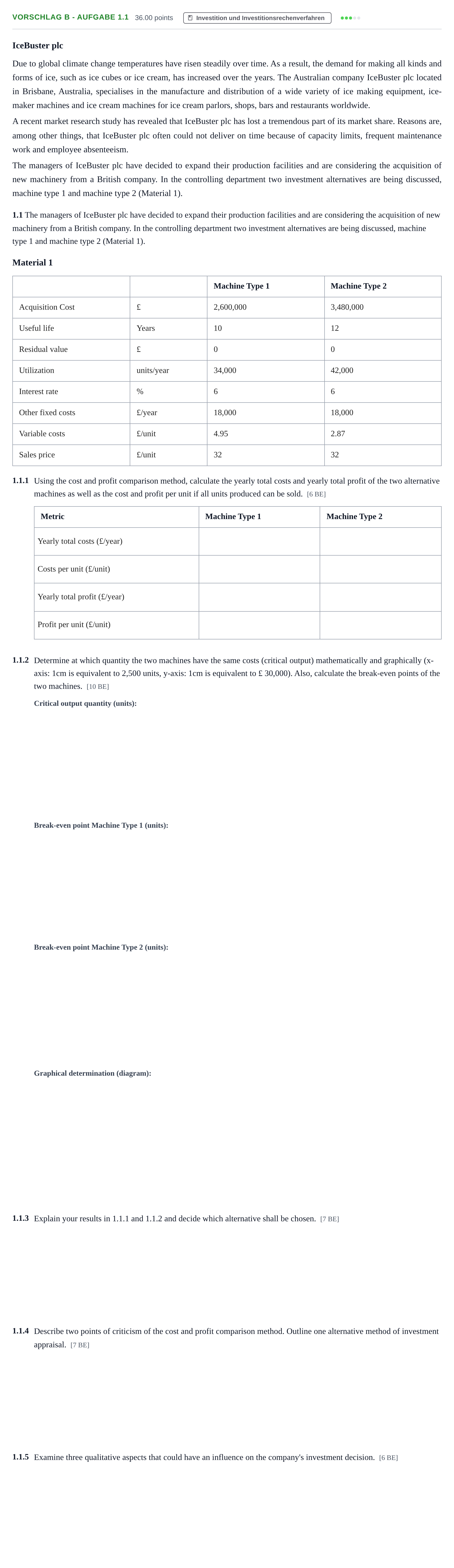
The managers of IceBuster plc have decided to expand their production facilities and are considering the acquisition of new machinery from a British company. In the controlling department two investment alternatives are being discussed, machine type 1 and machine type 2 (Material 1).
1.1 The managers of IceBuster plc have decided to expand their production facilities and are considering the acquisition of new machinery from a British company. In the controlling department two investment alternatives are being discussed, machine type 1 and machine type 2 (Material 1).
Material 1
Machine Type 1
Machine Type 2
Acquisition Cost
£
2,600,000
3,480,000
Useful life
Years
10
12
Residual value
£
0
0
Utilization
units/year
34,000
42,000
Interest rate
%
6
6
Other fixed costs
£/year
18,000
18,000
Variable costs
£/unit
4.95
2.87
Sales price
£/unit
32
32
1.1.1
Using the cost and profit comparison method, calculate the yearly total costs and yearly total profit of the two alternative machines as well as the cost and profit per unit if all units produced can be sold. [6 BE]
Metric
Machine Type 1
Machine Type 2
Yearly total costs (£/year)
Costs per unit (£/unit)
Yearly total profit (£/year)
Profit per unit (£/unit)
1.1.2
Determine at which quantity the two machines have the same costs (critical output) mathematically and graphically (x-axis: 1cm is equivalent to 2,500 units, y-axis: 1cm is equivalent to £ 30,000). Also, calculate the break-even points of the two machines. [10 BE]
1.1.3
Explain your results in 1.1.1 and 1.1.2 and decide which alternative shall be chosen. [7 BE]
1.1.4
Describe two points of criticism of the cost and profit comparison method. Outline one alternative method of investment appraisal. [7 BE]
1.1.5
Examine three qualitative aspects that could have an influence on the company's investment decision. [6 BE]
Lösung
Nach den offiziellen Korrekturhinweisen
1.1.1 Yearly total costs (£/year) - Machine Type 1
Lösung: 524300
1.1.1 Yearly total costs (£/year) - Machine Type 2
Lösung: 532940
1.1.1 Costs per unit (£/unit) - Machine Type 1
Lösung: 15.42
1.1.1 Costs per unit (£/unit) - Machine Type 2
Lösung: 12.69
1.1.1 Yearly total profit (£/year) - Machine Type 1
Lösung: 563700 / 563720
1.1.1 Yearly total profit (£/year) - Machine Type 2
Lösung: 811060 / 811020
1.1.1 Profit per unit (£/unit) - Machine Type 1
Lösung: 16.58
1.1.1 Profit per unit (£/unit) - Machine Type 2
Lösung: 19.31
1.1.2 Critical output quantity (units)
Lösung: 27115.38 / 27116
1.1.2 Break-even point Machine Type 1 (units)
Lösung: 13160.81 / 13161
1.1.2 Break-even point Machine Type 2 (units)
Lösung: 14157.23 / 14158
1.1.2 Graphical determination of critical output quantity
Lösung: The graph must accurately show both cost functions: - Machine 1: y-intercept at £ 356,000, passing through (34,000; £ 524,300). - Machine 2: y-intercept at £ 412,400, passing through (42,000; £ 532,940). - Intersection point (critical cost point) at units and Costs .
1.1.3 Explain your results in 1.1.1 and 1.1.2 and decide which alternative shall be chosen.
Lösung: Decision & Explanation: - Machine 2 is generally recommended if high demand is expected, because it yields higher yearly total profit (£ 811,060 vs £ 563,700), has lower unit costs (£ 12.69 vs £ 15.42), and lower variable costs per unit (£ 2.87 vs £ 4.95). - Machine 1 reaches the break-even point earlier (13,161 units vs 14,158 units) and is cheaper for production volumes below the critical output of 27,116 units. - Above 27,116 units, Machine 2 is more cost-effective.
1.1.4 Describe two points of criticism of the cost and profit comparison method. Outline one alternative method of investment appraisal.
Lösung: Criticism: 1. Only considers a single period (typically a fictitious average period) and ignores the timing of cash inflows and outflows (time value of money). 2. Difficult to allocate individual overhead costs and revenues accurately in practice; gives no information about true profitability or internal rate of return. Alternative method: - Net Present Value (Kapitalwertmethode): discounts future cash flows to using a cost of capital. - Internal Rate of Return (Interner Zinsfuß) or Profitability comparison (Rentabilitätsvergleichsrechnung).
1.1.5 Examine three qualitative aspects that could have an influence on the company's investment decision.
Lösung: Three qualitative criteria such as: 1. Reliability, maintenance, and after-sales service (speed and cost of repairs, availability of spare parts). 2. Flexibility and adaptability (ease of refitting/tooling for different product types, environmental and safety standards). 3. Production capacity, machine speed, and ease of operation (training required for staff).
Die ausführliche Erklärung Schritt für Schritt (mit KI) gibt es mit Premium. Premium
Löse sie direkt hier: automatische Korrektur, Hinweise und Lösung Schritt für Schritt.
‹ Aufgabe Vorschlag A - Aufgabe 1.1-1.2 · LK · bilingual Englisch 2021
Mehr Aufgaben zu Investition und Investitionsrechenverfahren
- Aufgabe Vorschlag A - Aufgabe 2 · LK · bilingual Englisch 2022
- Aufgabe Vorschlag C - Aufgabe 1 · LK · bilingual Englisch 2022
- Aufgabe Vorschlag A - Aufgabe 1.3: Investitionsrechenverf… · LK 2021
- Aufgabe Vorschlag C - Aufgabe 2.1-2.3: Investitionsrechen… · LK 2021
- Aufgabe Vorschlag A - Aufgabe 1.1-1.2 · LK · bilingual Englisch 2021