Aufgabe Vorschlag C - Aufgabe 1 (1.1-1.6, 1.8) · Abitur Hessen Wirtschaftslehre LK · bilingual Englisch 2021
Thema: Fertigungsprozesse, Rationalisierung und Arbeitsorganisation · Aus der Prüfung LK · bilingual Englisch (2021)
Aufgabenstellung
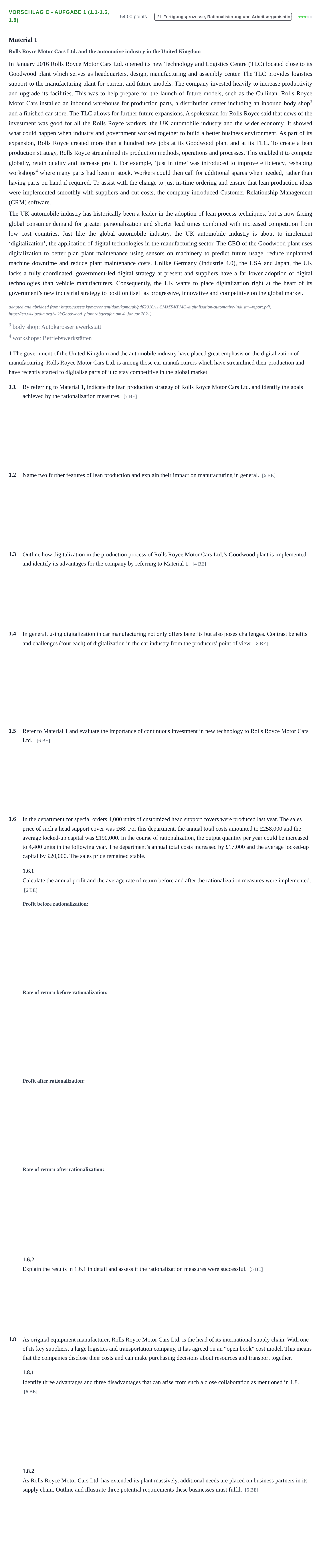
Material 1
Rolls Royce Motor Cars Ltd. and the automotive industry in the United Kingdom
In January 2016 Rolls Royce Motor Cars Ltd. opened its new Technology and Logistics Centre (TLC) located close to its Goodwood plant which serves as headquarters, design, manufacturing and assembly center. The TLC provides logistics support to the manufacturing plant for current and future models. The company invested heavily to increase productivity and upgrade its facilities. This was to help prepare for the launch of future models, such as the Cullinan. Rolls Royce Motor Cars installed an inbound warehouse for production parts, a distribution center including an inbound body shop 3 and a finished car store. The TLC allows for further future expansions. A spokesman for Rolls Royce said that news of the investment was good for all the Rolls Royce workers, the UK automobile industry and the wider economy. It showed what could happen when industry and government worked together to build a better business environment. As part of its expansion, Rolls Royce created more than a hundred new jobs at its Goodwood plant and at its TLC. To create a lean production strategy, Rolls Royce streamlined its production methods, operations and processes. This enabled it to compete globally, retain quality and increase profit. For example, ‘just in time’ was introduced to improve efficiency, reshaping workshops 4 where many parts had been in stock. Workers could then call for additional spares when needed, rather than having parts on hand if required. To assist with the change to just in-time ordering and ensure that lean production ideas were implemented smoothly with suppliers and cut costs, the company introduced Customer Relationship Management (CRM) software.
The UK automobile industry has historically been a leader in the adoption of lean process techniques, but is now facing global consumer demand for greater personalization and shorter lead times combined with increased competition from low cost countries. Just like the global automobile industry, the UK automobile industry is about to implement ‘digitalization’, the application of digital technologies in the manufacturing sector. The CEO of the Goodwood plant uses digitalization to better plan plant maintenance using sensors on machinery to predict future usage, reduce unplanned machine downtime and reduce plant maintenance costs. Unlike Germany (Industrie 4.0), the USA and Japan, the UK lacks a fully coordinated, government-led digital strategy at present and suppliers have a far lower adoption of digital technologies than vehicle manufacturers. Consequently, the UK wants to place digitalization right at the heart of its government’s new industrial strategy to position itself as progressive, innovative and competitive on the global market.
adapted and abridged from: https://assets.kpmg/content/dam/kpmg/uk/pdf/2016/11/SMMT-KPMG-digitalisation-automotive-industry-report.pdf; https://en.wikipedia.org/wiki/Goodwood_plant (abgerufen am 4. Januar 2021).
3 body shop: Autokarosseriewerkstatt
4 workshops: Betriebswerkstätten
1 The government of the United Kingdom and the automobile industry have placed great emphasis on the digitalization of manufacturing. Rolls Royce Motor Cars Ltd. is among those car manufacturers which have streamlined their production and have recently started to digitalise parts of it to stay competitive in the global market.
1.1
By referring to Material 1, indicate the lean production strategy of Rolls Royce Motor Cars Ltd. and identify the goals achieved by the rationalization measures. [7 BE]
1.2
Name two further features of lean production and explain their impact on manufacturing in general. [6 BE]
1.3
Outline how digitalization in the production process of Rolls Royce Motor Cars Ltd.’s Goodwood plant is implemented and identify its advantages for the company by referring to Material 1. [4 BE]
1.4
In general, using digitalization in car manufacturing not only offers benefits but also poses challenges. Contrast benefits and challenges (four each) of digitalization in the car industry from the producers’ point of view. [8 BE]
1.5
Refer to Material 1 and evaluate the importance of continuous investment in new technology to Rolls Royce Motor Cars Ltd.. [6 BE]
1.6
In the department for special orders 4,000 units of customized head support covers were produced last year. The sales price of such a head support cover was £68. For this department, the annual total costs amounted to £258,000 and the average locked-up capital was £190,000. In the course of rationalization, the output quantity per year could be increased to 4,400 units in the following year. The department’s annual total costs increased by £17,000 and the average locked-up capital by £20,000. The sales price remained stable.
1.6.1
Calculate the annual profit and the average rate of return before and after the rationalization measures were implemented. [6 BE]
1.6.2
Explain the results in 1.6.1 in detail and assess if the rationalization measures were successful. [5 BE]
1.8
As original equipment manufacturer, Rolls Royce Motor Cars Ltd. is the head of its international supply chain. With one of its key suppliers, a large logistics and transportation company, it has agreed on an “open book” cost model. This means that the companies disclose their costs and can make purchasing decisions about resources and transport together.
1.8.1
Identify three advantages and three disadvantages that can arise from such a close collaboration as mentioned in 1.8. [6 BE]
1.8.2
As Rolls Royce Motor Cars Ltd. has extended its plant massively, additional needs are placed on business partners in its supply chain. Outline and illustrate three potential requirements these businesses must fulfil. [6 BE]
Lösung
Nach den offiziellen Korrekturhinweisen
1.1 By referring to Material 1, indicate the lean production strategy of Rolls Royce Motor Cars Ltd. and identify the goals achieved by the rationalization measures.
Lösung: Indicate: Rationalisierung der Produktionsmethoden, -abläufe und -prozesse; Einführung von Just-In-Time und Customer Relationship Management (CRM) Software. Identify: Mehr Gewinn, Erhaltung und Verbesserung der Qualität, Ausbau der globalen Wettbewerbsfähigkeit, Effizienzsteigerung im Produktionsablauf und der Teilelieferung, Erleichterung des Wechsels zum JIT-Bestellprinzip, reibungsloses Umsetzen der Lean-Strategie mit Lieferanten, Kostensenkungen.
1.2 Name two further features of lean production and explain their impact on manufacturing in general.
Lösung: Zwei Konzepte (z. B. Kaizen, Empowerment, Kanban, Teamworking) mit entsprechender Erklärung ihrer Wirkung auf die Fertigung.
1.3 Outline how digitalization in the production process of Rolls Royce Motor Cars Ltd.’s Goodwood plant is implemented and identify its advantages for the company by referring to Material 1.
Lösung: Outline: Einsatz digitaler Technik zur besseren Instandhaltungsplanung mittels Sensoren an Maschinen (Z. 23–24). Identify: Vorhersage zukünftiger Maschineneinsätze, Reduktion ungeplanter Stillstände, Senkung der Instandhaltungskosten (Z. 24–25).
1.4 In general, using digitalization in car manufacturing not only offers benefits but also poses challenges. Contrast benefits and challenges (four each) of digitalization in the car industry from the producers’ point of view.
Lösung: Vorteile (4 nennen): z. B. Produktivitätssteigerung, bessere Arbeitssicherheit, Ersatz monotoner Tätigkeiten, Qualitätsverbesserung, schnellere Durchlaufzeiten, Kostensenkungen. Herausforderungen (4 nennen): z. B. Kapitalmangel, Fachkräftemangel, Schulungsaufwand, Datensicherheit/Cyberattacken, Infrastrukturanforderungen, ungleiche Digitalisierung bei Lieferanten.
1.5 Refer to Material 1 and evaluate the importance of continuous investment in new technology to Rolls Royce Motor Cars Ltd..
Lösung: Kontinuierliche Investitionen ermöglichen ständige Weiterentwicklung: bessere Ressourcennutzung, Produktivitäts- und Effizienzsteigerung, Kostensenkung, Ausbau der globalen Wettbewerbsfähigkeit, Marktanteils- und Umsatzsteigerung, Profilierung als moderner Arbeitgeber.
1.6.1 Calculate the annual profit before the rationalization measures were implemented.
Lösung: £14,000
1.6.1 Calculate the average rate of return before the rationalization measures were implemented.
Lösung: 7.4% / 7.37%
1.6.1 Calculate the annual profit after the rationalization measures were implemented.
Lösung: £24,200
1.6.1 Calculate the average rate of return after the rationalization measures were implemented.
Lösung: 11.5% / 11.52%
1.6.2 Explain the results in 1.6.1 in detail and assess if the rationalization measures were successful.
Lösung: Erklärung: Sowohl Gewinn als auch Rentabilität steigen deutlich an. Trotz höherer Gesamtkosten und mehr gebundenem Kapital ermöglicht die höhere Ausbringungsmenge bei stabilem Preis eine deutliche Ergebnisverbesserung. Beurteilung: Die Maßnahmen waren erfolgreich (Gewinnanstieg um £10.200 bzw. Rentabilitätsanstieg um ca. 4,1 Prozentpunkte).
1.8.1 Identify three advantages and three disadvantages that can arise from such a close collaboration as mentioned in 1.8.
Lösung: Vorteile (3 nennen): Einsparungspotenziale, Gewinnsteigerung, Transparenz, gemeinsame Planung/Datenerhebung, Loyalität/Bindung, schnellere Reaktionszeiten, Synergieeffekte. Nachteile (3 nennen): Diskrepanzen bzgl. Ressourcenbeschaffung oder Einsparpotenzialen, unterschiedliche Gewinnerwartungen, Uneinigkeiten/Streitigkeiten, gegenseitige Abhängigkeit, schwieriger Ausstieg.
1.8.2 Outline and illustrate three potential requirements these businesses must fulfil.
Lösung: Outline: Expansion/Investition, Anpassung/Flexibilität, Arbeitskräftebedarf, gute Kapitalausstattung, Abstimmung auf Technologie des Herstellers, Qualifizierung der Mitarbeiter. Illustrate: Um mit dem Wachstum Schritt zu halten, müssen Zulieferer selbst expandieren, mehr Personal schulen, Technologien kompatibel machen, Lieferzeiten verkürzen und Just-In-Time liefern können.
Die ausführliche Erklärung Schritt für Schritt (mit KI) gibt es mit Premium. Premium
Löse sie direkt hier: automatische Korrektur, Hinweise und Lösung Schritt für Schritt.
‹ Aufgabe Vorschlag B - Aufgabe 1.3-1.4 · LK · bilingual Englisch 2021
Mehr Aufgaben zu Fertigungsprozesse, Rationalisierung und Arbeitsorganisation
- Aufgabe Vorschlag A - Aufgabe 3 (3.3) · LK · bilingual Englisch 2022
- Aufgabe Vorschlag A - Aufgabe 1.4: Fachkräftemangel · LK 2021
- Aufgabe Vorschlag B - Aufgabe 1.2.3: Make or Buy · LK 2021
- Aufgabe Vorschlag C - Aufgabe 1.1: Fertigungsorganisation · LK 2021
- Aufgabe Vorschlag B - Aufgabe 1.3-1.4 · LK · bilingual Englisch 2021