Aufgabe Vorschlag B2 – 3.1 · Abitur Hessen Englisch LK 2022
Thema: Stellungnahme und Erörterung (Comment / Discuss / Assess) · Aus der Prüfung LK (2022)
Aufgabenstellung
Material
Afua Hirsch: Brit(ish): On Race, Identity and Belonging (memoir, 2018)
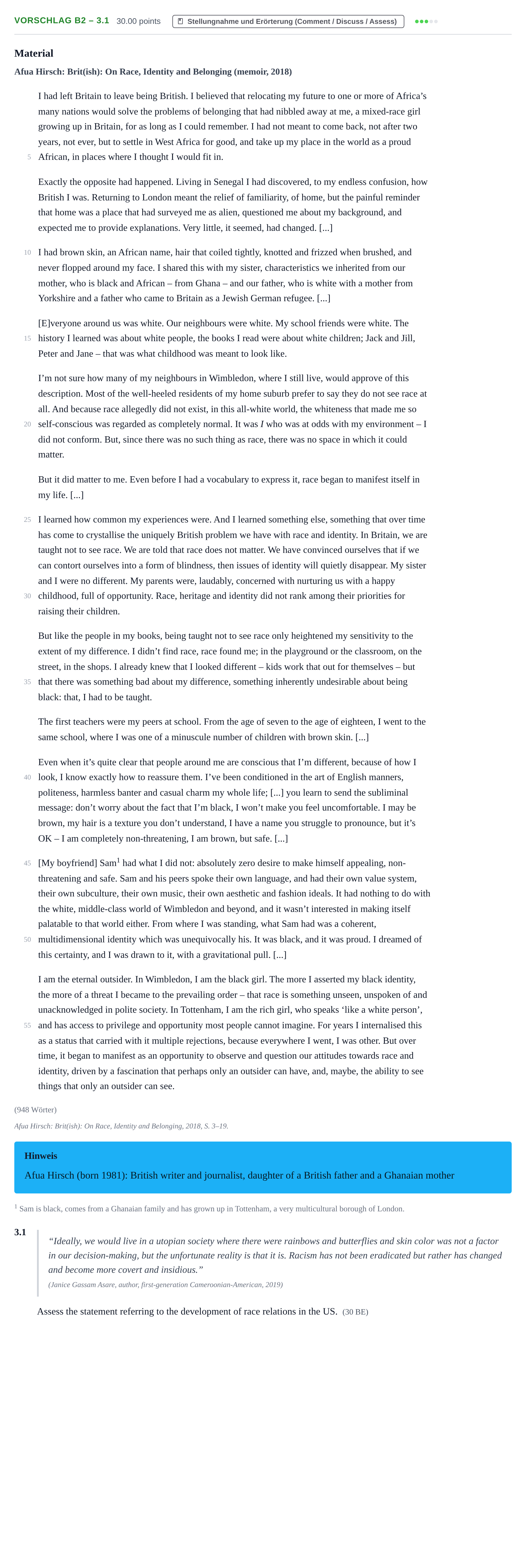
I had left Britain to leave being British. I believed that relocating my future to one or more of Africa’s
many nations would solve the problems of belonging that had nibbled away at me, a mixed-race girl
growing up in Britain, for as long as I could remember. I had not meant to come back, not after two
years, not ever, but to settle in West Africa for good, and take up my place in the world as a proud
5 African, in places where I thought I would fit in.
Exactly the opposite had happened. Living in Senegal I had discovered, to my endless confusion, how
British I was. Returning to London meant the relief of familiarity, of home, but the painful reminder
that home was a place that had surveyed me as alien, questioned me about my background, and
expected me to provide explanations. Very little, it seemed, had changed. [...]
10 I had brown skin, an African name, hair that coiled tightly, knotted and frizzed when brushed, and
never flopped around my face. I shared this with my sister, characteristics we inherited from our
mother, who is black and African – from Ghana – and our father, who is white with a mother from
Yorkshire and a father who came to Britain as a Jewish German refugee. [...]
[E]veryone around us was white. Our neighbours were white. My school friends were white. The
15 history I learned was about white people, the books I read were about white children; Jack and Jill,
Peter and Jane – that was what childhood was meant to look like.
I’m not sure how many of my neighbours in Wimbledon, where I still live, would approve of this
description. Most of the well-heeled residents of my home suburb prefer to say they do not see race at
all. And because race allegedly did not exist, in this all-white world, the whiteness that made me so
20 self-conscious was regarded as completely normal. It was I who was at odds with my environment – I
did not conform. But, since there was no such thing as race, there was no space in which it could
matter.
But it did matter to me. Even before I had a vocabulary to express it, race began to manifest itself in
my life. [...]
25 I learned how common my experiences were. And I learned something else, something that over time
has come to crystallise the uniquely British problem we have with race and identity. In Britain, we are
taught not to see race. We are told that race does not matter. We have convinced ourselves that if we
can contort ourselves into a form of blindness, then issues of identity will quietly disappear. My sister
and I were no different. My parents were, laudably, concerned with nurturing us with a happy
30 childhood, full of opportunity. Race, heritage and identity did not rank among their priorities for
raising their children.
But like the people in my books, being taught not to see race only heightened my sensitivity to the
extent of my difference. I didn’t find race, race found me; in the playground or the classroom, on the
street, in the shops. I already knew that I looked different – kids work that out for themselves – but
35 that there was something bad about my difference, something inherently undesirable about being
black: that, I had to be taught.
The first teachers were my peers at school. From the age of seven to the age of eighteen, I went to the
same school, where I was one of a minuscule number of children with brown skin. [...]
Even when it’s quite clear that people around me are conscious that I’m different, because of how I
40 look, I know exactly how to reassure them. I’ve been conditioned in the art of English manners,
politeness, harmless banter and casual charm my whole life; [...] you learn to send the subliminal
message: don’t worry about the fact that I’m black, I won’t make you feel uncomfortable. I may be
brown, my hair is a texture you don’t understand, I have a name you struggle to pronounce, but it’s
OK – I am completely non-threatening, I am brown, but safe. [...]
45 [My boyfriend] Sam 1 had what I did not: absolutely zero desire to make himself appealing, non-
threatening and safe. Sam and his peers spoke their own language, and had their own value system,
their own subculture, their own music, their own aesthetic and fashion ideals. It had nothing to do with
the white, middle-class world of Wimbledon and beyond, and it wasn’t interested in making itself
palatable to that world either. From where I was standing, what Sam had was a coherent,
50 multidimensional identity which was unequivocally his. It was black, and it was proud. I dreamed of
this certainty, and I was drawn to it, with a gravitational pull. [...]
I am the eternal outsider. In Wimbledon, I am the black girl. The more I asserted my black identity,
the more of a threat I became to the prevailing order – that race is something unseen, unspoken of and
unacknowledged in polite society. In Tottenham, I am the rich girl, who speaks ‘like a white person’,
55 and has access to privilege and opportunity most people cannot imagine. For years I internalised this
as a status that carried with it multiple rejections, because everywhere I went, I was other. But over
time, it began to manifest as an opportunity to observe and question our attitudes towards race and
identity, driven by a fascination that perhaps only an outsider can have, and, maybe, the ability to see
things that only an outsider can see.
(948 Wörter)
Afua Hirsch: Brit(ish): On Race, Identity and Belonging, 2018, S. 3–19.
Hinweis
Afua Hirsch (born 1981): British writer and journalist, daughter of a British father and a Ghanaian mother
1 Sam is black, comes from a Ghanaian family and has grown up in Tottenham, a very multicultural borough of London.
3.1
“Ideally, we would live in a utopian society where there were rainbows and butterflies and skin color was not a factor in our decision-making, but the unfortunate reality is that it is. Racism has not been eradicated but rather has changed and become more covert and insidious.”
(Janice Gassam Asare, author, first-generation Cameroonian-American, 2019)
Assess the statement referring to the development of race relations in the US.
(30 BE)
Lösung
Nach den offiziellen Korrekturhinweisen
3.1 Assess the statement referring to the development of race relations in the US. (30 BE)
Lösung: Key aspects of an assessment: - Clarification/paraphrase of the quotation: While legal and overt racism has officially been banned, racism persists in hidden, systemic, and unconscious forms. - Historical progress: Legal equality achieved through landmark legislation of the Civil Rights Movement (e.g. Civil Rights Act of 1964, Voting Rights Act of 1965); integration in public life, election of Barack Obama as president. - Everyday & covert racism: Unconscious racial bias, microaggressions, prevalence of white beauty standards, persistent stereotypes in media/social media. - Systemic / institutional racism: - Disproportionate incarceration rates of Black and Hispanic Americans. - Disparities in healthcare, quality of schooling, and housing/homeownership (redlining legacies). - Police brutality and unequal treatment by law enforcement, sparking the Black Lives Matter movement. - Conclusion / evaluation: Agreeing or differentiating that while overt segregation has declined, societal structures and covert discrimination remain significant obstacles to genuine racial equality.
Die ausführliche Erklärung Schritt für Schritt (mit KI) gibt es mit Premium. Premium
Löse sie direkt hier: automatische Korrektur, Hinweise und Lösung Schritt für Schritt.
‹ Aufgabe Vorschlag B1 – 3.1 · LK 2022 · Aufgabe Vorschlag B3 – 3.1 · LK 2022 ›
Mehr Aufgaben zu Stellungnahme und Erörterung (Comment / Discuss / Assess)
- Aufgabe Vorschlag B2 - 3.1 · GK 2022
- Aufgabe Vorschlag B3 - 3.1 · GK 2022
- Aufgabe Vorschlag B1 – 3.1 · LK 2022
- Aufgabe Vorschlag B3 – 3.1 · LK 2022
- Aufgabe Vorschlag B1 - Aufgabe 3.1 · GK 2021
- Aufgabe Vorschlag B1 - Aufgabe 3.2 · GK 2021
- Aufgabe Vorschlag B2 - Aufgabe 3.1 · GK 2021
- Aufgabe Vorschlag B3 - Aufgabe 3.1 · GK 2021
- Aufgabe Vorschlag B3 - Aufgabe 3.2 · GK 2021
- Aufgabe Vorschlag B1 - Aufgabe 3.1 · LK 2021