Aufgabe Vorschlag B1 - Aufgabe 3.2 · Abitur Hessen Englisch GK 2021
Thema: Stellungnahme und Erörterung (Comment / Discuss / Assess) · Aus der Prüfung GK (2021)
Aufgabenstellung
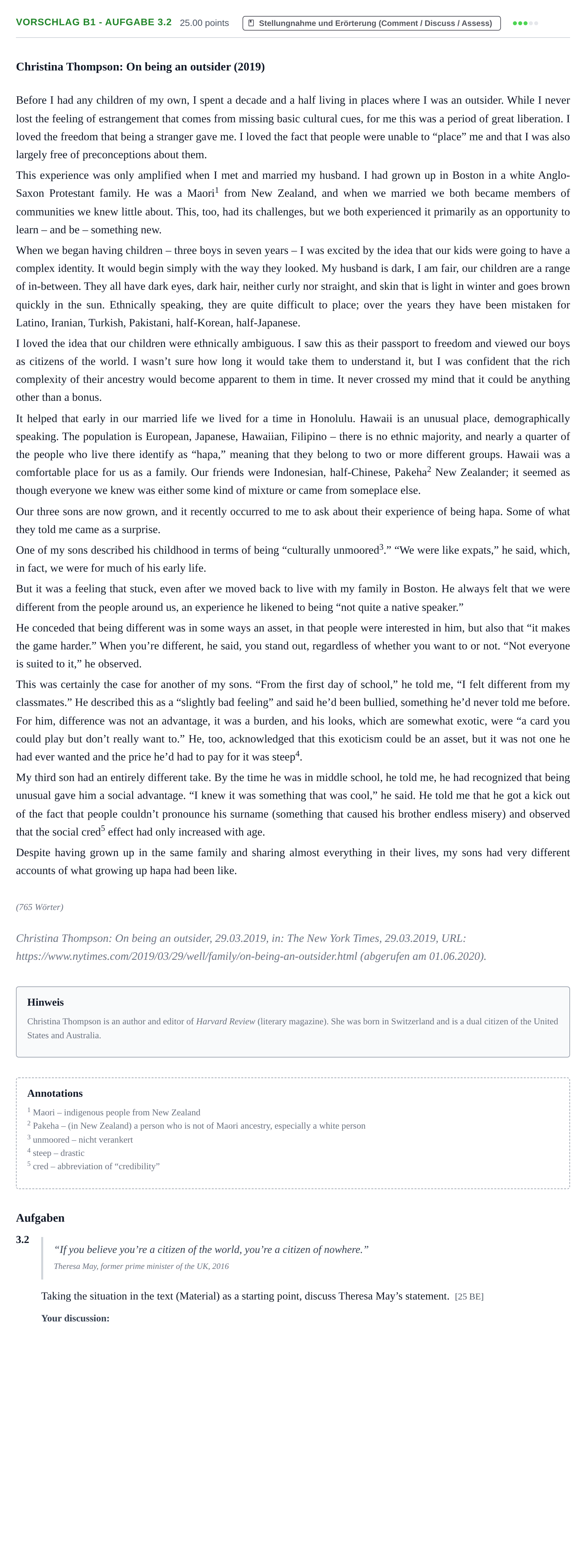
Christina Thompson: On being an outsider (2019)
Before I had any children of my own, I spent a decade and a half living in places where I was an outsider. While I never lost the feeling of estrangement that comes from missing basic cultural cues, for me this was a period of great liberation. I loved the freedom that being a stranger gave me. I loved the fact that people were unable to “place” me and that I was also largely free of preconceptions about them.
This experience was only amplified when I met and married my husband. I had grown up in Boston in a white Anglo-Saxon Protestant family. He was a Maori 1 from New Zealand, and when we married we both became members of communities we knew little about. This, too, had its challenges, but we both experienced it primarily as an opportunity to learn – and be – something new.
When we began having children – three boys in seven years – I was excited by the idea that our kids were going to have a complex identity. It would begin simply with the way they looked. My husband is dark, I am fair, our children are a range of in-between. They all have dark eyes, dark hair, neither curly nor straight, and skin that is light in winter and goes brown quickly in the sun. Ethnically speaking, they are quite difficult to place; over the years they have been mistaken for Latino, Iranian, Turkish, Pakistani, half-Korean, half-Japanese.
I loved the idea that our children were ethnically ambiguous. I saw this as their passport to freedom and viewed our boys as citizens of the world. I wasn’t sure how long it would take them to understand it, but I was confident that the rich complexity of their ancestry would become apparent to them in time. It never crossed my mind that it could be anything other than a bonus.
It helped that early in our married life we lived for a time in Honolulu. Hawaii is an unusual place, demographically speaking. The population is European, Japanese, Hawaiian, Filipino – there is no ethnic majority, and nearly a quarter of the people who live there identify as “hapa,” meaning that they belong to two or more different groups. Hawaii was a comfortable place for us as a family. Our friends were Indonesian, half-Chinese, Pakeha 2 New Zealander; it seemed as though everyone we knew was either some kind of mixture or came from someplace else.
Our three sons are now grown, and it recently occurred to me to ask about their experience of being hapa. Some of what they told me came as a surprise.
One of my sons described his childhood in terms of being “culturally unmoored 3.” “We were like expats,” he said, which, in fact, we were for much of his early life.
But it was a feeling that stuck, even after we moved back to live with my family in Boston. He always felt that we were different from the people around us, an experience he likened to being “not quite a native speaker.”
He conceded that being different was in some ways an asset, in that people were interested in him, but also that “it makes the game harder.” When you’re different, he said, you stand out, regardless of whether you want to or not. “Not everyone is suited to it,” he observed.
This was certainly the case for another of my sons. “From the first day of school,” he told me, “I felt different from my classmates.” He described this as a “slightly bad feeling” and said he’d been bullied, something he’d never told me before. For him, difference was not an advantage, it was a burden, and his looks, which are somewhat exotic, were “a card you could play but don’t really want to.” He, too, acknowledged that this exoticism could be an asset, but it was not one he had ever wanted and the price he’d had to pay for it was steep 4.
My third son had an entirely different take. By the time he was in middle school, he told me, he had recognized that being unusual gave him a social advantage. “I knew it was something that was cool,” he said. He told me that he got a kick out of the fact that people couldn’t pronounce his surname (something that caused his brother endless misery) and observed that the social cred 5 effect had only increased with age.
Despite having grown up in the same family and sharing almost everything in their lives, my sons had very different accounts of what growing up hapa had been like.
(765 Wörter)
Christina Thompson: On being an outsider, 29.03.2019, in: The New York Times, 29.03.2019, URL: https://www.nytimes.com/2019/03/29/well/family/on-being-an-outsider.html (abgerufen am 01.06.2020).
Hinweis
Christina Thompson is an author and editor of Harvard Review (literary magazine). She was born in Switzerland and is a dual citizen of the United States and Australia.
Annotations
1 Maori – indigenous people from New Zealand
2 Pakeha – (in New Zealand) a person who is not of Maori ancestry, especially a white person
3 unmoored – nicht verankert
4 steep – drastic
5 cred – abbreviation of “credibility”
Aufgaben
3.2
“If you believe you’re a citizen of the world, you’re a citizen of nowhere.”
Theresa May, former prime minister of the UK, 2016
Taking the situation in the text (Material) as a starting point, discuss Theresa May’s statement.
[25 BE]
Lösung
Nach den offiziellen Korrekturhinweisen
3.2 Taking the situation in the text (Material) as a starting point, discuss Theresa May’s statement.
Lösung: Expected content and structure: • Introduction paraphrasing Theresa May’s statement and explaining its implication (that claiming to belong everywhere means lacking real local roots, allegiance, or community). • Arguments supporting May’s statement: - Corroborated in the text by the feeling of estrangement and missing cultural cues; - The son's sensation of being "culturally unmoored" and not feeling like a "native speaker" even in his home country; - A clear local identity, shared language, and cultural familiarity provide psychological safety, roots, and belonging in an increasingly complex world. • Arguments countering May’s statement: - A cosmopolitan mindset fosters empathy, open-mindedness, and global responsibility (e.g. towards global crises such as climate change or pandemics); - Borders and rigid national definitions can be seen as artificial social constructs; - Modern multicultural communities (like Hawaii described in the text) show that belonging arises from interpersonal relationships rather than ethnic or cultural homogeneity; - The author’s own view of cosmopolitanism as liberation and a "passport to freedom." • Conclusion summarizing the discussion in a balanced, well-founded personal assessment.
Die ausführliche Erklärung Schritt für Schritt (mit KI) gibt es mit Premium. Premium
Löse sie direkt hier: automatische Korrektur, Hinweise und Lösung Schritt für Schritt.
‹ Aufgabe Vorschlag B1 - Aufgabe 3.1 · GK 2021 · Aufgabe Vorschlag B2 - Aufgabe 3.1 · GK 2021 ›
Mehr Aufgaben zu Stellungnahme und Erörterung (Comment / Discuss / Assess)
- Aufgabe Vorschlag B3 - 3.1 · GK 2022
- Aufgabe Vorschlag B1 – 3.1 · LK 2022
- Aufgabe Vorschlag B2 – 3.1 · LK 2022
- Aufgabe Vorschlag B3 – 3.1 · LK 2022
- Aufgabe Vorschlag B1 - Aufgabe 3.1 · GK 2021
- Aufgabe Vorschlag B2 - Aufgabe 3.1 · GK 2021
- Aufgabe Vorschlag B3 - Aufgabe 3.1 · GK 2021
- Aufgabe Vorschlag B3 - Aufgabe 3.2 · GK 2021
- Aufgabe Vorschlag B1 - Aufgabe 3.1 · LK 2021
- Aufgabe Vorschlag B2 - Aufgabe 3.2 · LK 2021