Prüfungsteil 1 - Vorschlag A · Abitur Hessen Englisch LK 2021
Thema: Sprachmittlung Deutsch → Englisch (Mediation) · Aus der Prüfung LK (2021)
Aufgabenstellung
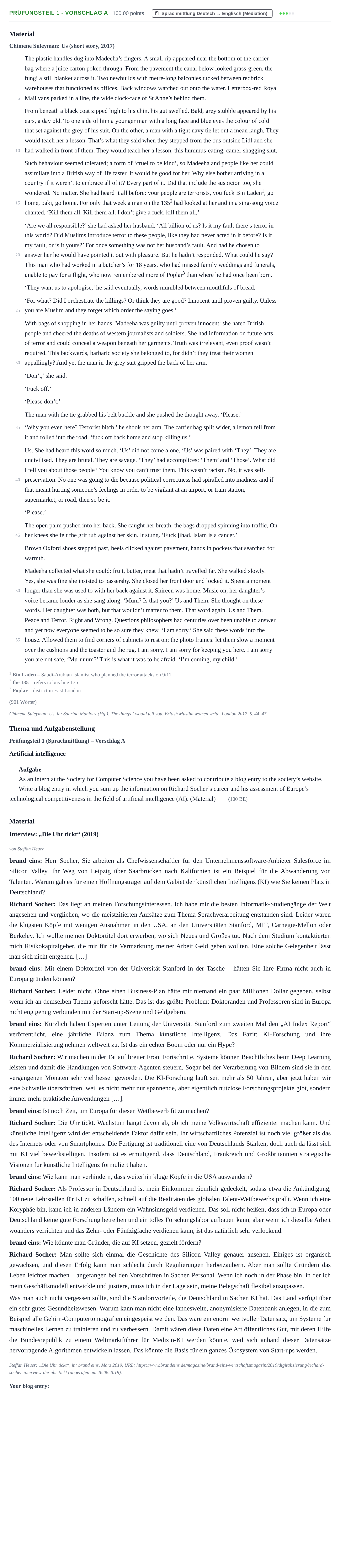
Material
Chimene Suleyman: Us (short story, 2017)
The plastic handles dug into Madeeha’s fingers. A small rip appeared near the bottom of the carrier-
bag where a juice carton poked through. From the pavement the canal below looked grass-green, the
fungi a still blanket across it. Two newbuilds with metre-long balconies tucked between redbrick
warehouses that functioned as offices. Back windows watched out onto the water. Letterbox-red Royal
5 Mail vans parked in a line, the wide clock-face of St Anne’s behind them.
From beneath a black coat zipped high to his chin, his gut swelled. Bald, grey stubble appeared by his
ears, a day old. To one side of him a younger man with a long face and blue eyes the colour of cold
that set against the grey of his suit. On the other, a man with a tight navy tie let out a mean laugh. They
would teach her a lesson. That’s what they said when they stepped from the bus outside Lidl and she
10 had walked in front of them. They would teach her a lesson, this hummus-eating, camel-shagging slut.
Such behaviour seemed tolerated; a form of ‘cruel to be kind’, so Madeeha and people like her could
assimilate into a British way of life faster. It would be good for her. Why else bother arriving in a
country if it weren’t to embrace all of it? Every part of it. Did that include the suspicion too, she
wondered. No matter. She had heard it all before: your people are terrorists, you fuck Bin Laden 1, go
15 home, paki, go home. For only that week a man on the 135 2 had looked at her and in a sing-song voice
chanted, ‘Kill them all. Kill them all. I don’t give a fuck, kill them all.’
‘Are we all responsible?’ she had asked her husband. ‘All billion of us? Is it my fault there’s terror in
this world? Did Muslims introduce terror to these people, like they had never acted in it before? Is it
my fault, or is it yours?’ For once something was not her husband’s fault. And had he chosen to
20 answer her he would have pointed it out with pleasure. But he hadn’t responded. What could he say?
This man who had worked in a butcher’s for 18 years, who had missed family weddings and funerals,
unable to pay for a flight, who now remembered more of Poplar 3 than where he had once been born.
‘They want us to apologise,’ he said eventually, words mumbled between mouthfuls of bread.
‘For what? Did I orchestrate the killings? Or think they are good? Innocent until proven guilty. Unless
25 you are Muslim and they forget which order the saying goes.’
With bags of shopping in her hands, Madeeha was guilty until proven innocent: she hated British
people and cheered the deaths of western journalists and soldiers. She had information on future acts
of terror and could conceal a weapon beneath her garments. Truth was irrelevant, even proof wasn’t
required. This backwards, barbaric society she belonged to, for didn’t they treat their women
30 appallingly? And yet the man in the grey suit gripped the back of her arm.
‘Don’t,’ she said.
‘Fuck off.’
‘Please don’t.’
The man with the tie grabbed his belt buckle and she pushed the thought away. ‘Please.’
35 ‘Why you even here? Terrorist bitch,’ he shook her arm. The carrier bag split wider, a lemon fell from
it and rolled into the road, ‘fuck off back home and stop killing us.’
Us. She had heard this word so much. ‘Us’ did not come alone. ‘Us’ was paired with ‘They’. They are
uncivilised. They are brutal. They are savage. ‘They’ had accomplices: ‘Them’ and ‘Those’. What did
I tell you about those people? You know you can’t trust them. This wasn’t racism. No, it was self-
40 preservation. No one was going to die because political correctness had spiralled into madness and if
that meant hurting someone’s feelings in order to be vigilant at an airport, or train station,
supermarket, or road, then so be it.
‘Please.’
The open palm pushed into her back. She caught her breath, the bags dropped spinning into traffic. On
45 her knees she felt the grit rub against her skin. It stung. ‘Fuck jihad. Islam is a cancer.’
Brown Oxford shoes stepped past, heels clicked against pavement, hands in pockets that searched for
warmth.
Madeeha collected what she could: fruit, butter, meat that hadn’t travelled far. She walked slowly.
Yes, she was fine she insisted to passersby. She closed her front door and locked it. Spent a moment
50 longer than she was used to with her back against it. Shireen was home. Music on, her daughter’s
voice became louder as she sang along. ‘Mum? Is that you?’ Us and Them. She thought on these
words. Her daughter was both, but that wouldn’t matter to them. That word again. Us and Them.
Peace and Terror. Right and Wrong. Questions philosophers had centuries over been unable to answer
and yet now everyone seemed to be so sure they knew. ‘I am sorry.’ She said these words into the
55 house. Allowed them to find corners of cabinets to rest on; the photo frames: let them slow a moment
over the cushions and the toaster and the rug. I am sorry. I am sorry for keeping you here. I am sorry
you are not safe. ‘Mu-uuum?’ This is what it was to be afraid. ‘I’m coming, my child.’
1 Bin Laden – Saudi-Arabian Islamist who planned the terror attacks on 9/11
2 the 135 – refers to bus line 135
3 Poplar – district in East London
(901 Wörter)
Chimene Suleyman: Us, in: Sabrina Mahfouz (Hg.): The things I would tell you. British Muslim women write, London 2017, S. 44–47.
Thema und Aufgabenstellung
Prüfungsteil 1 (Sprachmittlung) – Vorschlag A
Artificial intelligence
Aufgabe
As an intern at the Society for Computer Science you have been asked to contribute a blog entry to the society’s website.
Write a blog entry in which you sum up the information on Richard Socher’s career and his assessment of Europe’s technological competitiveness in the field of artificial intelligence (AI). (Material)
(100 BE)
Material
Interview: „Die Uhr tickt“ (2019)
von Steffan Heuer
brand eins: Herr Socher, Sie arbeiten als Chefwissenschaftler für den Unternehmenssoftware-Anbieter Salesforce im Silicon Valley. Ihr Weg von Leipzig über Saarbrücken nach Kalifornien ist ein Beispiel für die Abwanderung von Talenten. Warum gab es für einen Hoffnungsträger auf dem Gebiet der künstlichen Intelligenz (KI) wie Sie keinen Platz in Deutschland?
Richard Socher: Das liegt an meinen Forschungsinteressen. Ich habe mir die besten Informatik-Studiengänge der Welt angesehen und verglichen, wo die meistzitierten Aufsätze zum Thema Sprachverarbeitung entstanden sind. Leider waren die klügsten Köpfe mit wenigen Ausnahmen in den USA, an den Universitäten Stanford, MIT, Carnegie-Mellon oder Berkeley. Ich wollte meinen Doktortitel dort erwerben, wo sich Neues und Großes tut. Nach dem Studium kontaktierten mich Risikokapitalgeber, die mir für die Vermarktung meiner Arbeit Geld geben wollten. Eine solche Gelegenheit lässt man sich nicht entgehen. […]
brand eins: Mit einem Doktortitel von der Universität Stanford in der Tasche – hätten Sie Ihre Firma nicht auch in Europa gründen können?
Richard Socher: Leider nicht. Ohne einen Business-Plan hätte mir niemand ein paar Millionen Dollar gegeben, selbst wenn ich an demselben Thema geforscht hätte. Das ist das größte Problem: Doktoranden und Professoren sind in Europa nicht eng genug verbunden mit der Start-up-Szene und Geldgebern.
brand eins: Kürzlich haben Experten unter Leitung der Universität Stanford zum zweiten Mal den „AI Index Report“ veröffentlicht, eine jährliche Bilanz zum Thema künstliche Intelligenz. Das Fazit: KI-Forschung und ihre Kommerzialisierung nehmen weltweit zu. Ist das ein echter Boom oder nur ein Hype?
Richard Socher: Wir machen in der Tat auf breiter Front Fortschritte. Systeme können Beachtliches beim Deep Learning leisten und damit die Handlungen von Software-Agenten steuern. Sogar bei der Verarbeitung von Bildern sind sie in den vergangenen Monaten sehr viel besser geworden. Die KI-Forschung läuft seit mehr als 50 Jahren, aber jetzt haben wir eine Schwelle überschritten, weil es nicht mehr nur spannende, aber eigentlich nutzlose Forschungsprojekte gibt, sondern immer mehr praktische Anwendungen […].
brand eins: Ist noch Zeit, um Europa für diesen Wettbewerb fit zu machen?
Richard Socher: Die Uhr tickt. Wachstum hängt davon ab, ob ich meine Volkswirtschaft effizienter machen kann. Und künstliche Intelligenz wird der entscheidende Faktor dafür sein. Ihr wirtschaftliches Potenzial ist noch viel größer als das des Internets oder von Smartphones. Die Fertigung ist traditionell eine von Deutschlands Stärken, doch auch da lässt sich mit KI viel bewerkstelligen. Insofern ist es ermutigend, dass Deutschland, Frankreich und Großbritannien strategische Visionen für künstliche Intelligenz formuliert haben.
brand eins: Wie kann man verhindern, dass weiterhin kluge Köpfe in die USA auswandern?
Richard Socher: Als Professor in Deutschland ist mein Einkommen ziemlich gedeckelt, sodass etwa die Ankündigung, 100 neue Lehrstellen für KI zu schaffen, schnell auf die Realitäten des globalen Talent-Wettbewerbs prallt. Wenn ich eine Koryphäe bin, kann ich in anderen Ländern ein Wahnsinnsgeld verdienen. Das soll nicht heißen, dass ich in Europa oder Deutschland keine gute Forschung betreiben und ein tolles Forschungslabor aufbauen kann, aber wenn ich dieselbe Arbeit woanders verrichten und das Zehn- oder Fünfzigfache verdienen kann, ist das natürlich sehr verlockend.
brand eins: Wie könnte man Gründer, die auf KI setzen, gezielt fördern?
Richard Socher: Man sollte sich einmal die Geschichte des Silicon Valley genauer ansehen. Einiges ist organisch gewachsen, und diesen Erfolg kann man schlecht durch Regulierungen herbeizaubern. Aber man sollte Gründern das Leben leichter machen – angefangen bei den Vorschriften in Sachen Personal. Wenn ich noch in der Phase bin, in der ich mein Geschäftsmodell entwickle und justiere, muss ich in der Lage sein, meine Belegschaft flexibel anzupassen.
Was man auch nicht vergessen sollte, sind die Standortvorteile, die Deutschland in Sachen KI hat. Das Land verfügt über ein sehr gutes Gesundheitswesen. Warum kann man nicht eine landesweite, anonymisierte Datenbank anlegen, in die zum Beispiel alle Gehirn-Computertomografien eingespeist werden. Das wäre ein enorm wertvoller Datensatz, um Systeme für maschinelles Lernen zu trainieren und zu verbessern. Damit wären diese Daten eine Art öffentliches Gut, mit deren Hilfe die Bundesrepublik zu einem Weltmarktführer für Medizin-KI werden könnte, weil sich anhand dieser Datensätze hervorragende Algorithmen entwickeln lassen. Das könnte die Basis für ein ganzes Ökosystem von Start-ups werden.
Steffan Heuer: „Die Uhr tickt“, in: brand eins, März 2019, URL: https://www.brandeins.de/magazine/brand-eins-wirtschaftsmagazin/2019/digitalisierung/richard-socher-interview-die-uhr-tickt (abgerufen am 26.08.2019).
Lösung
Nach den offiziellen Korrekturhinweisen
Write a blog entry in which you sum up the information on Richard Socher’s career and his assessment of Europe’s technological competitiveness in the field of artificial intelligence (AI).
Lösung: Blog entry addressing a broad international audience with the characteristic features of a blog post (title/headline, engaging introduction, structured body, concluding thought). It summarizes key aspects from the interview: 1. Richard Socher's career: - Studied computer science at German universities (Leipzig, Saarbrücken). - Moved to the US to earn his Ph.D. at Stanford University because top research in NLP was centered at US elite universities. - Venture capitalists funded the commercialization of his research, leading to his role as chief scientist for Salesforce in Silicon Valley. 2. Europe's technological competitiveness: Challenges / problems: - Lack of connection between doctoral students/professors and the start-up / venture capital scene. - Strict employment regulations hinder start-up flexibility. - Capped salaries for academics in Germany compared to significantly higher incomes in the US global talent competition. Promising aspects / opportunities: - Strong manufacturing base can benefit heavily from AI. - Strategic national visions developed by Germany, France, and the UK. - Competitive advantages such as an excellent healthcare system (potential for a national anonymized data pool to become a global leader in medical AI).
Die ausführliche Erklärung Schritt für Schritt (mit KI) gibt es mit Premium. Premium
Löse sie direkt hier: automatische Korrektur, Hinweise und Lösung Schritt für Schritt.
‹ Prüfungsteil 1 - Vorschlag A · GK 2021