Prüfungsteil 1 - Vorschlag A · Abitur Hessen Englisch GK 2021
Thema: Sprachmittlung Deutsch → Englisch (Mediation) · Aus der Prüfung GK (2021)
Aufgabenstellung
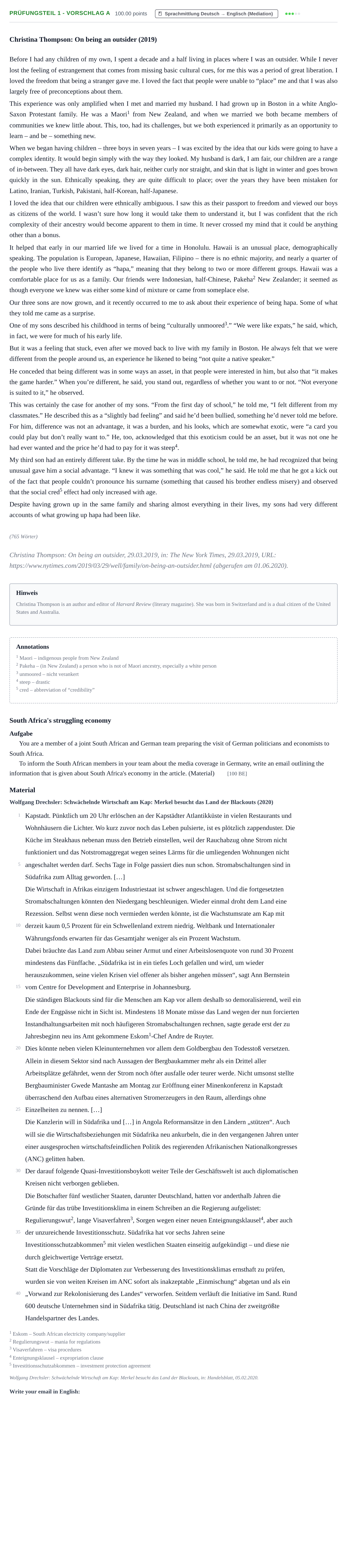
Christina Thompson: On being an outsider (2019)
Before I had any children of my own, I spent a decade and a half living in places where I was an outsider. While I never lost the feeling of estrangement that comes from missing basic cultural cues, for me this was a period of great liberation. I loved the freedom that being a stranger gave me. I loved the fact that people were unable to “place” me and that I was also largely free of preconceptions about them.
This experience was only amplified when I met and married my husband. I had grown up in Boston in a white Anglo-Saxon Protestant family. He was a Maori 1 from New Zealand, and when we married we both became members of communities we knew little about. This, too, had its challenges, but we both experienced it primarily as an opportunity to learn – and be – something new.
When we began having children – three boys in seven years – I was excited by the idea that our kids were going to have a complex identity. It would begin simply with the way they looked. My husband is dark, I am fair, our children are a range of in-between. They all have dark eyes, dark hair, neither curly nor straight, and skin that is light in winter and goes brown quickly in the sun. Ethnically speaking, they are quite difficult to place; over the years they have been mistaken for Latino, Iranian, Turkish, Pakistani, half-Korean, half-Japanese.
I loved the idea that our children were ethnically ambiguous. I saw this as their passport to freedom and viewed our boys as citizens of the world. I wasn’t sure how long it would take them to understand it, but I was confident that the rich complexity of their ancestry would become apparent to them in time. It never crossed my mind that it could be anything other than a bonus.
It helped that early in our married life we lived for a time in Honolulu. Hawaii is an unusual place, demographically speaking. The population is European, Japanese, Hawaiian, Filipino – there is no ethnic majority, and nearly a quarter of the people who live there identify as “hapa,” meaning that they belong to two or more different groups. Hawaii was a comfortable place for us as a family. Our friends were Indonesian, half-Chinese, Pakeha 2 New Zealander; it seemed as though everyone we knew was either some kind of mixture or came from someplace else.
Our three sons are now grown, and it recently occurred to me to ask about their experience of being hapa. Some of what they told me came as a surprise.
One of my sons described his childhood in terms of being “culturally unmoored 3.” “We were like expats,” he said, which, in fact, we were for much of his early life.
But it was a feeling that stuck, even after we moved back to live with my family in Boston. He always felt that we were different from the people around us, an experience he likened to being “not quite a native speaker.”
He conceded that being different was in some ways an asset, in that people were interested in him, but also that “it makes the game harder.” When you’re different, he said, you stand out, regardless of whether you want to or not. “Not everyone is suited to it,” he observed.
This was certainly the case for another of my sons. “From the first day of school,” he told me, “I felt different from my classmates.” He described this as a “slightly bad feeling” and said he’d been bullied, something he’d never told me before. For him, difference was not an advantage, it was a burden, and his looks, which are somewhat exotic, were “a card you could play but don’t really want to.” He, too, acknowledged that this exoticism could be an asset, but it was not one he had ever wanted and the price he’d had to pay for it was steep 4.
My third son had an entirely different take. By the time he was in middle school, he told me, he had recognized that being unusual gave him a social advantage. “I knew it was something that was cool,” he said. He told me that he got a kick out of the fact that people couldn’t pronounce his surname (something that caused his brother endless misery) and observed that the social cred 5 effect had only increased with age.
Despite having grown up in the same family and sharing almost everything in their lives, my sons had very different accounts of what growing up hapa had been like.
(765 Wörter)
Christina Thompson: On being an outsider, 29.03.2019, in: The New York Times, 29.03.2019, URL: https://www.nytimes.com/2019/03/29/well/family/on-being-an-outsider.html (abgerufen am 01.06.2020).
Hinweis
Christina Thompson is an author and editor of Harvard Review (literary magazine). She was born in Switzerland and is a dual citizen of the United States and Australia.
Annotations
1 Maori – indigenous people from New Zealand
2 Pakeha – (in New Zealand) a person who is not of Maori ancestry, especially a white person
3 unmoored – nicht verankert
4 steep – drastic
5 cred – abbreviation of “credibility”
South Africa's struggling economy
Aufgabe
You are a member of a joint South African and German team preparing the visit of German politicians and economists to South Africa.
To inform the South African members in your team about the media coverage in Germany, write an email outlining the information that is given about South Africa's economy in the article. (Material) [100 BE]
Material
Wolfgang Drechsler: Schwächelnde Wirtschaft am Kap: Merkel besucht das Land der Blackouts (2020)
1 Kapstadt. Pünktlich um 20 Uhr erlöschen an der Kapstädter Atlantikküste in vielen Restaurants und
Wohnhäusern die Lichter. Wo kurz zuvor noch das Leben pulsierte, ist es plötzlich zappenduster. Die
Küche im Steakhaus nebenan muss den Betrieb einstellen, weil der Rauchabzug ohne Strom nicht
funktioniert und das Notstromaggregat wegen seines Lärms für die umliegenden Wohnungen nicht
5 angeschaltet werden darf. Sechs Tage in Folge passiert dies nun schon. Stromabschaltungen sind in
Südafrika zum Alltag geworden. […]
Die Wirtschaft in Afrikas einzigem Industriestaat ist schwer angeschlagen. Und die fortgesetzten
Stromabschaltungen könnten den Niedergang beschleunigen. Wieder einmal droht dem Land eine
Rezession. Selbst wenn diese noch vermieden werden könnte, ist die Wachstumsrate am Kap mit
10 derzeit kaum 0,5 Prozent für ein Schwellenland extrem niedrig. Weltbank und Internationaler
Währungsfonds erwarten für das Gesamtjahr weniger als ein Prozent Wachstum.
Dabei bräuchte das Land zum Abbau seiner Armut und einer Arbeitslosenquote von rund 30 Prozent
mindestens das Fünffache. „Südafrika ist in ein tiefes Loch gefallen und wird, um wieder
herauszukommen, seine vielen Krisen viel offener als bisher angehen müssen“, sagt Ann Bernstein
15 vom Centre for Development and Enterprise in Johannesburg.
Die ständigen Blackouts sind für die Menschen am Kap vor allem deshalb so demoralisierend, weil ein
Ende der Engpässe nicht in Sicht ist. Mindestens 18 Monate müsse das Land wegen der nun forcierten
Instandhaltungsarbeiten mit noch häufigeren Stromabschaltungen rechnen, sagte gerade erst der zu
Jahresbeginn neu ins Amt gekommene Eskom 1 -Chef Andre de Ruyter.
20 Dies könnte neben vielen Kleinunternehmen vor allem dem Goldbergbau den Todesstoß versetzen.
Allein in diesem Sektor sind nach Aussagen der Bergbaukammer mehr als ein Drittel aller
Arbeitsplätze gefährdet, wenn der Strom noch öfter ausfalle oder teurer werde. Nicht umsonst stellte
Bergbauminister Gwede Mantashe am Montag zur Eröffnung einer Minenkonferenz in Kapstadt
überraschend den Aufbau eines alternativen Stromerzeugers in den Raum, allerdings ohne
25 Einzelheiten zu nennen. […]
Die Kanzlerin will in Südafrika und […] in Angola Reformansätze in den Ländern „stützen“. Auch
will sie die Wirtschaftsbeziehungen mit Südafrika neu ankurbeln, die in den vergangenen Jahren unter
einer ausgesprochen wirtschaftsfeindlichen Politik des regierenden Afrikanischen Nationalkongresses
(ANC) gelitten haben.
30 Der darauf folgende Quasi-Investitionsboykott weiter Teile der Geschäftswelt ist auch diplomatischen
Kreisen nicht verborgen geblieben.
Die Botschafter fünf westlicher Staaten, darunter Deutschland, hatten vor anderthalb Jahren die
Gründe für das trübe Investitionsklima in einem Schreiben an die Regierung aufgelistet:
Regulierungswut 2, lange Visaverfahren 3, Sorgen wegen einer neuen Enteignungsklausel 4, aber auch
35 der unzureichende Investitionsschutz. Südafrika hat vor sechs Jahren seine
Investitionsschutzabkommen 5 mit vielen westlichen Staaten einseitig aufgekündigt – und diese nie
durch gleichwertige Verträge ersetzt.
Statt die Vorschläge der Diplomaten zur Verbesserung des Investitionsklimas ernsthaft zu prüfen,
wurden sie von weiten Kreisen im ANC sofort als inakzeptable „Einmischung“ abgetan und als ein
40 „Vorwand zur Rekolonisierung des Landes“ verworfen. Seitdem verläuft die Initiative im Sand. Rund
600 deutsche Unternehmen sind in Südafrika tätig. Deutschland ist nach China der zweitgrößte
Handelspartner des Landes.
1 Eskom – South African electricity company/supplier
2 Regulierungswut – mania for regulations
3 Visaverfahren – visa procedures
4 Enteignungsklausel – expropriation clause
5 Investitionsschutzabkommen – investment protection agreement
Wolfgang Drechsler: Schwächelnde Wirtschaft am Kap: Merkel besucht das Land der Blackouts, in: Handelsblatt, 05.02.2020.
Lösung
Nach den offiziellen Korrekturhinweisen
To inform the South African members in your team about the media coverage in Germany, write an email outlining the information that is given about South Africa's economy in the article. (Material)
Lösung: An email in formal English containing appropriate conventions (salutation, reference to project/article, purpose, sign-off) and summarizing key economic aspects from the text: - Regular power cuts / blackouts in Cape Town have become a daily issue. - South Africa's economy is in decline; looming recession with expected annual growth of less than one percent (World Bank and IMF), while at least a fivefold increase would be necessary to combat high poverty and an unemployment rate of around 30%. - Blackouts expected for at least another 18 months due to maintenance work by Eskom. - Severe consequences: possible collapse of small ventures and grave threats to the gold mining sector (risk of losing more than a third of jobs). - The German chancellor aims to support reform measures and revive economic ties, which suffered under the ANC's anti-business policies. - Western ambassadors (including Germany) listed investment obstacles 1.5 years ago: excessive regulations, prolonged visa procedures, fears over expropriation clauses, and canceled investment protection agreements. - The ANC dismissed these suggestions as unacceptable interference / an attempt at recolonization. - Germany is South Africa's second-biggest trading partner after China, with around 600 German companies active in the country.
Die ausführliche Erklärung Schritt für Schritt (mit KI) gibt es mit Premium. Premium
Löse sie direkt hier: automatische Korrektur, Hinweise und Lösung Schritt für Schritt.
‹ Prüfungsteil 1 – Vorschlag A · LK 2022 · Prüfungsteil 1 - Vorschlag A · LK 2021 ›