Ejercicio 1 - True/False · Inglés PAU Valencia Ordinaria solapamiento 2026
Tema: Verdadero o falso con justificación textual (True/False) · Del examen Ordinaria solapamiento (2026)
Enunciado
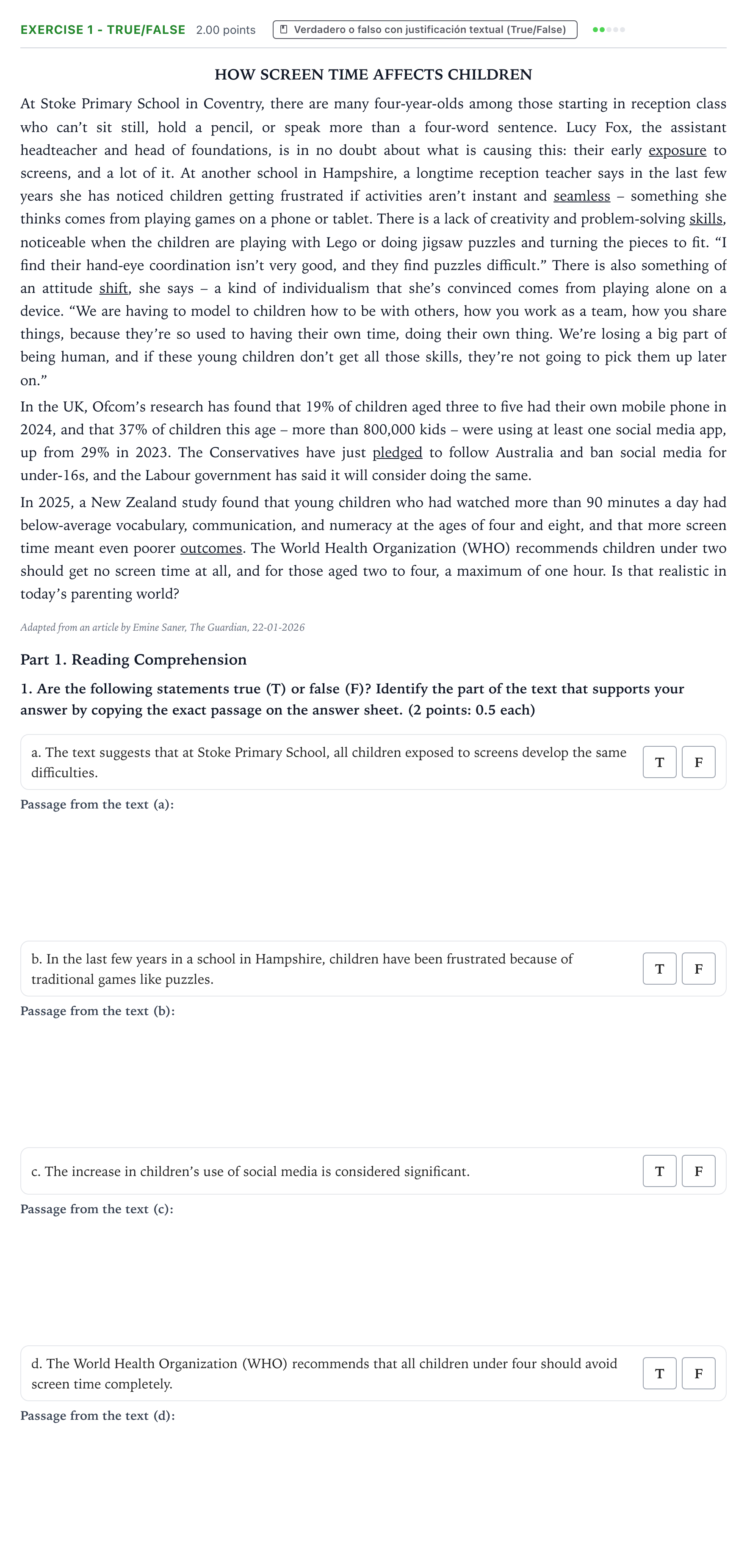
HOW SCREEN TIME AFFECTS CHILDREN
At Stoke Primary School in Coventry, there are many four-year-olds among those starting in reception class who can’t sit still, hold a pencil, or speak more than a four-word sentence. Lucy Fox, the assistant headteacher and head of foundations, is in no doubt about what is causing this: their early exposure to screens, and a lot of it. At another school in Hampshire, a longtime reception teacher says in the last few years she has noticed children getting frustrated if activities aren’t instant and seamless – something she thinks comes from playing games on a phone or tablet. There is a lack of creativity and problem-solving skills, noticeable when the children are playing with Lego or doing jigsaw puzzles and turning the pieces to fit. “I find their hand-eye coordination isn’t very good, and they find puzzles difficult.” There is also something of an attitude shift, she says – a kind of individualism that she’s convinced comes from playing alone on a device. “We are having to model to children how to be with others, how you work as a team, how you share things, because they’re so used to having their own time, doing their own thing. We’re losing a big part of being human, and if these young children don’t get all those skills, they’re not going to pick them up later on.”
In the UK, Ofcom’s research has found that 19% of children aged three to five had their own mobile phone in 2024, and that 37% of children this age – more than 800,000 kids – were using at least one social media app, up from 29% in 2023. The Conservatives have just pledged to follow Australia and ban social media for under-16s, and the Labour government has said it will consider doing the same.
In 2025, a New Zealand study found that young children who had watched more than 90 minutes a day had below-average vocabulary, communication, and numeracy at the ages of four and eight, and that more screen time meant even poorer outcomes. The World Health Organization (WHO) recommends children under two should get no screen time at all, and for those aged two to four, a maximum of one hour. Is that realistic in today’s parenting world?
Adapted from an article by Emine Saner, The Guardian, 22-01-2026
Part 1. Reading Comprehension
1. Are the following statements true (T) or false (F)? Identify the part of the text that supports your answer by copying the exact passage on the answer sheet. (2 points: 0.5 each)
.
T
F
Solución
Solución de AprenAI (no es la oficial)
a. The text suggests that at Stoke Primary School, all children exposed to screens develop the same difficulties.
Solución: False. “there are many four-year-olds among those starting in reception class who can’t sit still, hold a pencil, or speak more than a four-word sentence”
b. In the last few years in a school in Hampshire, children have been frustrated because of traditional games like puzzles.
Solución: False. “she has noticed children getting frustrated if activities aren’t instant and seamless – something she thinks comes from playing games on a phone or tablet”
c. The increase in children’s use of social media is considered significant.
Solución: True. “37% of children this age – more than 800,000 kids – were using at least one social media app, up from 29% in 2023”
Las soluciones de los 2 apartados que faltan y la explicación paso a paso son Premium. Premium
Resuélvelo aquí mismo: corrección automática, pistas y solución paso a paso.
‹ Ejercicio 1 - True/False · Ordinaria 2026 · Problema 1 · Extraordinaria 2025 ›
Más ejercicios de Verdadero o falso con justificación textual (True/False)
- Ejercicio 1 - True/False · Extraordinaria 2026
- Ejercicio 1 - True/False · Extraordinaria solapamiento 2026
- Ejercicio 1 - True/False · Ordinaria 2026
- Problema 1 · Extraordinaria 2025
- Problema 1 · Extraordinaria DANA 2025
- Problema 1 · Extraordinaria solapamiento 2025
- Problema 1 · Ordinaria 2025
- Problema 1 · Ordinaria solapamiento 2025
- Ejercicio A2 · Extraordinaria 2024
- Ejercicio B2 · Extraordinaria 2024