Ejercicio 1 - True/False · Inglés PAU Valencia Extraordinaria 2026
Tema: Verdadero o falso con justificación textual (True/False) · Del examen Extraordinaria (2026)
Enunciado
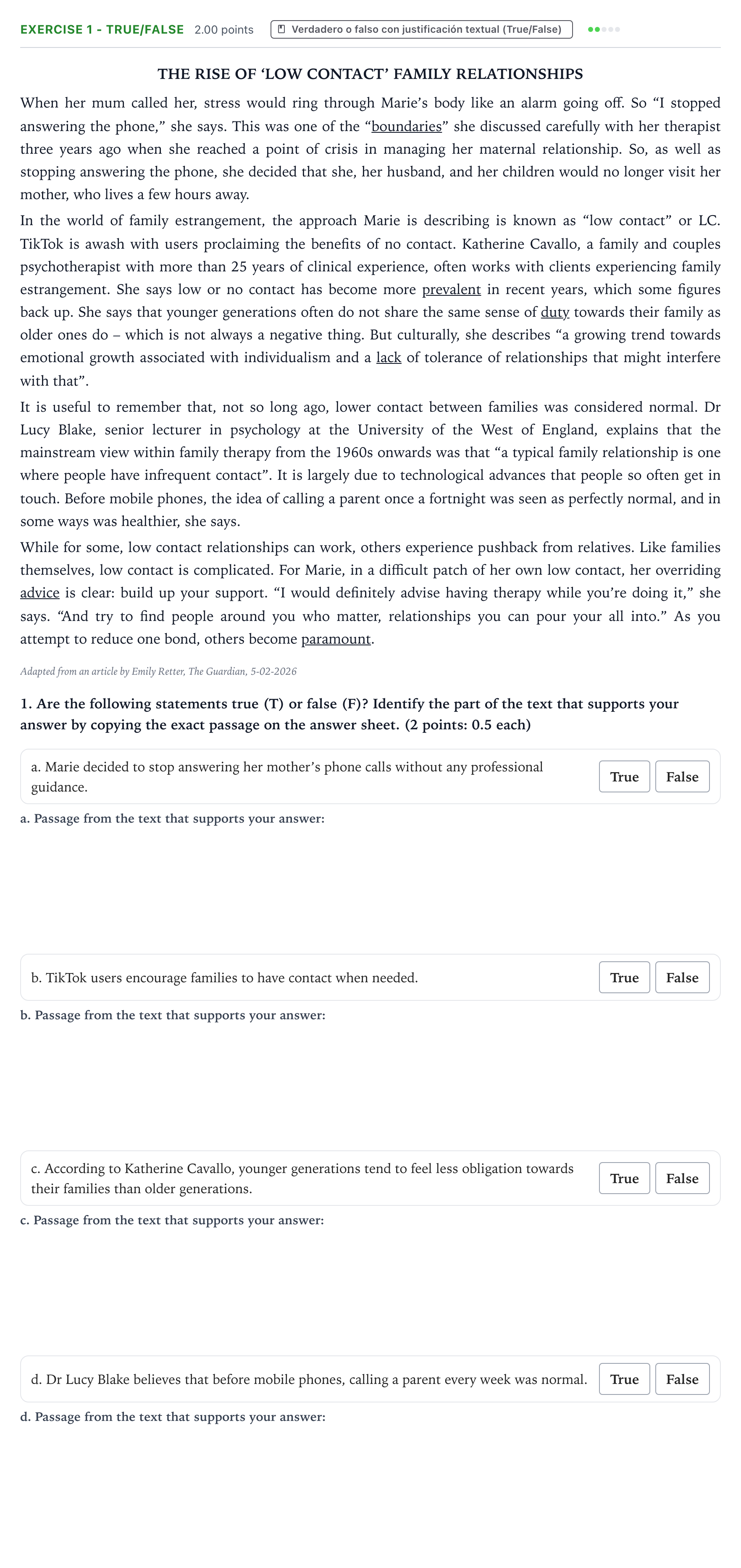
THE RISE OF ‘LOW CONTACT’ FAMILY RELATIONSHIPS
When her mum called her, stress would ring through Marie’s body like an alarm going off. So “I stopped answering the phone,” she says. This was one of the “ boundaries ” she discussed carefully with her therapist three years ago when she reached a point of crisis in managing her maternal relationship. So, as well as stopping answering the phone, she decided that she, her husband, and her children would no longer visit her mother, who lives a few hours away.
In the world of family estrangement, the approach Marie is describing is known as “low contact” or LC. TikTok is awash with users proclaiming the benefits of no contact. Katherine Cavallo, a family and couples psychotherapist with more than 25 years of clinical experience, often works with clients experiencing family estrangement. She says low or no contact has become more prevalent in recent years, which some figures back up. She says that younger generations often do not share the same sense of duty towards their family as older ones do – which is not always a negative thing. But culturally, she describes “a growing trend towards emotional growth associated with individualism and a lack of tolerance of relationships that might interfere with that”.
It is useful to remember that, not so long ago, lower contact between families was considered normal. Dr Lucy Blake, senior lecturer in psychology at the University of the West of England, explains that the mainstream view within family therapy from the 1960s onwards was that “a typical family relationship is one where people have infrequent contact”. It is largely due to technological advances that people so often get in touch. Before mobile phones, the idea of calling a parent once a fortnight was seen as perfectly normal, and in some ways was healthier, she says.
While for some, low contact relationships can work, others experience pushback from relatives. Like families themselves, low contact is complicated. For Marie, in a difficult patch of her own low contact, her overriding advice is clear: build up your support. “I would definitely advise having therapy while you’re doing it,” she says. “And try to find people around you who matter, relationships you can pour your all into.” As you attempt to reduce one bond, others become paramount.
Adapted from an article by Emily Retter, The Guardian, 5-02-2026
1. Are the following statements true (T) or false (F)? Identify the part of the text that supports your answer by copying the exact passage on the answer sheet. (2 points: 0.5 each)
.
True
False
Solución
Según los criterios oficiales de corrección
Are the following statements true (T) or false (F)?
Solución: a. False; b. False; c. True; d. False
a. Marie decided to stop answering her mother’s phone calls without any professional guidance.
Solución: F. “This was one of the ‘boundaries’ she discussed carefully with her therapist three years ago when she reached a point of crisis in managing her maternal relationship.”
b. TikTok users encourage families to have contact when needed.
Solución: F. “TikTok is awash with users proclaiming the benefits of no contact.”
c. According to Katherine Cavallo, younger generations tend to feel less obligation towards their families than older generations.
Solución: T. “She says that younger generations often do not share the same sense of duty towards their family as older ones do – which is not always a negative thing.”
d. Dr Lucy Blake believes that before mobile phones, calling a parent every week was normal.
Solución: F. “Before mobile phones, the idea of calling a parent once a fortnight was seen as perfectly normal, and in some ways was healthier, she says.”
La explicación paso a paso, hecha con IA, es Premium. Premium
Resuélvelo aquí mismo: corrección automática, pistas y solución paso a paso.
Ejercicio 1 - True/False · Extraordinaria solapamiento 2026 ›
Más ejercicios de Verdadero o falso con justificación textual (True/False)
- Ejercicio 1 - True/False · Extraordinaria solapamiento 2026
- Ejercicio 1 - True/False · Ordinaria 2026
- Ejercicio 1 - True/False · Ordinaria solapamiento 2026
- Problema 1 · Extraordinaria 2025
- Problema 1 · Extraordinaria DANA 2025
- Problema 1 · Extraordinaria solapamiento 2025
- Problema 1 · Ordinaria 2025
- Problema 1 · Ordinaria solapamiento 2025
- Ejercicio A2 · Extraordinaria 2024
- Ejercicio B2 · Extraordinaria 2024