Ejercicio A2 · Inglés PAU Valencia Ordinaria solapamiento 2024
Tema: Verdadero o falso con justificación textual (True/False) · Del examen Ordinaria solapamiento (2024)
Enunciado
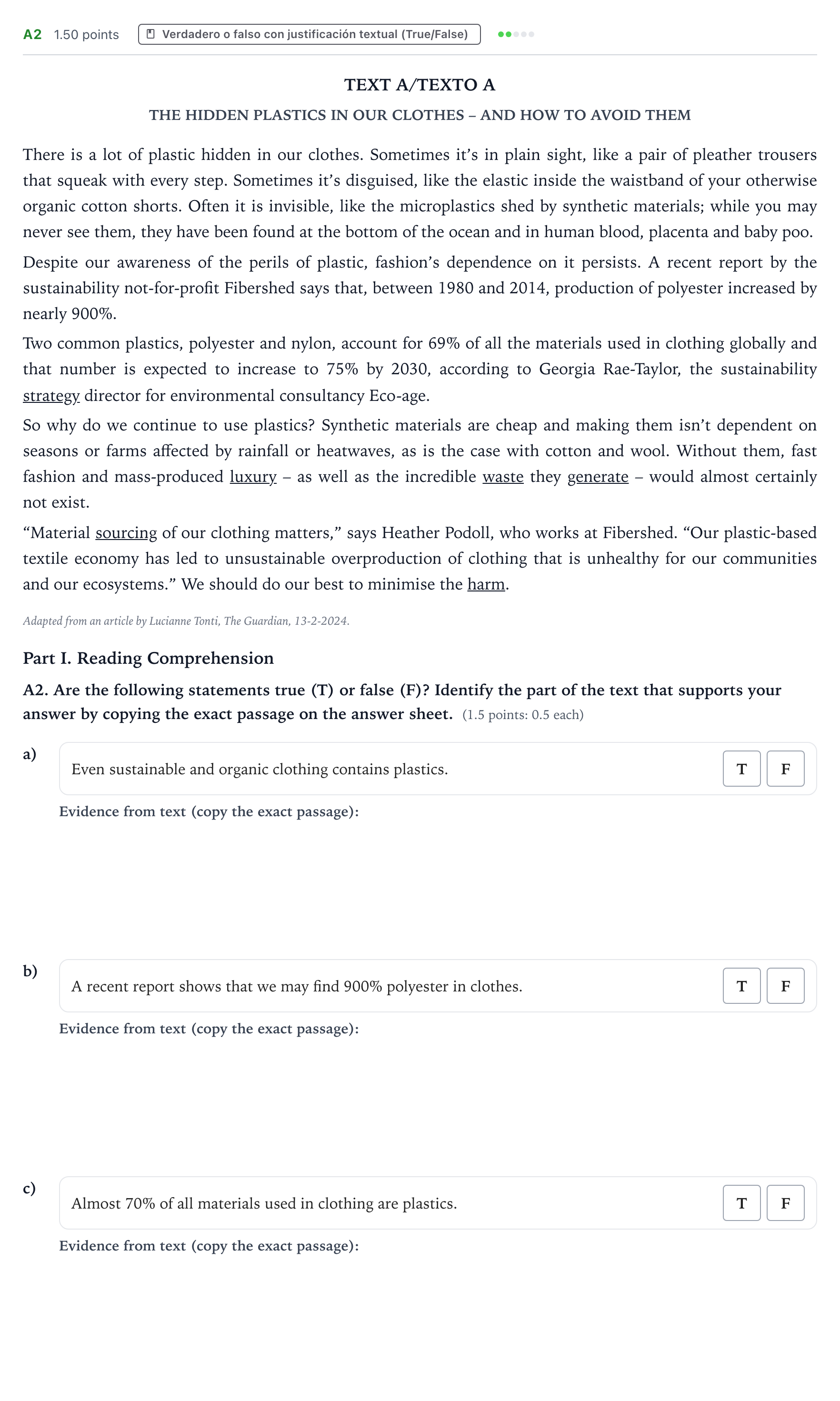
TEXT A/TEXTO A
THE HIDDEN PLASTICS IN OUR CLOTHES – AND HOW TO AVOID THEM
There is a lot of plastic hidden in our clothes. Sometimes it’s in plain sight, like a pair of pleather trousers that squeak with every step. Sometimes it’s disguised, like the elastic inside the waistband of your otherwise organic cotton shorts. Often it is invisible, like the microplastics shed by synthetic materials; while you may never see them, they have been found at the bottom of the ocean and in human blood, placenta and baby poo.
Despite our awareness of the perils of plastic, fashion’s dependence on it persists. A recent report by the sustainability not-for-profit Fibershed says that, between 1980 and 2014, production of polyester increased by nearly 900%.
Two common plastics, polyester and nylon, account for 69% of all the materials used in clothing globally and that number is expected to increase to 75% by 2030, according to Georgia Rae-Taylor, the sustainability strategy director for environmental consultancy Eco-age.
So why do we continue to use plastics? Synthetic materials are cheap and making them isn’t dependent on seasons or farms affected by rainfall or heatwaves, as is the case with cotton and wool. Without them, fast fashion and mass-produced luxury – as well as the incredible waste they generate – would almost certainly not exist.
“Material sourcing of our clothing matters,” says Heather Podoll, who works at Fibershed. “Our plastic-based textile economy has led to unsustainable overproduction of clothing that is unhealthy for our communities and our ecosystems.” We should do our best to minimise the harm.
Adapted from an article by Lucianne Tonti, The Guardian, 13-2-2024.
Part I. Reading Comprehension
A2. Are the following statements true (T) or false (F)? Identify the part of the text that supports your answer by copying the exact passage on the answer sheet. (1.5 points: 0.5 each)
a)
Even sustainable and organic clothing contains plastics.
b)
A recent report shows that we may find 900% polyester in clothes.
c)
Almost 70% of all materials used in clothing are plastics.
Solución
Solución de AprenAI (no es la oficial)
a. Even sustainable and organic clothing contains plastics. (True / False)
Solución: T (True)
a. Identify the part of the text that supports your answer: 'Even sustainable and organic clothing contains plastics.'
Solución: "Sometimes it’s disguised, like the elastic inside the waistband of your otherwise organic cotton shorts."
b. A recent report shows that we may find 900% polyester in clothes. (True / False)
Solución: F (False)
Las soluciones de los 3 apartados que faltan y la explicación paso a paso son Premium. Premium
Resuélvelo aquí mismo: corrección automática, pistas y solución paso a paso.
‹ Ejercicio B2 · Ordinaria 2024 · Ejercicio B2 · Ordinaria solapamiento 2024 ›
Más ejercicios de Verdadero o falso con justificación textual (True/False)
- Ejercicio B2 · Extraordinaria 2024
- Ejercicio A2 · Extraordinaria solapamiento 2024
- Ejercicio B2 · Extraordinaria solapamiento 2024
- Ejercicio A2 · Ordinaria 2024
- Ejercicio B2 · Ordinaria 2024
- Ejercicio B2 · Ordinaria solapamiento 2024
- Ejercicio A2 - True/False · Extraordinaria 2023
- Ejercicio B2 - True/False · Extraordinaria 2023
- Ejercicio A2 · Ordinaria 2023
- Ejercicio B2 · Ordinaria 2023