Ejercicio I.- b) · Inglés PAU País Vasco Extraordinaria 2026
Tema: Verdadero o falso con justificación textual (True/False) · Del examen Extraordinaria (2026)
Enunciado
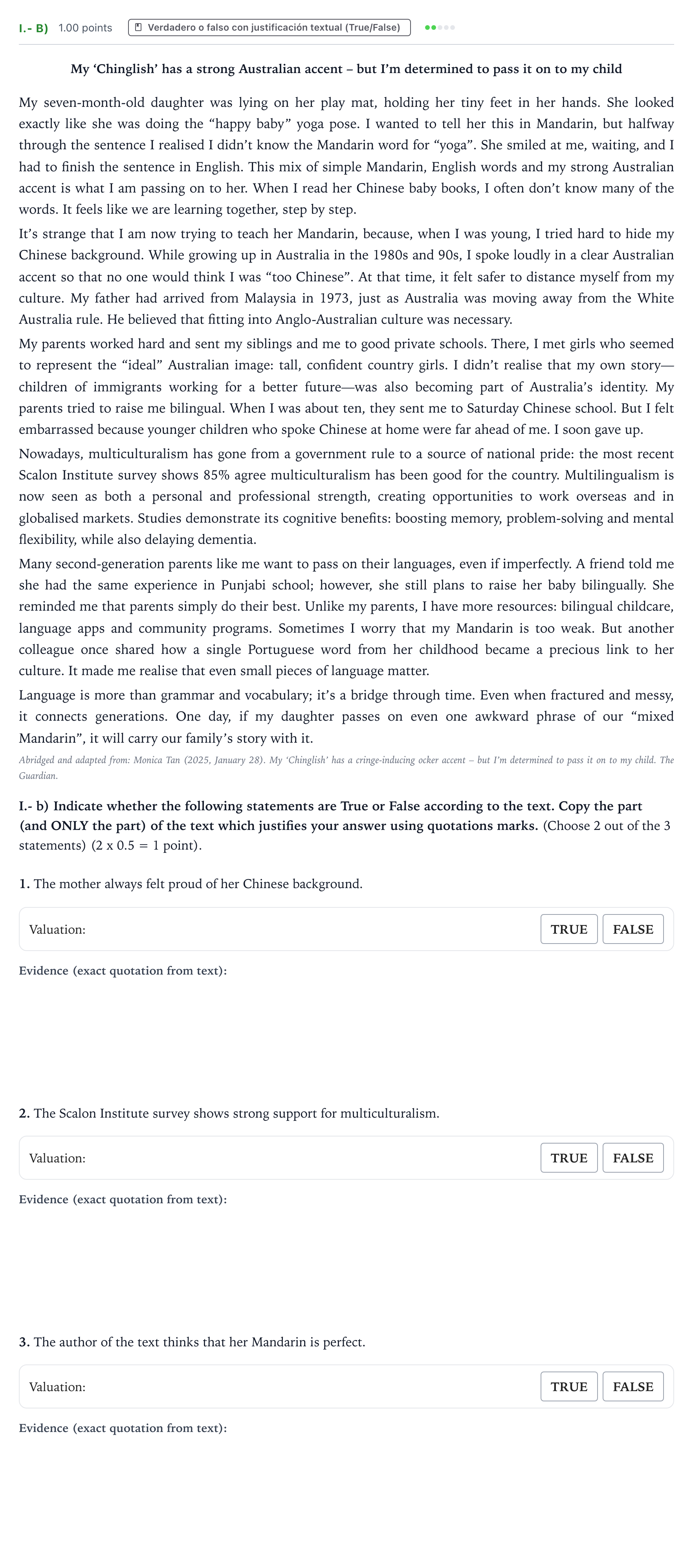
My ‘Chinglish’ has a strong Australian accent – but I’m determined to pass it on to my child
My seven-month-old daughter was lying on her play mat, holding her tiny feet in her hands. She looked exactly like she was doing the “happy baby” yoga pose. I wanted to tell her this in Mandarin, but halfway through the sentence I realised I didn’t know the Mandarin word for “yoga”. She smiled at me, waiting, and I had to finish the sentence in English. This mix of simple Mandarin, English words and my strong Australian accent is what I am passing on to her. When I read her Chinese baby books, I often don’t know many of the words. It feels like we are learning together, step by step.
It’s strange that I am now trying to teach her Mandarin, because, when I was young, I tried hard to hide my Chinese background. While growing up in Australia in the 1980s and 90s, I spoke loudly in a clear Australian accent so that no one would think I was “too Chinese”. At that time, it felt safer to distance myself from my culture. My father had arrived from Malaysia in 1973, just as Australia was moving away from the White Australia rule. He believed that fitting into Anglo-Australian culture was necessary.
My parents worked hard and sent my siblings and me to good private schools. There, I met girls who seemed to represent the “ideal” Australian image: tall, confident country girls. I didn’t realise that my own story—children of immigrants working for a better future—was also becoming part of Australia’s identity. My parents tried to raise me bilingual. When I was about ten, they sent me to Saturday Chinese school. But I felt embarrassed because younger children who spoke Chinese at home were far ahead of me. I soon gave up.
Nowadays, multiculturalism has gone from a government rule to a source of national pride: the most recent Scalon Institute survey shows 85% agree multiculturalism has been good for the country. Multilingualism is now seen as both a personal and professional strength, creating opportunities to work overseas and in globalised markets. Studies demonstrate its cognitive benefits: boosting memory, problem-solving and mental flexibility, while also delaying dementia.
Many second-generation parents like me want to pass on their languages, even if imperfectly. A friend told me she had the same experience in Punjabi school; however, she still plans to raise her baby bilingually. She reminded me that parents simply do their best. Unlike my parents, I have more resources: bilingual childcare, language apps and community programs. Sometimes I worry that my Mandarin is too weak. But another colleague once shared how a single Portuguese word from her childhood became a precious link to her culture. It made me realise that even small pieces of language matter.
Language is more than grammar and vocabulary; it’s a bridge through time. Even when fractured and messy, it connects generations. One day, if my daughter passes on even one awkward phrase of our “mixed Mandarin”, it will carry our family’s story with it.
Abridged and adapted from: Monica Tan (2025, January 28). My ‘Chinglish’ has a cringe-inducing ocker accent – but I’m determined to pass it on to my child. The Guardian.
I.- b) Indicate whether the following statements are True or False according to the text. Copy the part (and ONLY the part) of the text which justifies your answer using quotations marks. (Choose 2 out of the 3 statements) (2 x 0.5 = 1 point).
.
Valuation:
Solución
Según los criterios oficiales de corrección
True / False choices for statements 1, 2 and 3
Solución: 1. FALSE; 2. TRUE; 3. FALSE
Justification for 1. The mother always felt proud of her Chinese background.
Solución: “[...] I tried hard to hide my Chinese background.” / “[...] it felt safer to distance myself from my culture.”
Justification for 2. The Scalon Institute survey shows strong support for multiculturalism.
Solución: “[...] the most recent Scalon Institute survey shows 85% agree multiculturalism has been good for the country.”
Justification for 3. The author of the text thinks that her Mandarin is perfect.
Solución: “Sometimes I worry that my Mandarin is too weak.”
La explicación paso a paso, hecha con IA, es Premium. Premium
Resuélvelo aquí mismo: corrección automática, pistas y solución paso a paso.
Ejercicio I.- b) · Ordinaria 2026 ›
Más ejercicios de Verdadero o falso con justificación textual (True/False)
- Ejercicio I.- b) · Ordinaria 2026
- Ejercicio SECTION I - b) · Extraordinaria 2025
- Ejercicio SECTION I - b) · Ordinaria 2025
- Ejercicio Option A - II · Extraordinaria 2024
- Ejercicio Option B - II · Extraordinaria 2024
- Ejercicio OPTION A - II · Ordinaria 2024
- Ejercicio OPTION B - II · Ordinaria 2024
- Ejercicio Option A - II · Extraordinaria 2022
- Ejercicio Option B - II · Extraordinaria 2022
- Ejercicio Option A - II · Ordinaria 2022