Ejercicio Option A - II · Inglés PAU País Vasco Ordinaria 2022
Tema: Verdadero o falso con justificación textual (True/False) · Del examen Ordinaria (2022)
Enunciado
OPTION A
WHY PEOPLE GET TATTOOS
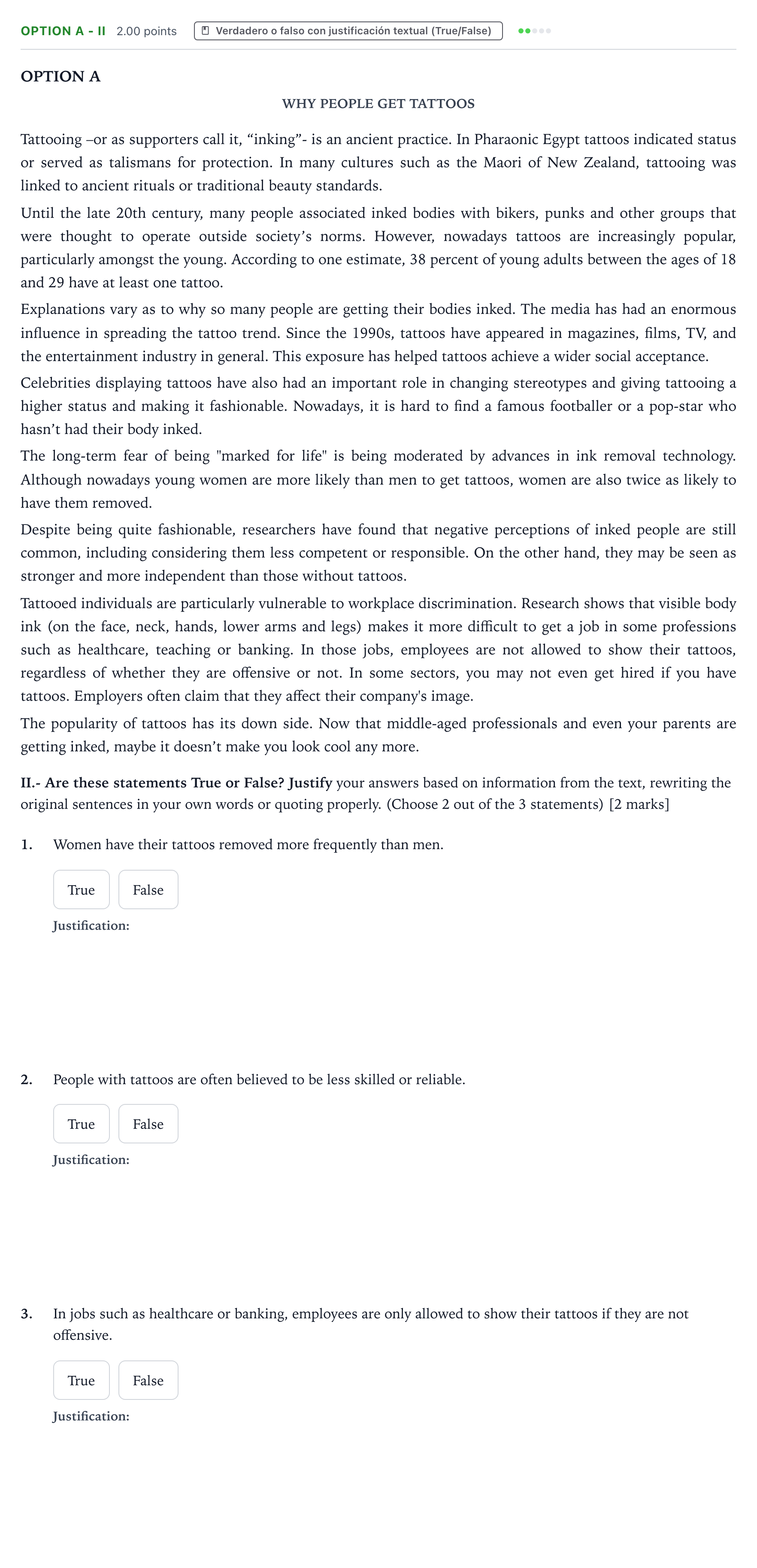
Tattooing –or as supporters call it, “inking”- is an ancient practice. In Pharaonic Egypt tattoos indicated status or served as talismans for protection. In many cultures such as the Maori of New Zealand, tattooing was linked to ancient rituals or traditional beauty standards.
Until the late 20th century, many people associated inked bodies with bikers, punks and other groups that were thought to operate outside society’s norms. However, nowadays tattoos are increasingly popular, particularly amongst the young. According to one estimate, 38 percent of young adults between the ages of 18 and 29 have at least one tattoo.
Explanations vary as to why so many people are getting their bodies inked. The media has had an enormous influence in spreading the tattoo trend. Since the 1990s, tattoos have appeared in magazines, films, TV, and the entertainment industry in general. This exposure has helped tattoos achieve a wider social acceptance.
Celebrities displaying tattoos have also had an important role in changing stereotypes and giving tattooing a higher status and making it fashionable. Nowadays, it is hard to find a famous footballer or a pop-star who hasn’t had their body inked.
The long-term fear of being "marked for life" is being moderated by advances in ink removal technology. Although nowadays young women are more likely than men to get tattoos, women are also twice as likely to have them removed.
Despite being quite fashionable, researchers have found that negative perceptions of inked people are still common, including considering them less competent or responsible. On the other hand, they may be seen as stronger and more independent than those without tattoos.
Tattooed individuals are particularly vulnerable to workplace discrimination. Research shows that visible body ink (on the face, neck, hands, lower arms and legs) makes it more difficult to get a job in some professions such as healthcare, teaching or banking. In those jobs, employees are not allowed to show their tattoos, regardless of whether they are offensive or not. In some sectors, you may not even get hired if you have tattoos. Employers often claim that they affect their company's image.
The popularity of tattoos has its down side. Now that middle-aged professionals and even your parents are getting inked, maybe it doesn’t make you look cool any more.
II.- Are these statements True or False? Justify your answers based on information from the text, rewriting the original sentences in your own words or quoting properly. (Choose 2 out of the 3 statements) [2 marks]
1.
Women have their tattoos removed more frequently than men.
True
False
2.
People with tattoos are often believed to be less skilled or reliable.
True
False
3.
In jobs such as healthcare or banking, employees are only allowed to show their tattoos if they are not offensive.
True
False
Solución
Según los criterios oficiales de corrección
1. Women have their tattoos removed more frequently than men.
Solución: True
1. Justification: Women have their tattoos removed more frequently than men.
Solución: This statement is true because the text says, "women are also twice as likely to have them removed." (p.5)
2. People with tattoos are often believed to be less skilled or reliable.
Solución: True
2. Justification: People with tattoos are often believed to be less skilled or reliable.
Solución: This statement is true because, as the text says, "negative perceptions of inked people are still common, including considering them less competent or responsible." (p.6)
3. In jobs such as healthcare or banking, employees are only allowed to show their tattoos if they are not offensive.
Solución: False
3. Justification: In jobs such as healthcare or banking, employees are only allowed to show their tattoos if they are not offensive.
Solución: The sentence is false because the text states, "In those jobs, employees are not allowed to show their tattoos, regardless of whether they are offensive or not." (p.7) / (Also acceptable if students answer: "The sentence is false because the text says that, in those professions, employees cannot show their tattoos whether they are offensive or not.") (p.7)
La explicación paso a paso, hecha con IA, es Premium. Premium
Resuélvelo aquí mismo: corrección automática, pistas y solución paso a paso.
‹ Ejercicio Option B - II · Extraordinaria 2022 · Ejercicio Option B - II · Ordinaria 2022 ›
Más ejercicios de Verdadero o falso con justificación textual (True/False)
- Ejercicio Option B - II · Extraordinaria 2024
- Ejercicio OPTION A - II · Ordinaria 2024
- Ejercicio OPTION B - II · Ordinaria 2024
- Ejercicio Option A - II · Extraordinaria 2022
- Ejercicio Option B - II · Extraordinaria 2022
- Ejercicio Option B - II · Ordinaria 2022
- Ejercicio Option A - II · Extraordinaria 2021
- Ejercicio Option B - II · Extraordinaria 2021
- Ejercicio Option A - II · Ordinaria 2021
- Ejercicio Option B - II · Ordinaria 2021