Ejercicio Option A - II · Inglés PAU País Vasco Extraordinaria 2021
Tema: Verdadero o falso con justificación textual (True/False) · Del examen Extraordinaria (2021)
Enunciado
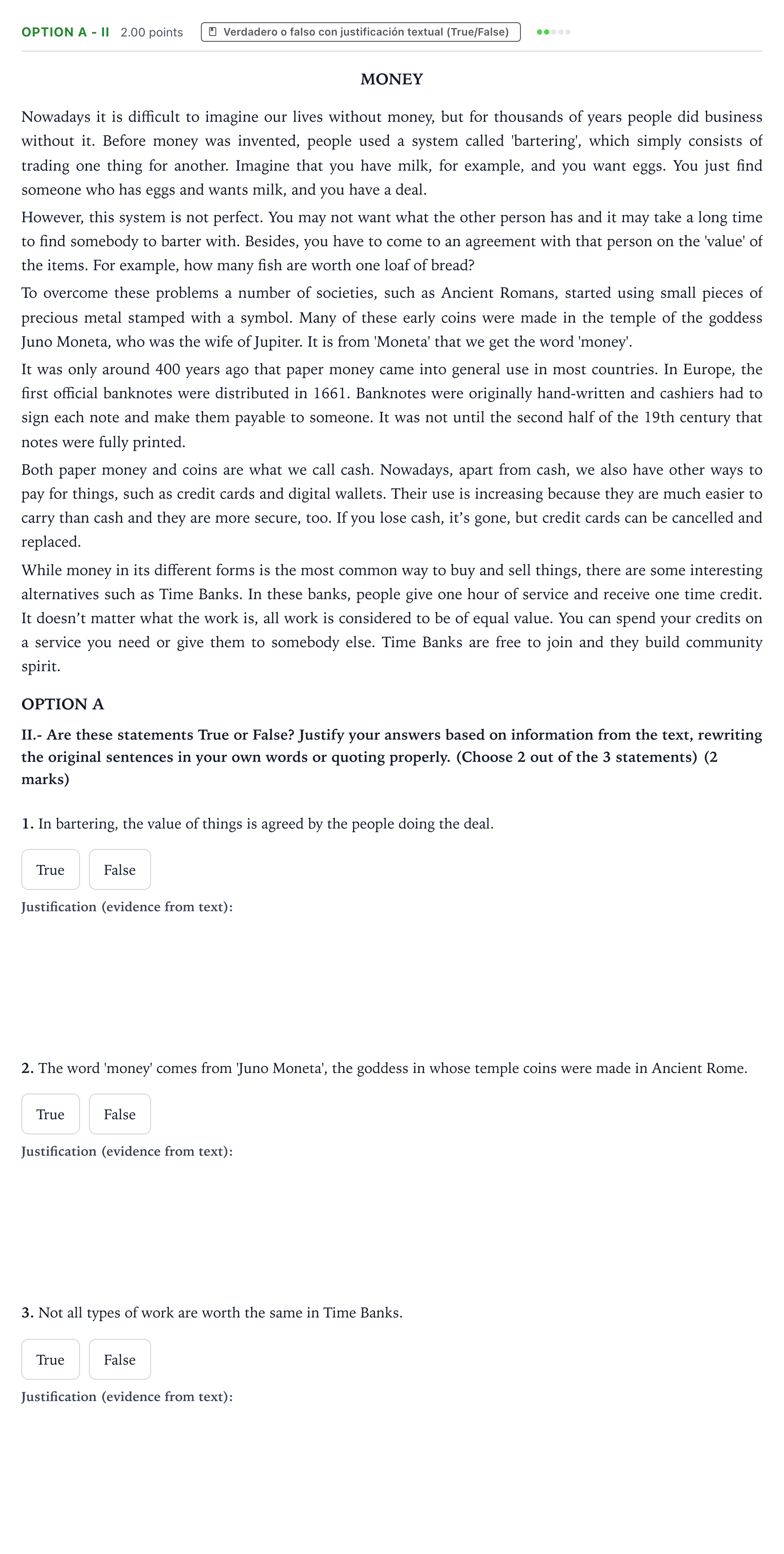
MONEY
Nowadays it is difficult to imagine our lives without money, but for thousands of years people did business without it. Before money was invented, people used a system called 'bartering', which simply consists of trading one thing for another. Imagine that you have milk, for example, and you want eggs. You just find someone who has eggs and wants milk, and you have a deal.
However, this system is not perfect. You may not want what the other person has and it may take a long time to find somebody to barter with. Besides, you have to come to an agreement with that person on the 'value' of the items. For example, how many fish are worth one loaf of bread?
To overcome these problems a number of societies, such as Ancient Romans, started using small pieces of precious metal stamped with a symbol. Many of these early coins were made in the temple of the goddess Juno Moneta, who was the wife of Jupiter. It is from 'Moneta' that we get the word 'money'.
It was only around 400 years ago that paper money came into general use in most countries. In Europe, the first official banknotes were distributed in 1661. Banknotes were originally hand-written and cashiers had to sign each note and make them payable to someone. It was not until the second half of the 19th century that notes were fully printed.
Both paper money and coins are what we call cash. Nowadays, apart from cash, we also have other ways to pay for things, such as credit cards and digital wallets. Their use is increasing because they are much easier to carry than cash and they are more secure, too. If you lose cash, it’s gone, but credit cards can be cancelled and replaced.
While money in its different forms is the most common way to buy and sell things, there are some interesting alternatives such as Time Banks. In these banks, people give one hour of service and receive one time credit. It doesn’t matter what the work is, all work is considered to be of equal value. You can spend your credits on a service you need or give them to somebody else. Time Banks are free to join and they build community spirit.
OPTION A
II.- Are these statements True or False? Justify your answers based on information from the text, rewriting the original sentences in your own words or quoting properly. (Choose 2 out of the 3 statements) (2 marks)
1. In bartering, the value of things is agreed by the people doing the deal.
True
False
2. The word 'money' comes from 'Juno Moneta', the goddess in whose temple coins were made in Ancient Rome.
True
False
3. Not all types of work are worth the same in Time Banks.
True
False
Solución
Según los criterios oficiales de corrección
1. In bartering, the value of things is agreed by the people doing the deal. (True/False)
Solución: True
1. Justification
Solución: This is a true sentence because the text states that in bartering "you have to come to an agreement with that person on the 'value' of the items." (p. 2)
2. The word 'money' comes from 'Juno Moneta', the goddess in whose temple coins were made in Ancient Rome. (True/False)
Solución: True
2. Justification
Solución: This statement is true. According to the text, "coins were made in the temple of the goddess Juno Moneta, who was the wife of Jupiter. It is from 'Moneta' that we get the word 'money'." (p. 3)
3. Not all types of work are worth the same in Time Banks. (True/False)
Solución: False
3. Justification
Solución: This sentence is false because the text mentions that, in these banks, "all work is considered to be of equal value." (p. 6)
La explicación paso a paso, hecha con IA, es Premium. Premium
Resuélvelo aquí mismo: corrección automática, pistas y solución paso a paso.
‹ Ejercicio Option B - II · Ordinaria 2022 · Ejercicio Option B - II · Extraordinaria 2021 ›
Más ejercicios de Verdadero o falso con justificación textual (True/False)
- Ejercicio OPTION B - II · Ordinaria 2024
- Ejercicio Option A - II · Extraordinaria 2022
- Ejercicio Option B - II · Extraordinaria 2022
- Ejercicio Option A - II · Ordinaria 2022
- Ejercicio Option B - II · Ordinaria 2022
- Ejercicio Option B - II · Extraordinaria 2021
- Ejercicio Option A - II · Ordinaria 2021
- Ejercicio Option B - II · Ordinaria 2021