Ejercicio Text A - Task 1 · Inglés PAU Murcia Ordinaria 2022
Tema: Comprensión: opción múltiple y verdadero o falso con cita (Multiple choice, True/False) · Del examen Ordinaria (2022)
Enunciado
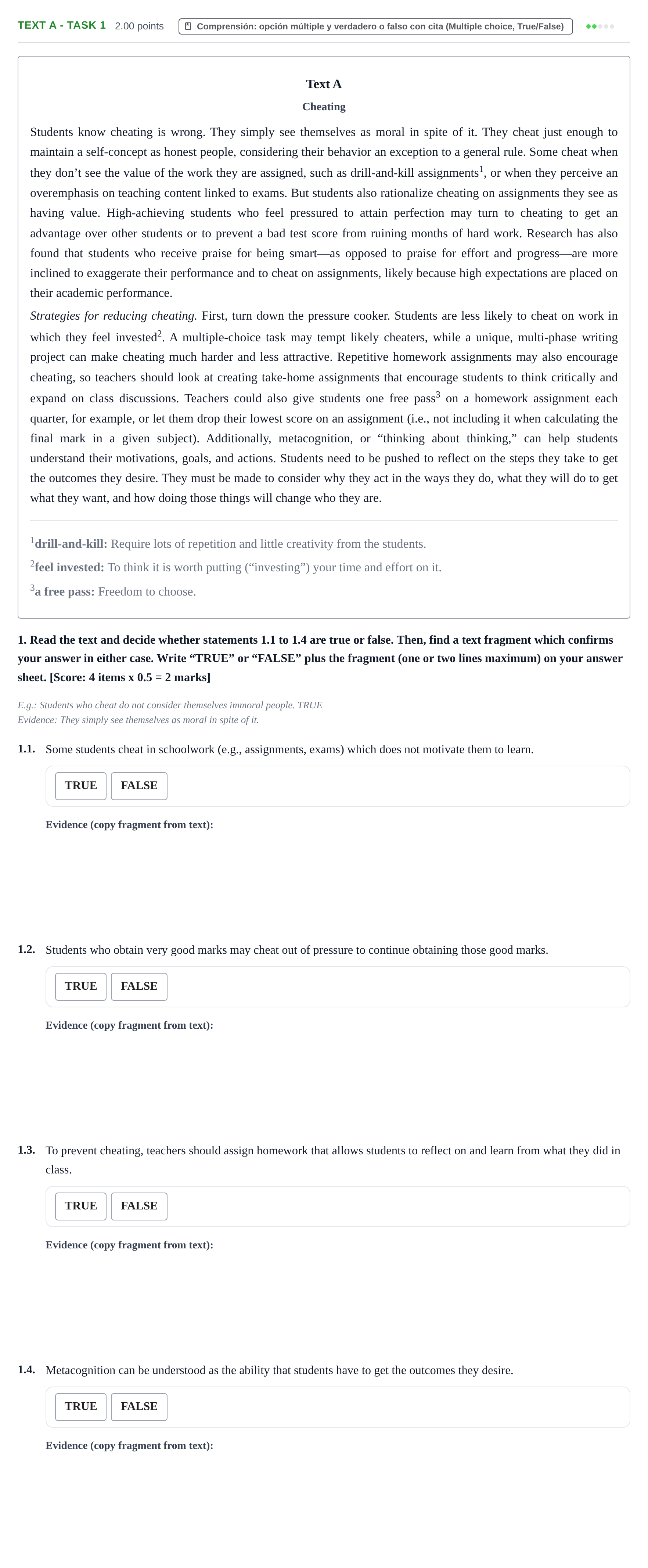
Text A
Cheating
Students know cheating is wrong. They simply see themselves as moral in spite of it. They cheat just enough to maintain a self-concept as honest people, considering their behavior an exception to a general rule. Some cheat when they don’t see the value of the work they are assigned, such as drill-and-kill assignments 1, or when they perceive an overemphasis on teaching content linked to exams. But students also rationalize cheating on assignments they see as having value. High-achieving students who feel pressured to attain perfection may turn to cheating to get an advantage over other students or to prevent a bad test score from ruining months of hard work. Research has also found that students who receive praise for being smart—as opposed to praise for effort and progress—are more inclined to exaggerate their performance and to cheat on assignments, likely because high expectations are placed on their academic performance.
Strategies for reducing cheating. First, turn down the pressure cooker. Students are less likely to cheat on work in which they feel invested 2. A multiple-choice task may tempt likely cheaters, while a unique, multi-phase writing project can make cheating much harder and less attractive. Repetitive homework assignments may also encourage cheating, so teachers should look at creating take-home assignments that encourage students to think critically and expand on class discussions. Teachers could also give students one free pass 3 on a homework assignment each quarter, for example, or let them drop their lowest score on an assignment (i.e., not including it when calculating the final mark in a given subject). Additionally, metacognition, or “thinking about thinking,” can help students understand their motivations, goals, and actions. Students need to be pushed to reflect on the steps they take to get the outcomes they desire. They must be made to consider why they act in the ways they do, what they will do to get what they want, and how doing those things will change who they are.
1 drill-and-kill: Require lots of repetition and little creativity from the students.
2 feel invested: To think it is worth putting (“investing”) your time and effort on it.
3 a free pass: Freedom to choose.
1. Read the text and decide whether statements 1.1 to 1.4 are true or false. Then, find a text fragment which confirms your answer in either case. Write “TRUE” or “FALSE” plus the fragment (one or two lines maximum) on your answer sheet. [Score: 4 items x 0.5 = 2 marks]
E.g.: Students who cheat do not consider themselves immoral people. TRUE
Evidence: They simply see themselves as moral in spite of it.
Solución
Según los criterios oficiales de corrección
1. Read the text and decide whether statements 1.1 to 1.4 are true or false.
Solución: 1.1: TRUE; 1.2: TRUE; 1.3: TRUE; 1.4: FALSE
1.1. Some students cheat in schoolwork (e.g., assignments, exams) which does not motivate them to learn.
Solución: TRUE. Evidence: "Some cheat when they don't see the value of the work they are assigned, such as drill-and-kill assignments, or when they perceive an overemphasis on teaching content linked to exams."
1.2. Students who obtain very good marks may cheat out of pressure to continue obtaining those good marks.
Solución: TRUE. Evidence: "High-achieving students who feel pressured to attain perfection may turn to cheating to get an advantage over other students or to prevent a bad test score from ruining months of hard work."
1.3. To prevent cheating, teachers should assign homework that allows students to reflect on and learn from what they did in class.
Solución: TRUE. Evidence: "...teachers should look at creating take-home assignments that encourage students to think critically and expand on class discussions."
1.4. Metacognition can be understood as the ability that students have to get the outcomes they desire.
Solución: FALSE. Evidence: "Additionally, metacognition, or 'thinking about thinking,' can help students understand their motivations, goals, and actions."
La explicación paso a paso, hecha con IA, es Premium. Premium
Resuélvelo aquí mismo: corrección automática, pistas y solución paso a paso.
‹ Ejercicio Text B - Task 1 · Extraordinaria 2022 · Ejercicio Text B - Task 1 · Ordinaria 2022 ›
Más ejercicios de Comprensión: opción múltiple y verdadero o falso con cita (Multiple choice, True/False)
- Ejercicio Text B - Task 1 · Extraordinaria 2023
- Ejercicio Text A - 1 · Ordinaria 2023
- Ejercicio Text B - 1 · Ordinaria 2023
- Ejercicio Text A - Task 1 · Extraordinaria 2022
- Ejercicio Text B - Task 1 · Extraordinaria 2022
- Ejercicio Text B - Task 1 · Ordinaria 2022
- Ejercicio Text A - Task 1 · Extraordinaria 2021
- Ejercicio Text B - Task 1 · Extraordinaria 2021
- Ejercicio Text A - Task 1 · Ordinaria 2021
- Ejercicio Text B - Task 1 · Ordinaria 2021