Problema 3 · Inglés PAU Madrid Ordinaria (2ª lengua) Coincidencias 2026
Tema: Vocabulario · Del examen Ordinaria (2ª lengua) Coincidencias (2026)
Enunciado
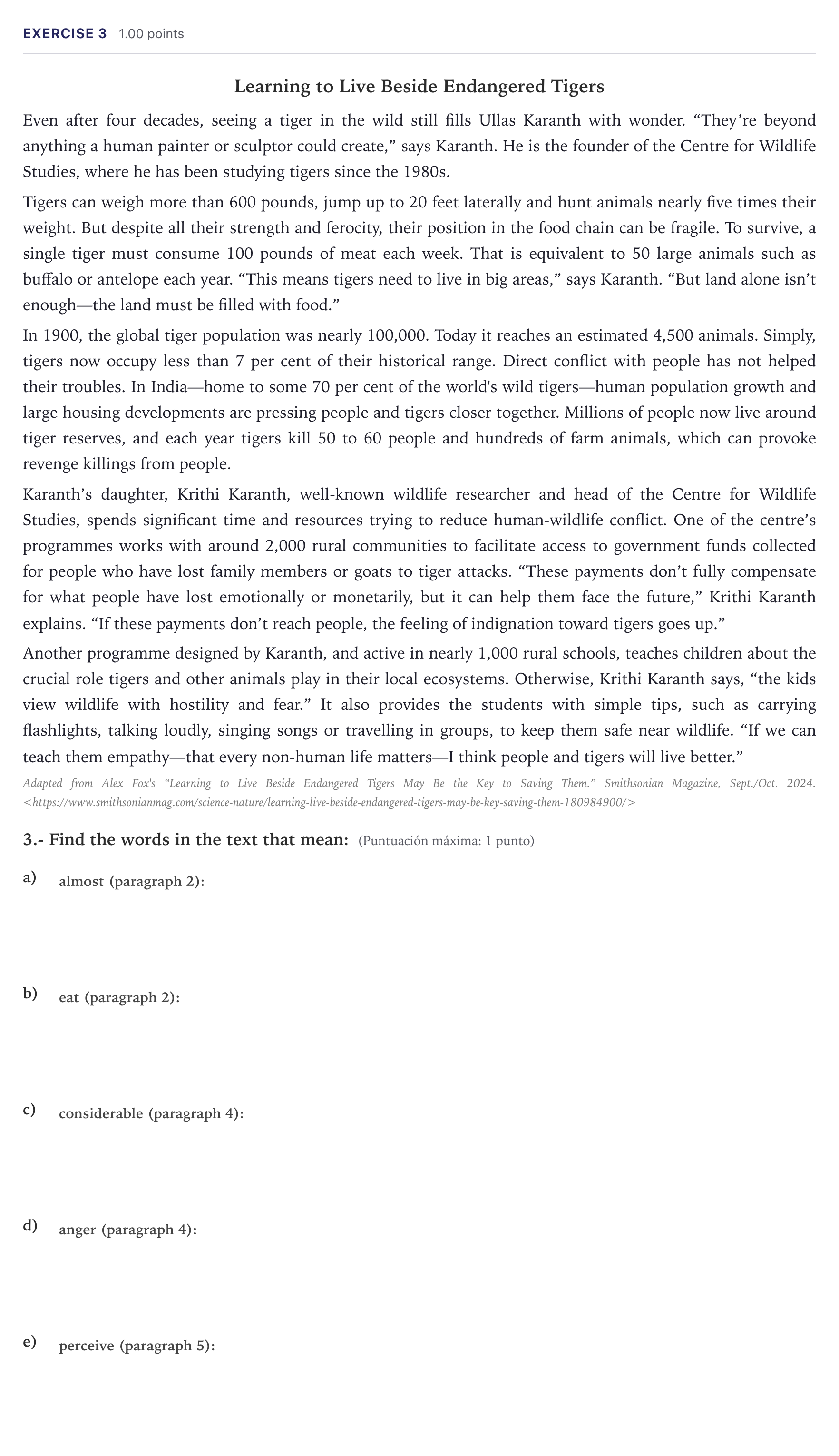
Learning to Live Beside Endangered Tigers
Even after four decades, seeing a tiger in the wild still fills Ullas Karanth with wonder. “They’re beyond anything a human painter or sculptor could create,” says Karanth. He is the founder of the Centre for Wildlife Studies, where he has been studying tigers since the 1980s.
Tigers can weigh more than 600 pounds, jump up to 20 feet laterally and hunt animals nearly five times their weight. But despite all their strength and ferocity, their position in the food chain can be fragile. To survive, a single tiger must consume 100 pounds of meat each week. That is equivalent to 50 large animals such as buffalo or antelope each year. “This means tigers need to live in big areas,” says Karanth. “But land alone isn’t enough—the land must be filled with food.”
In 1900, the global tiger population was nearly 100,000. Today it reaches an estimated 4,500 animals. Simply, tigers now occupy less than 7 per cent of their historical range. Direct conflict with people has not helped their troubles. In India—home to some 70 per cent of the world's wild tigers—human population growth and large housing developments are pressing people and tigers closer together. Millions of people now live around tiger reserves, and each year tigers kill 50 to 60 people and hundreds of farm animals, which can provoke revenge killings from people.
Karanth’s daughter, Krithi Karanth, well-known wildlife researcher and head of the Centre for Wildlife Studies, spends significant time and resources trying to reduce human-wildlife conflict. One of the centre’s programmes works with around 2,000 rural communities to facilitate access to government funds collected for people who have lost family members or goats to tiger attacks. “These payments don’t fully compensate for what people have lost emotionally or monetarily, but it can help them face the future,” Krithi Karanth explains. “If these payments don’t reach people, the feeling of indignation toward tigers goes up.”
Another programme designed by Karanth, and active in nearly 1,000 rural schools, teaches children about the crucial role tigers and other animals play in their local ecosystems. Otherwise, Krithi Karanth says, “the kids view wildlife with hostility and fear.” It also provides the students with simple tips, such as carrying flashlights, talking loudly, singing songs or travelling in groups, to keep them safe near wildlife. “If we can teach them empathy—that every non-human life matters—I think people and tigers will live better.”
Adapted from Alex Fox's “Learning to Live Beside Endangered Tigers May Be the Key to Saving Them.” Smithsonian Magazine, Sept./Oct. 2024. <https://www.smithsonianmag.com/science-nature/learning-live-beside-endangered-tigers-may-be-key-saving-them-180984900/>
3.- Find the words in the text that mean: (Puntuación máxima: 1 punto)
a)
b)
c)
d)
e)
Solución
Según los criterios oficiales de corrección
a) almost (paragraph 2)
Solución: nearly
b) eat (paragraph 2)
Solución: consume
c) considerable (paragraph 4)
Solución: significant
d) anger (paragraph 4)
Solución: indignation
e) perceive (paragraph 5)
Solución: view
La explicación paso a paso, hecha con IA, es Premium. Premium
Resuélvelo aquí mismo: corrección automática, pistas y solución paso a paso.
‹ Problema 3 · Ordinaria (2ª lengua) 2026 · Problema 3 · Ordinaria 12:00 2026 ›
Más ejercicios de Vocabulario
- Problema 3 · Extraordinaria 2026
- Problema 3 · Extraordinaria (2ª lengua) 2026
- Problema 3 · Extraordinaria (2ª lengua) Coincidencias 2026
- Problema 3 · Ordinaria (2ª lengua) 2026
- Problema 3 · Ordinaria 12:00 2026
- Problema 3 · Ordinaria 9:30 2026
- Problema 3 · Extraordinaria 2025
- Problema 3 · Modelo 2025
- Problema 3 · Ordinaria 12:00 2025
- Problema 3 · Ordinaria 9:30 2025