Problema 3 · Inglés PAU Madrid Extraordinaria (2ª lengua) Coincidencias 2026
Tema: Vocabulario · Del examen Extraordinaria (2ª lengua) Coincidencias (2026)
Enunciado
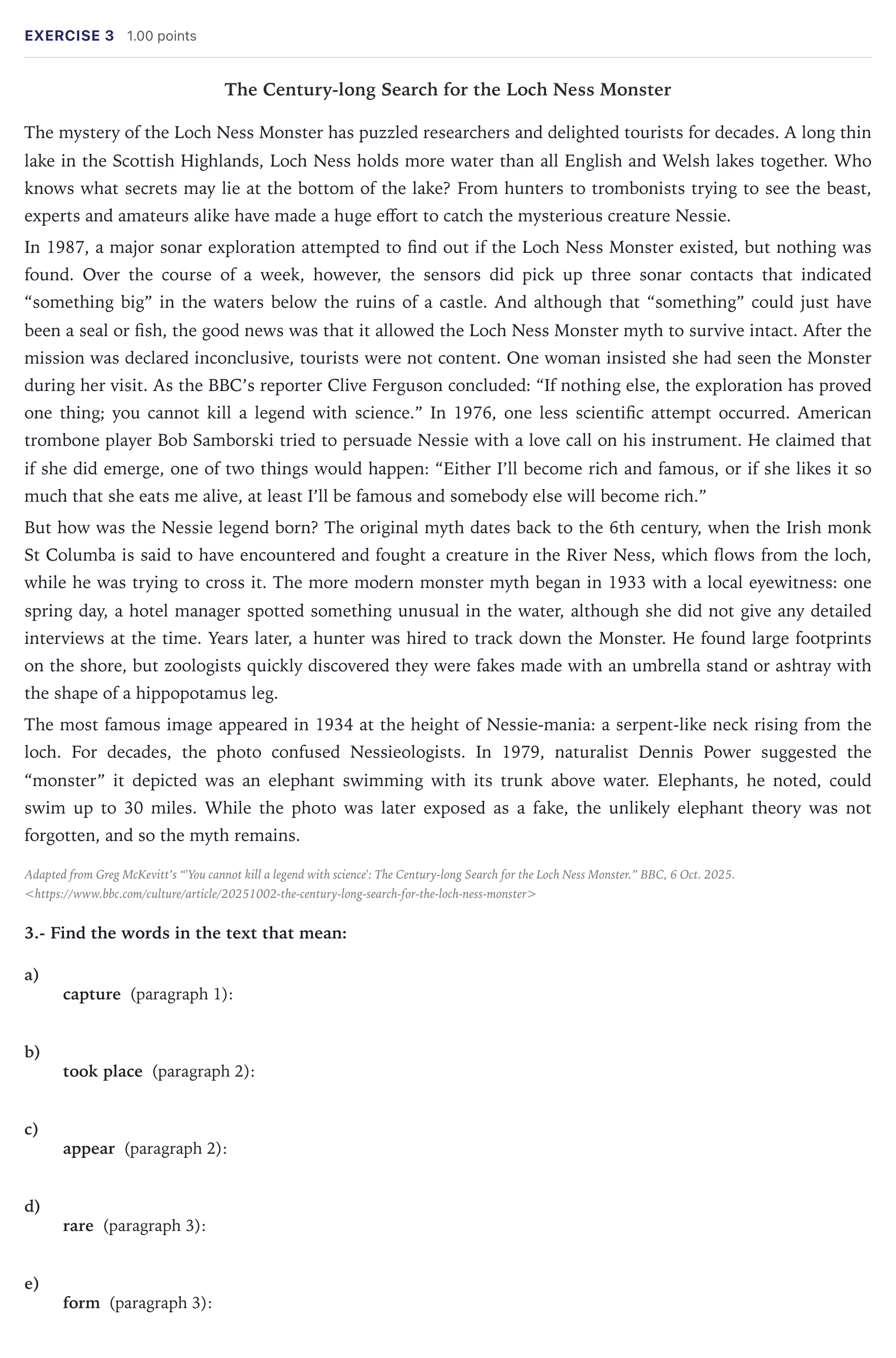
The Century-long Search for the Loch Ness Monster
The mystery of the Loch Ness Monster has puzzled researchers and delighted tourists for decades. A long thin lake in the Scottish Highlands, Loch Ness holds more water than all English and Welsh lakes together. Who knows what secrets may lie at the bottom of the lake? From hunters to trombonists trying to see the beast, experts and amateurs alike have made a huge effort to catch the mysterious creature Nessie.
In 1987, a major sonar exploration attempted to find out if the Loch Ness Monster existed, but nothing was found. Over the course of a week, however, the sensors did pick up three sonar contacts that indicated “something big” in the waters below the ruins of a castle. And although that “something” could just have been a seal or fish, the good news was that it allowed the Loch Ness Monster myth to survive intact. After the mission was declared inconclusive, tourists were not content. One woman insisted she had seen the Monster during her visit. As the BBC’s reporter Clive Ferguson concluded: “If nothing else, the exploration has proved one thing; you cannot kill a legend with science.” In 1976, one less scientific attempt occurred. American trombone player Bob Samborski tried to persuade Nessie with a love call on his instrument. He claimed that if she did emerge, one of two things would happen: “Either I’ll become rich and famous, or if she likes it so much that she eats me alive, at least I’ll be famous and somebody else will become rich.”
But how was the Nessie legend born? The original myth dates back to the 6th century, when the Irish monk St Columba is said to have encountered and fought a creature in the River Ness, which flows from the loch, while he was trying to cross it. The more modern monster myth began in 1933 with a local eyewitness: one spring day, a hotel manager spotted something unusual in the water, although she did not give any detailed interviews at the time. Years later, a hunter was hired to track down the Monster. He found large footprints on the shore, but zoologists quickly discovered they were fakes made with an umbrella stand or ashtray with the shape of a hippopotamus leg.
The most famous image appeared in 1934 at the height of Nessie-mania: a serpent-like neck rising from the loch. For decades, the photo confused Nessieologists. In 1979, naturalist Dennis Power suggested the “monster” it depicted was an elephant swimming with its trunk above water. Elephants, he noted, could swim up to 30 miles. While the photo was later exposed as a fake, the unlikely elephant theory was not forgotten, and so the myth remains.
Adapted from Greg McKevitt’s “'You cannot kill a legend with science': The Century-long Search for the Loch Ness Monster.” BBC, 6 Oct. 2025. <https://www.bbc.com/culture/article/20251002-the-century-long-search-for-the-loch-ness-monster>
3.- Find the words in the text that mean:
a)
capture (paragraph 1):
b)
took place (paragraph 2):
c)
appear (paragraph 2):
d)
rare (paragraph 3):
e)
form (paragraph 3):
Solución
Según los criterios oficiales de corrección
a) capture (paragraph 1)
Solución: catch
b) took place (paragraph 2)
Solución: occurred
c) appear (paragraph 2)
Solución: emerge
d) rare (paragraph 3)
Solución: unusual
e) form (paragraph 3)
Solución: shape
La explicación paso a paso, hecha con IA, es Premium. Premium
Resuélvelo aquí mismo: corrección automática, pistas y solución paso a paso.
‹ Problema 3 · Extraordinaria (2ª lengua) 2026 · Problema 3 · Ordinaria (2ª lengua) 2026 ›
Más ejercicios de Vocabulario
- Problema 3 · Extraordinaria 2026
- Problema 3 · Extraordinaria (2ª lengua) 2026
- Problema 3 · Ordinaria (2ª lengua) 2026
- Problema 3 · Ordinaria (2ª lengua) Coincidencias 2026
- Problema 3 · Ordinaria 12:00 2026
- Problema 3 · Ordinaria 9:30 2026
- Problema 3 · Extraordinaria 2025
- Problema 3 · Modelo 2025
- Problema 3 · Ordinaria 12:00 2025
- Problema 3 · Ordinaria 9:30 2025