Ejercicio B.3 - Vocabulario · Inglés PAU Madrid Ordinaria Coincidencias 2022
Tema: Vocabulario · Del examen Ordinaria Coincidencias (2022)
Enunciado
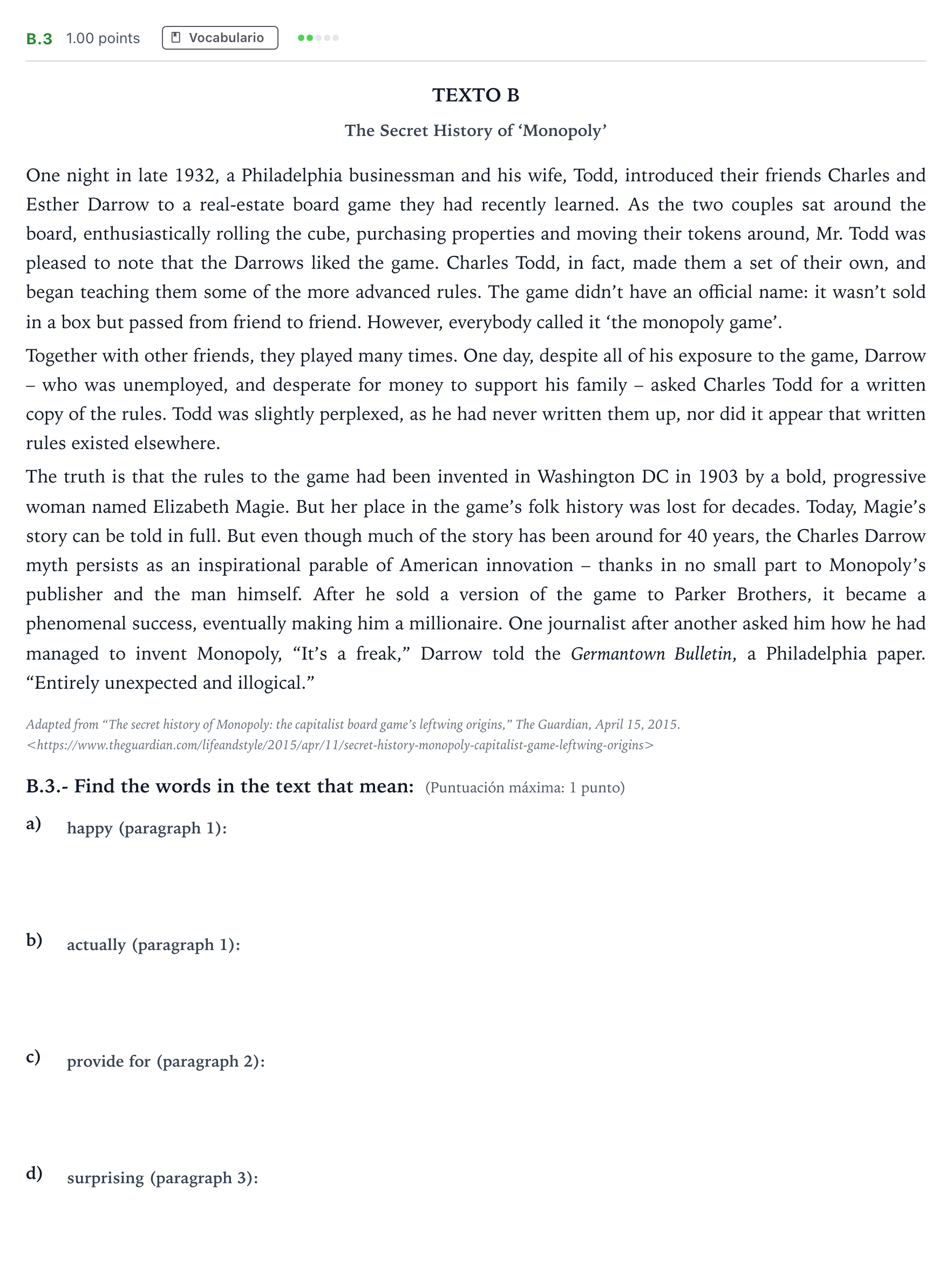
TEXTO B
The Secret History of ‘Monopoly’
One night in late 1932, a Philadelphia businessman and his wife, Todd, introduced their friends Charles and Esther Darrow to a real-estate board game they had recently learned. As the two couples sat around the board, enthusiastically rolling the cube, purchasing properties and moving their tokens around, Mr. Todd was pleased to note that the Darrows liked the game. Charles Todd, in fact, made them a set of their own, and began teaching them some of the more advanced rules. The game didn’t have an official name: it wasn’t sold in a box but passed from friend to friend. However, everybody called it ‘the monopoly game’.
Together with other friends, they played many times. One day, despite all of his exposure to the game, Darrow – who was unemployed, and desperate for money to support his family – asked Charles Todd for a written copy of the rules. Todd was slightly perplexed, as he had never written them up, nor did it appear that written rules existed elsewhere.
The truth is that the rules to the game had been invented in Washington DC in 1903 by a bold, progressive woman named Elizabeth Magie. But her place in the game’s folk history was lost for decades. Today, Magie’s story can be told in full. But even though much of the story has been around for 40 years, the Charles Darrow myth persists as an inspirational parable of American innovation – thanks in no small part to Monopoly’s publisher and the man himself. After he sold a version of the game to Parker Brothers, it became a phenomenal success, eventually making him a millionaire. One journalist after another asked him how he had managed to invent Monopoly, “It’s a freak,” Darrow told the Germantown Bulletin, a Philadelphia paper. “Entirely unexpected and illogical.”
Adapted from “The secret history of Monopoly: the capitalist board game’s leftwing origins,” The Guardian, April 15, 2015. <https://www.theguardian.com/lifeandstyle/2015/apr/11/secret-history-monopoly-capitalist-game-leftwing-origins>
B.3.- Find the words in the text that mean: (Puntuación máxima: 1 punto)
a)
b)
c)
d)
Solución
Según los criterios oficiales de corrección
a) happy (paragraph 1)
Solución: pleased
b) actually (paragraph 1)
Solución: in fact
c) provide for (paragraph 2)
Solución: support
d) surprising (paragraph 3)
Solución: unexpected
La explicación paso a paso, hecha con IA, es Premium. Premium
Resuélvelo aquí mismo: corrección automática, pistas y solución paso a paso.
‹ Ejercicio A.3 - Vocabulario · Ordinaria Coincidencias 2022 · Ejercicio A.3 · Ordinaria Lunes 2022 ›
Más ejercicios de Vocabulario
- Ejercicio A.3 · Modelo 2022
- Ejercicio B.3 · Modelo 2022
- Ejercicio A.3 · Ordinaria (2ª lengua) 2022
- Ejercicio B.3 · Ordinaria (2ª lengua) 2022
- Ejercicio A.3 - Vocabulario · Ordinaria Coincidencias 2022
- Ejercicio A.3 · Ordinaria Lunes 2022
- Ejercicio B.3 · Ordinaria Lunes 2022
- Ejercicio A.3 · Ordinaria Martes 2022
- Ejercicio B.3 · Ordinaria Martes 2022
- Ejercicio A.3 · Extraordinaria 2021