Ejercicio A.3 · Inglés PAU Madrid Ordinaria (2ª lengua) 2022
Tema: Vocabulario · Del examen Ordinaria (2ª lengua) (2022)
Enunciado
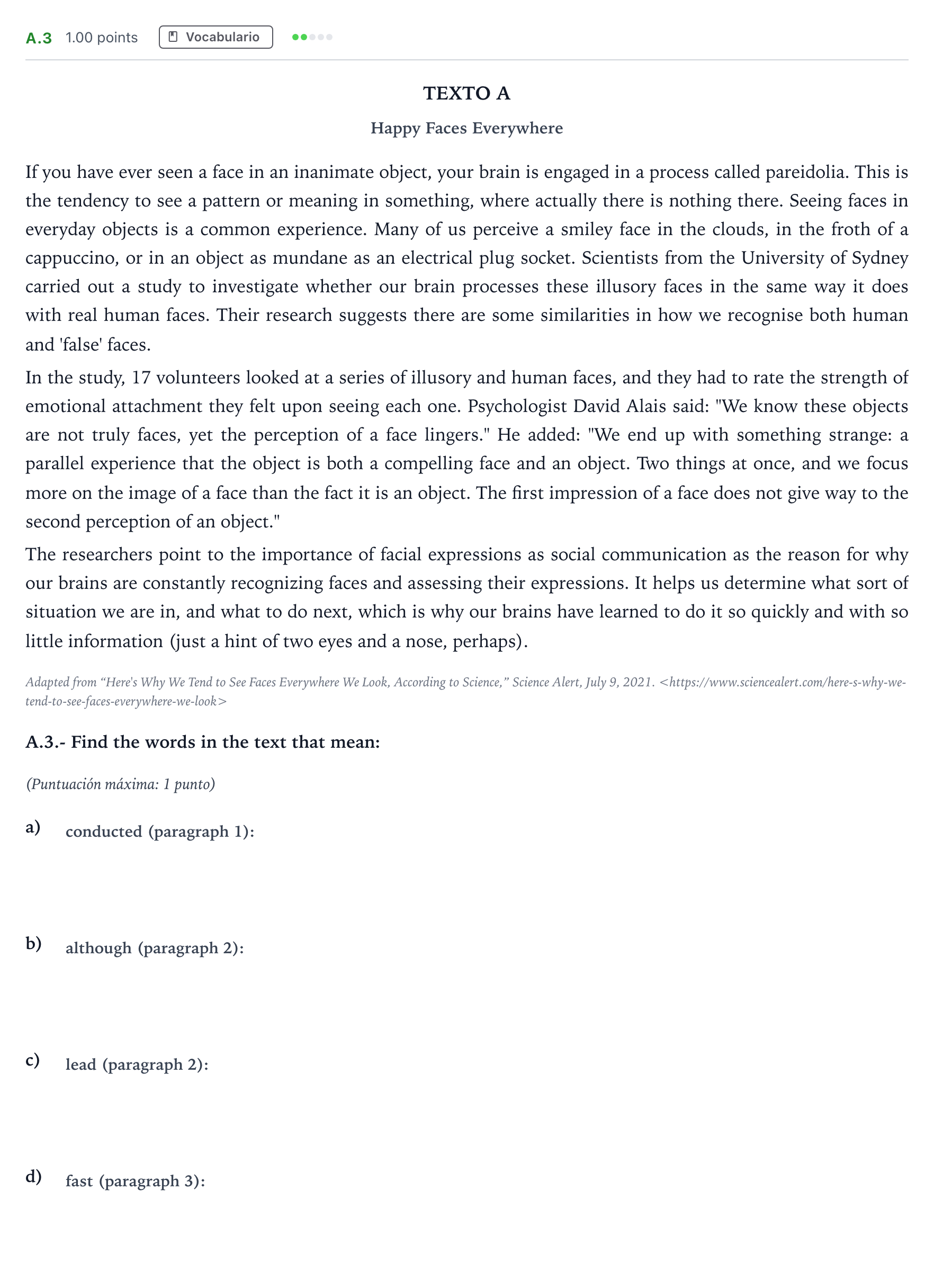
TEXTO A
Happy Faces Everywhere
If you have ever seen a face in an inanimate object, your brain is engaged in a process called pareidolia. This is the tendency to see a pattern or meaning in something, where actually there is nothing there. Seeing faces in everyday objects is a common experience. Many of us perceive a smiley face in the clouds, in the froth of a cappuccino, or in an object as mundane as an electrical plug socket. Scientists from the University of Sydney carried out a study to investigate whether our brain processes these illusory faces in the same way it does with real human faces. Their research suggests there are some similarities in how we recognise both human and 'false' faces.
In the study, 17 volunteers looked at a series of illusory and human faces, and they had to rate the strength of emotional attachment they felt upon seeing each one. Psychologist David Alais said: "We know these objects are not truly faces, yet the perception of a face lingers." He added: "We end up with something strange: a parallel experience that the object is both a compelling face and an object. Two things at once, and we focus more on the image of a face than the fact it is an object. The first impression of a face does not give way to the second perception of an object."
The researchers point to the importance of facial expressions as social communication as the reason for why our brains are constantly recognizing faces and assessing their expressions. It helps us determine what sort of situation we are in, and what to do next, which is why our brains have learned to do it so quickly and with so little information (just a hint of two eyes and a nose, perhaps).
Adapted from “Here's Why We Tend to See Faces Everywhere We Look, According to Science,” Science Alert, July 9, 2021. <https://www.sciencealert.com/here-s-why-we-tend-to-see-faces-everywhere-we-look>
A.3.- Find the words in the text that mean:
(Puntuación máxima: 1 punto)
a)
b)
c)
d)
Solución
Según los criterios oficiales de corrección
a) conducted (paragraph 1)
Solución: carried out
b) although (paragraph 2)
Solución: yet
c) lead (paragraph 2)
Solución: give way
d) fast (paragraph 3)
Solución: quickly
La explicación paso a paso, hecha con IA, es Premium. Premium
Resuélvelo aquí mismo: corrección automática, pistas y solución paso a paso.
‹ Ejercicio B.3 · Modelo 2022 · Ejercicio B.3 · Ordinaria (2ª lengua) 2022 ›
Más ejercicios de Vocabulario
- Ejercicio B.3 · Extraordinaria (2ª lengua) 2022
- Ejercicio A.3 · Extraordinaria Coincidencias 2022
- Ejercicio B.3 · Extraordinaria Coincidencias 2022
- Ejercicio A.3 · Modelo 2022
- Ejercicio B.3 · Modelo 2022
- Ejercicio B.3 · Ordinaria (2ª lengua) 2022
- Ejercicio A.3 - Vocabulario · Ordinaria Coincidencias 2022
- Ejercicio B.3 - Vocabulario · Ordinaria Coincidencias 2022
- Ejercicio A.3 · Ordinaria Lunes 2022
- Ejercicio B.3 · Ordinaria Lunes 2022