Opción B · Inglés PAU Madrid Extraordinaria 2018
Tema: Comprensión Lectora · Del examen Extraordinaria (2018)
Enunciado
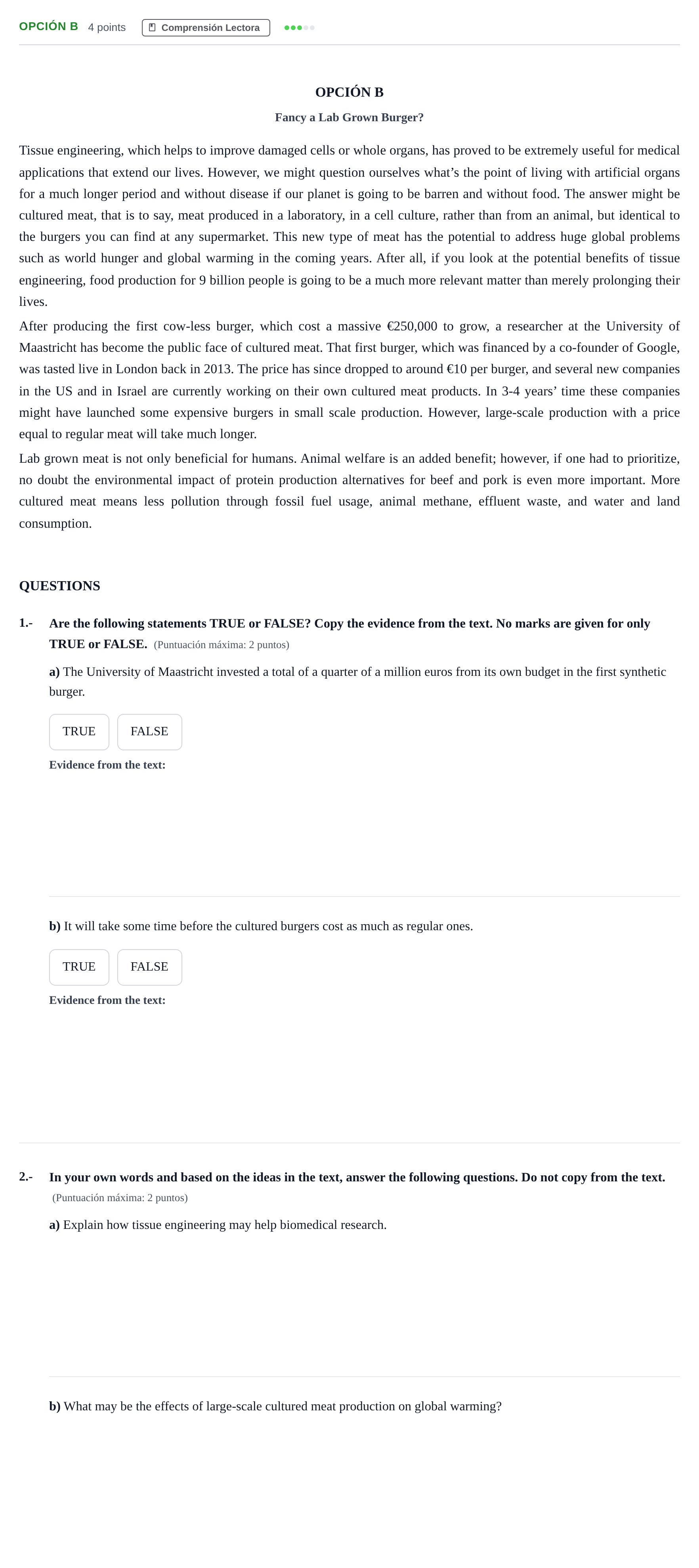
OPCIÓN B
Fancy a Lab Grown Burger?
Tissue engineering, which helps to improve damaged cells or whole organs, has proved to be extremely useful for medical applications that extend our lives. However, we might question ourselves what’s the point of living with artificial organs for a much longer period and without disease if our planet is going to be barren and without food. The answer might be cultured meat, that is to say, meat produced in a laboratory, in a cell culture, rather than from an animal, but identical to the burgers you can find at any supermarket. This new type of meat has the potential to address huge global problems such as world hunger and global warming in the coming years. After all, if you look at the potential benefits of tissue engineering, food production for 9 billion people is going to be a much more relevant matter than merely prolonging their lives.
After producing the first cow-less burger, which cost a massive €250,000 to grow, a researcher at the University of Maastricht has become the public face of cultured meat. That first burger, which was financed by a co-founder of Google, was tasted live in London back in 2013. The price has since dropped to around €10 per burger, and several new companies in the US and in Israel are currently working on their own cultured meat products. In 3-4 years’ time these companies might have launched some expensive burgers in small scale production. However, large-scale production with a price equal to regular meat will take much longer.
Lab grown meat is not only beneficial for humans. Animal welfare is an added benefit; however, if one had to prioritize, no doubt the environmental impact of protein production alternatives for beef and pork is even more important. More cultured meat means less pollution through fossil fuel usage, animal methane, effluent waste, and water and land consumption.
QUESTIONS
1.-
Are the following statements TRUE or FALSE? Copy the evidence from the text. No marks are given for only TRUE or FALSE.
(Puntuación máxima: 2 puntos)
a) The University of Maastricht invested a total of a quarter of a million euros from its own budget in the first synthetic burger.
TRUE
FALSE
b) It will take some time before the cultured burgers cost as much as regular ones.
TRUE
FALSE
2.-
In your own words and based on the ideas in the text, answer the following questions. Do not copy from the text.
(Puntuación máxima: 2 puntos)
a) Explain how tissue engineering may help biomedical research.
b) What may be the effects of large-scale cultured meat production on global warming?
Solución
Según los criterios oficiales de corrección
1. a) The University of Maastricht invested a total of a quarter of a million euros from its own budget in the first synthetic burger. (TRUE or FALSE)
Solución: FALSE
1. a) Evidence from the text
Solución: «That first burger, which was financed by a co-founder of Google, was tasted live in London back in 2013.»
1. b) It will take some time before the cultured burgers cost as much as regular ones. (TRUE or FALSE)
Solución: TRUE
1. b) Evidence from the text
Solución: «However, large-scale production with a price equal to regular meat will take much longer.»
2. a) Explain how tissue engineering may help biomedical research.
Solución: Tissue engineering can help biomedical research by assisting in the repair or regeneration of damaged cells and whole organs, which can contribute to treating diseases and extending people's lives.
2. b) What may be the effects of large-scale cultured meat production on global warming?
Solución: Producing cultured meat on a large scale could reduce global warming by decreasing the pollution caused by fossil fuels, animal methane emissions, effluent waste, and the consumption of land and water resources.
La explicación paso a paso, hecha con IA, es Premium. Premium
Resuélvelo aquí mismo: corrección automática, pistas y solución paso a paso.
‹ Opción A · Extraordinaria 2018 · Opción A · Extraordinaria (2ª lengua) 2018 ›
Más ejercicios de Comprensión Lectora
- Opción B - Pregunta 1 · Ordinaria 2019
- Opción B - Pregunta 2 · Ordinaria 2019
- Opción A · Ordinaria (2ª lengua) 2019
- Opción B · Ordinaria (2ª lengua) 2019
- Opción A · Extraordinaria 2018
- Opción A · Extraordinaria (2ª lengua) 2018
- Opción B · Extraordinaria (2ª lengua) 2018
- Opción A - 1 y 2 · Modelo 2018
- Opción B - 1 y 2 · Modelo 2018
- Opción A · Ordinaria 2018