Question 2 - 2.1.1 · Inglés PAU Galicia Ordinaria 2023
Tema: Verdadero, falso o no se dice, con cita del texto (True/False/Not Given) · Del examen Ordinaria (2023)
Enunciado
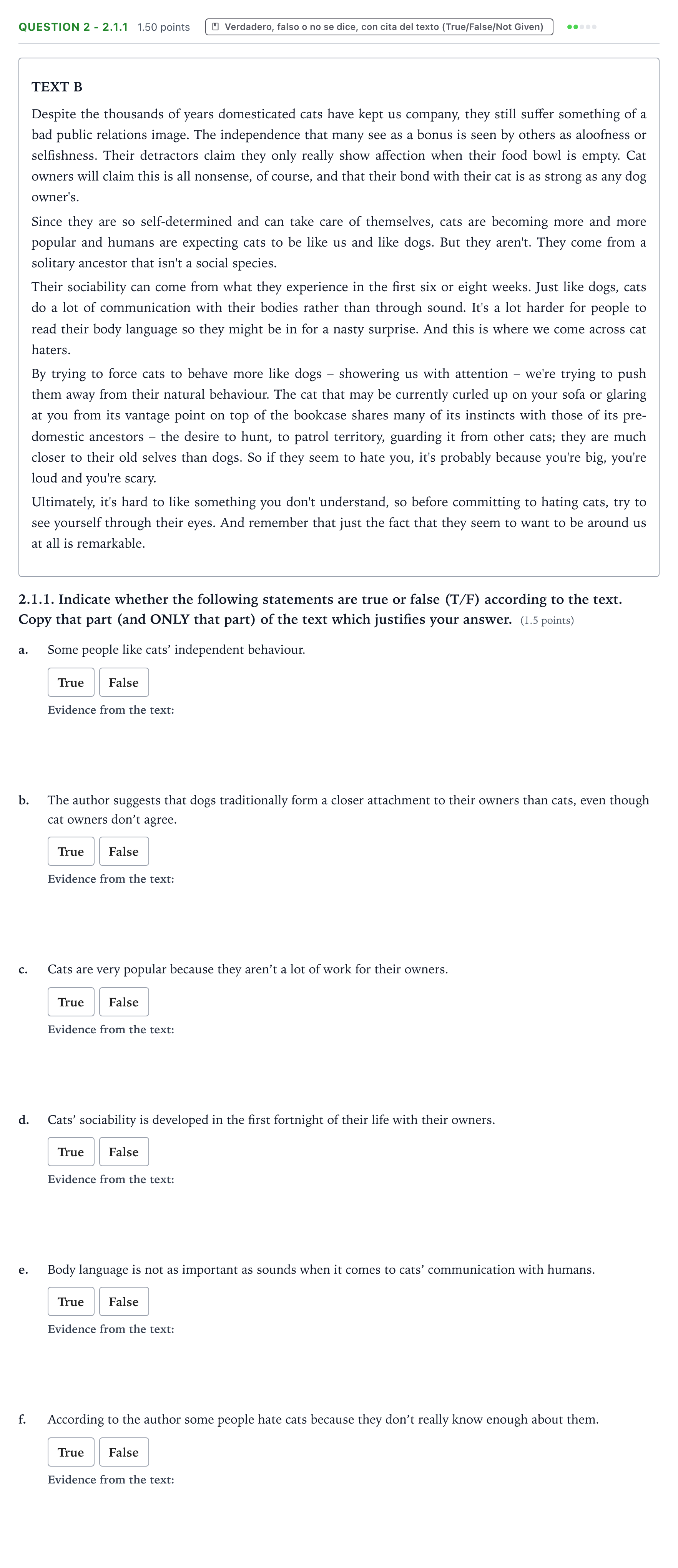
TEXT B
Despite the thousands of years domesticated cats have kept us company, they still suffer something of a bad public relations image. The independence that many see as a bonus is seen by others as aloofness or selfishness. Their detractors claim they only really show affection when their food bowl is empty. Cat owners will claim this is all nonsense, of course, and that their bond with their cat is as strong as any dog owner's.
Since they are so self-determined and can take care of themselves, cats are becoming more and more popular and humans are expecting cats to be like us and like dogs. But they aren't. They come from a solitary ancestor that isn't a social species.
Their sociability can come from what they experience in the first six or eight weeks. Just like dogs, cats do a lot of communication with their bodies rather than through sound. It's a lot harder for people to read their body language so they might be in for a nasty surprise. And this is where we come across cat haters.
By trying to force cats to behave more like dogs – showering us with attention – we're trying to push them away from their natural behaviour. The cat that may be currently curled up on your sofa or glaring at you from its vantage point on top of the bookcase shares many of its instincts with those of its pre-domestic ancestors – the desire to hunt, to patrol territory, guarding it from other cats; they are much closer to their old selves than dogs. So if they seem to hate you, it's probably because you're big, you're loud and you're scary.
Ultimately, it's hard to like something you don't understand, so before committing to hating cats, try to see yourself through their eyes. And remember that just the fact that they seem to want to be around us at all is remarkable.
2.1.1. Indicate whether the following statements are true or false (T/F) according to the text. Copy that part (and ONLY that part) of the text which justifies your answer. (1.5 points)
a.
Some people like cats’ independent behaviour.
b.
The author suggests that dogs traditionally form a closer attachment to their owners than cats, even though cat owners don’t agree.
c.
Cats are very popular because they aren’t a lot of work for their owners.
d.
Cats’ sociability is developed in the first fortnight of their life with their owners.
e.
Body language is not as important as sounds when it comes to cats’ communication with humans.
f.
According to the author some people hate cats because they don’t really know enough about them.
Solución
Según los criterios oficiales de corrección
2.1.1. True or False statements
Solución: a. True; b. True; c. True; d. False; e. False; f. True
a. Some people like cats’ independent behaviour.
Solución: The independence that many see as a bonus
b. The author suggests that dogs traditionally form a closer attachment to their owners than cats, even though cat owners don’t agree.
Solución: Cat owners will claim this is all nonsense, of course, and that their bond with their cat is as strong as any dog owner’s.
c. Cats are very popular because they aren’t a lot of work for their owners.
Solución: they are so self-determined and can take care of themselves
d. Cats’ sociability is developed in the first fortnight of their life with their owners.
Solución: Their sociability can come from what they experience in the first six or eight weeks.
e. Body language is not as important as sounds when it comes to cats’ communication with humans.
Solución: Just like dogs, cats do a lot of communication with their bodies rather than through sound
f. According to the author some people hate cats because they don’t really know enough about them.
Solución: it’s hard to like something you don’t understand.
La explicación paso a paso, hecha con IA, es Premium. Premium
Resuélvelo aquí mismo: corrección automática, pistas y solución paso a paso.
‹ Question 1 - 1.1.1 · Ordinaria 2023 · Question 1 - 1.1.1 · Ordinaria (2ª lengua extranjera) 2023 ›
Más ejercicios de Verdadero, falso o no se dice, con cita del texto (True/False/Not Given)
- Question 1 - 1.1.1 · Extraordinaria 2023
- Question 2 - 2.1.1 · Extraordinaria 2023
- Question 1.1.1 · Extraordinaria (2ª lengua extranjera) 2023
- Question 2.1.1 · Extraordinaria (2ª lengua extranjera) 2023
- Question 1 - 1.1.1 · Ordinaria 2023
- Question 1 - 1.1.1 · Ordinaria (2ª lengua extranjera) 2023
- Question 2 - 2.1.1 · Ordinaria (2ª lengua extranjera) 2023
- Question 1.2 - True/False · Extraordinaria 2022
- Question 3.2 - True/False · Extraordinaria 2022
- Ejercicio 1.2 - True/False · Extraordinaria (2ª lengua extranjera) 2022