Question 1.2 - True/False · Inglés PAU Galicia Extraordinaria 2022
Tema: Verdadero, falso o no se dice, con cita del texto (True/False/Not Given) · Del examen Extraordinaria (2022)
Enunciado
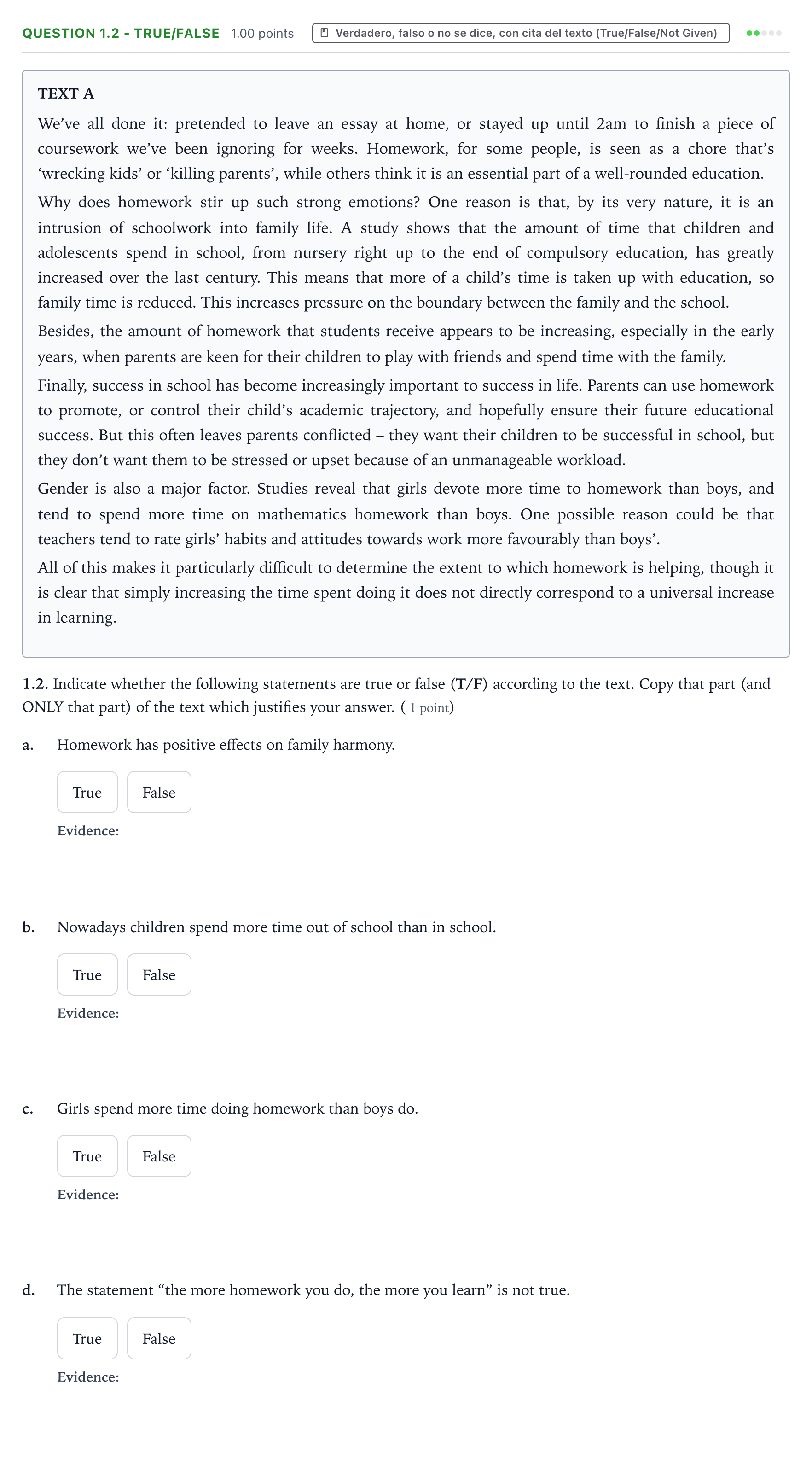
TEXT A
We’ve all done it: pretended to leave an essay at home, or stayed up until 2am to finish a piece of coursework we’ve been ignoring for weeks. Homework, for some people, is seen as a chore that’s ‘wrecking kids’ or ‘killing parents’, while others think it is an essential part of a well-rounded education.
Why does homework stir up such strong emotions? One reason is that, by its very nature, it is an intrusion of schoolwork into family life. A study shows that the amount of time that children and adolescents spend in school, from nursery right up to the end of compulsory education, has greatly increased over the last century. This means that more of a child’s time is taken up with education, so family time is reduced. This increases pressure on the boundary between the family and the school.
Besides, the amount of homework that students receive appears to be increasing, especially in the early years, when parents are keen for their children to play with friends and spend time with the family.
Finally, success in school has become increasingly important to success in life. Parents can use homework to promote, or control their child’s academic trajectory, and hopefully ensure their future educational success. But this often leaves parents conflicted – they want their children to be successful in school, but they don’t want them to be stressed or upset because of an unmanageable workload.
Gender is also a major factor. Studies reveal that girls devote more time to homework than boys, and tend to spend more time on mathematics homework than boys. One possible reason could be that teachers tend to rate girls’ habits and attitudes towards work more favourably than boys’.
All of this makes it particularly difficult to determine the extent to which homework is helping, though it is clear that simply increasing the time spent doing it does not directly correspond to a universal increase in learning.
1.2. Indicate whether the following statements are true or false ( T/F) according to the text. Copy that part (and ONLY that part) of the text which justifies your answer. ( 1 point)
a.
Homework has positive effects on family harmony.
True
False
b.
Nowadays children spend more time out of school than in school.
True
False
c.
Girls spend more time doing homework than boys do.
True
False
d.
The statement “the more homework you do, the more you learn” is not true.
True
False
Solución
Según los criterios oficiales de corrección
1.2. a. Homework has positive effects on family harmony.
Solución: F: "... it (homework) is an intrusion of schoolwork into family life."
1.2. b. Nowadays children spend more time out of school than in school.
Solución: F: "This means that more of a child's time is taken up with education, so family time is reduced"
1.2. c. Girls spend more time doing homework than boys do.
Solución: T: "Studies reveal that girls devote more time to homework than boys"
1.2. d. The statement “the more homework you do, the more you learn” is not true.
Solución: T: "... it is clear that simply increasing the time spent doing it does not directly correspond to a universal increase in learning."
1.2. Indicate whether the following statements are true or false (T/F) according to the text.
Solución: a: False, b: False, c: True, d: True
La explicación paso a paso, hecha con IA, es Premium. Premium
Resuélvelo aquí mismo: corrección automática, pistas y solución paso a paso.
‹ Question 2 - 2.1.1 · Ordinaria (2ª lengua extranjera) 2023 · Question 3.2 - True/False · Extraordinaria 2022 ›
Más ejercicios de Verdadero, falso o no se dice, con cita del texto (True/False/Not Given)
- Question 2.1.1 · Extraordinaria (2ª lengua extranjera) 2023
- Question 1 - 1.1.1 · Ordinaria 2023
- Question 2 - 2.1.1 · Ordinaria 2023
- Question 1 - 1.1.1 · Ordinaria (2ª lengua extranjera) 2023
- Question 2 - 2.1.1 · Ordinaria (2ª lengua extranjera) 2023
- Question 3.2 - True/False · Extraordinaria 2022
- Ejercicio 1.2 - True/False · Extraordinaria (2ª lengua extranjera) 2022
- Ejercicio 3.2 - True/False · Extraordinaria (2ª lengua extranjera) 2022
- Question 1.2 - True/False · Ordinaria 2022
- Question 3.2 - True/False · Ordinaria 2022