Problema 3 · Inglés PAU Galicia Extraordinaria (2ª lengua extranjera) 2026
Tema: Texto con huecos: banco de palabras u opción múltiple (Gap filling) · Del examen Extraordinaria (2ª lengua extranjera) (2026)
Enunciado
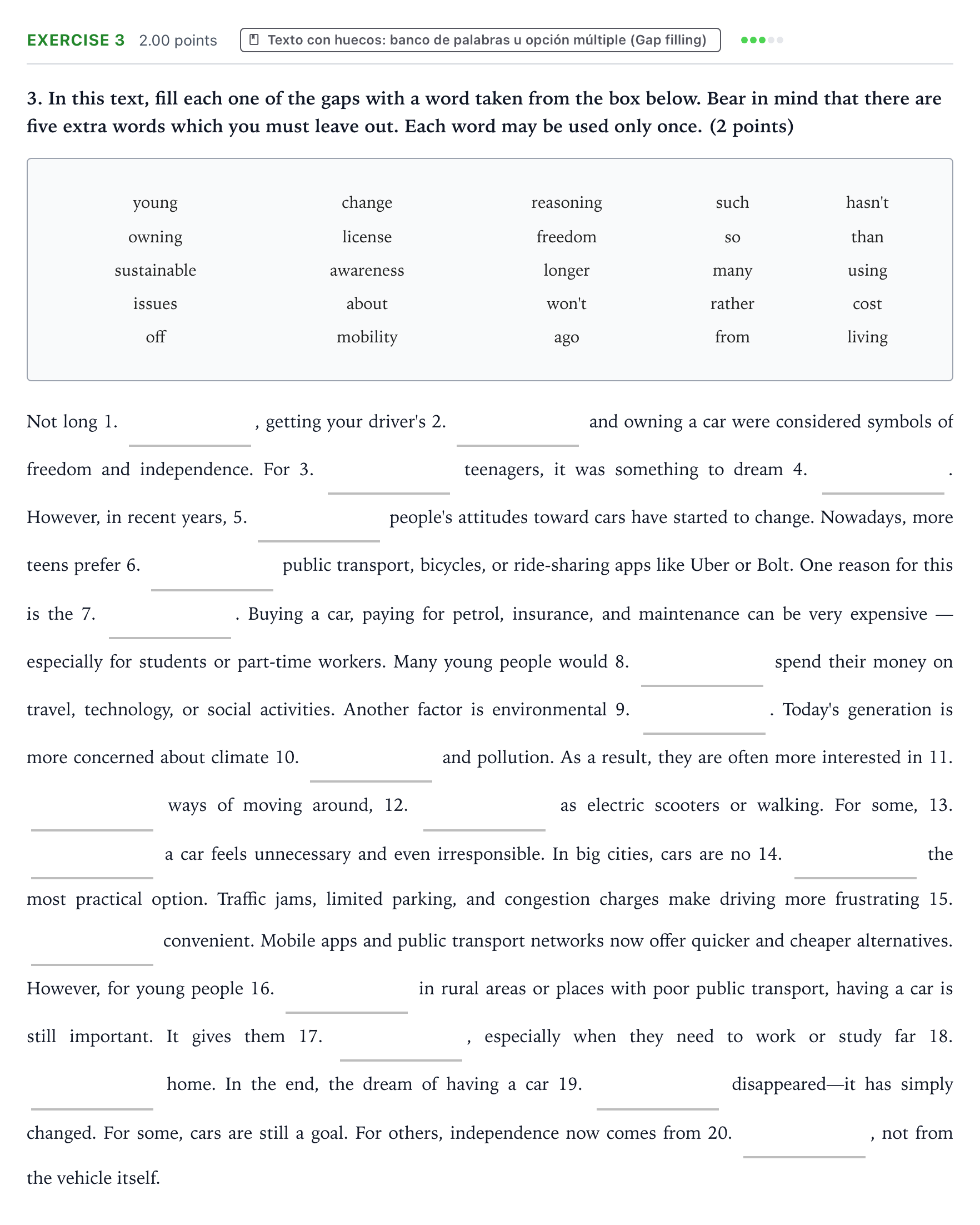
3. In this text, fill each one of the gaps with a word taken from the box below. Bear in mind that there are five extra words which you must leave out. Each word may be used only once. (2 points)
young · change · reasoning · such · hasn't
owning · license · freedom · so · than
sustainable · awareness · longer · many · using
issues · about · won't · rather · cost
off · mobility · ago · from · living
Not long 1., getting your driver's 2. and owning a car were considered symbols of freedom and independence. For 3. teenagers, it was something to dream 4.. However, in recent years, 5. people's attitudes toward cars have started to change. Nowadays, more teens prefer 6. public transport, bicycles, or ride-sharing apps like Uber or Bolt. One reason for this is the 7.. Buying a car, paying for petrol, insurance, and maintenance can be very expensive — especially for students or part-time workers. Many young people would 8. spend their money on travel, technology, or social activities. Another factor is environmental 9.. Today's generation is more concerned about climate 10. and pollution. As a result, they are often more interested in 11. ways of moving around, 12. as electric scooters or walking. For some, 13. a car feels unnecessary and even irresponsible. In big cities, cars are no 14. the most practical option. Traffic jams, limited parking, and congestion charges make driving more frustrating 15. convenient. Mobile apps and public transport networks now offer quicker and cheaper alternatives. However, for young people 16. in rural areas or places with poor public transport, having a car is still important. It gives them 17., especially when they need to work or study far 18. home. In the end, the dream of having a car 19. disappeared—it has simply changed. For some, cars are still a goal. For others, independence now comes from 20., not from the vehicle itself.
Solución
Según los criterios oficiales de corrección
Gap 1: Not long ___, getting your driver's...
Solución: ago
Gap 2: ...getting your driver's ___ and owning a car...
Solución: license
Gap 3: For ___ teenagers, it was something...
Solución: many
Gap 4: ...something to dream ___.
Solución: about
Gap 5: ...in recent years, ___ people's attitudes...
Solución: young
Gap 6: Nowadays, more teens prefer ___ public transport...
Solución: using
Gap 7: One reason for this is the ___.
Solución: cost
Gap 8: Many young people would ___ spend their money...
Solución: rather
Gap 9: Another factor is environmental ___.
Solución: awareness
Gap 10: ...concerned about climate ___ and pollution.
Solución: change
Gap 11: ...more interested in ___ ways of moving around...
Solución: sustainable
Gap 12: ...ways of moving around, ___ as electric scooters...
Solución: such
Gap 13: For some, ___ a car feels unnecessary...
Solución: owning
Gap 14: In big cities, cars are no ___ the most practical option.
Solución: longer
Gap 15: ...make driving more frustrating ___ convenient.
Solución: than
Gap 16: However, for young people ___ in rural areas...
Solución: living
Gap 17: It gives them ___, especially when...
Solución: freedom
Gap 18: ...when they need to work or study far ___ home.
Solución: from
Gap 19: ...the dream of having a car ___ disappeared...
Solución: hasn't
Gap 20: ...independence now comes from ___, not from the vehicle itself.
Solución: mobility
La explicación paso a paso, hecha con IA, es Premium. Premium
Resuélvelo aquí mismo: corrección automática, pistas y solución paso a paso.
‹ Problema 3 · Extraordinaria 2026 · Problema 3 · Ordinaria 2026 ›