Problema 3 · Inglés PAU Galicia Extraordinaria (2ª lengua extranjera) 2025
Tema: Texto con huecos: banco de palabras u opción múltiple (Gap filling) · Del examen Extraordinaria (2ª lengua extranjera) (2025)
Enunciado
3. In this text, fill in the gaps with the most suitable option from the four options given for each gap.
(2.5 points; 0.25 each)
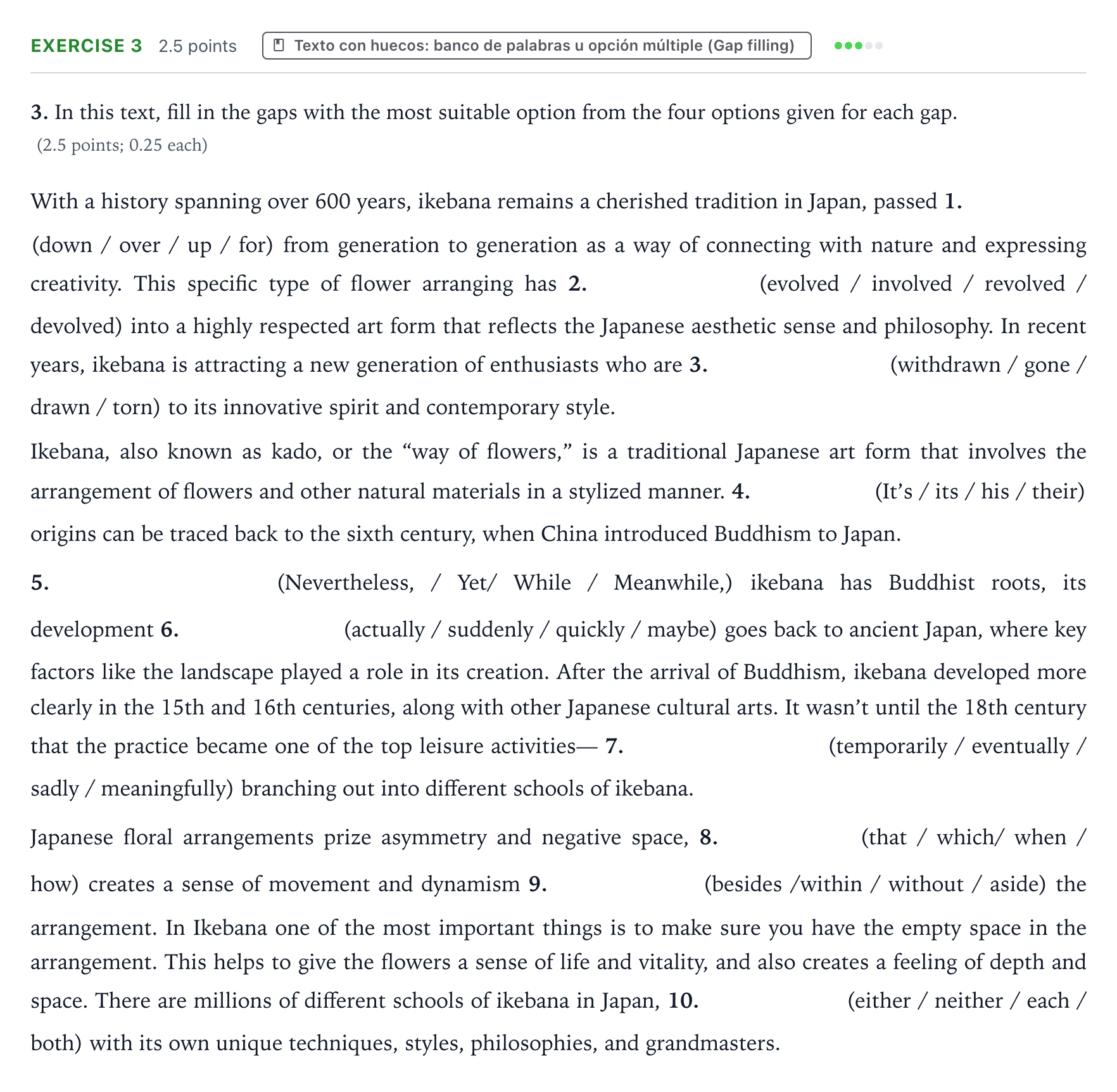
With a history spanning over 600 years, ikebana remains a cherished tradition in Japan, passed
1.
(down / over / up / for) from generation to generation as a way of connecting with nature and expressing creativity. This specific type of flower arranging has
2.
(evolved / involved / revolved / devolved) into a highly respected art form that reflects the Japanese aesthetic sense and philosophy. In recent years, ikebana is attracting a new generation of enthusiasts who are
3.
(withdrawn / gone / drawn / torn) to its innovative spirit and contemporary style.
Ikebana, also known as kado, or the “way of flowers,” is a traditional Japanese art form that involves the arrangement of flowers and other natural materials in a stylized manner.
4.
(It’s / its / his / their) origins can be traced back to the sixth century, when China introduced Buddhism to Japan.
5.
(Nevertheless, / Yet/ While / Meanwhile,) ikebana has Buddhist roots, its development
6.
(actually / suddenly / quickly / maybe) goes back to ancient Japan, where key factors like the landscape played a role in its creation. After the arrival of Buddhism, ikebana developed more clearly in the 15th and 16th centuries, along with other Japanese cultural arts. It wasn’t until the 18th century that the practice became one of the top leisure activities—
7.
(temporarily / eventually / sadly / meaningfully) branching out into different schools of ikebana.
Japanese floral arrangements prize asymmetry and negative space,
8.
(that / which/ when / how) creates a sense of movement and dynamism
9.
(besides /within / without / aside) the arrangement. In Ikebana one of the most important things is to make sure you have the empty space in the arrangement. This helps to give the flowers a sense of life and vitality, and also creates a feeling of depth and space. There are millions of different schools of ikebana in Japan,
10.
(either / neither / each / both) with its own unique techniques, styles, philosophies, and grandmasters.
Solución
Solución de AprenAI (no es la oficial)
1. ...passed ___ (down / over / up / for) from generation to generation...
Solución: down
2. ...flower arranging has ___ (evolved / involved / revolved / devolved) into a highly respected art form...
Solución: evolved
3. ...enthusiasts who are ___ (withdrawn / gone / drawn / torn) to its innovative spirit...
Solución: drawn
4. ___ (It’s / its / his / their) origins can be traced back...
Solución: its
5. ___ (Nevertheless, / Yet/ While / Meanwhile,) ikebana has Buddhist roots, its development...
Solución: While
Las soluciones de los 5 apartados que faltan y la explicación paso a paso son Premium. Premium
Resuélvelo aquí mismo: corrección automática, pistas y solución paso a paso.
‹ Problema 3 · Extraordinaria 2025 · Problema 3 · Ordinaria 2025 ›