Problema 4 · Inglés PAU Castilla y León Ordinaria 2026
Tema: Opción múltiple de comprensión lectora (Multiple choice) · Del examen Ordinaria (2026)
Enunciado
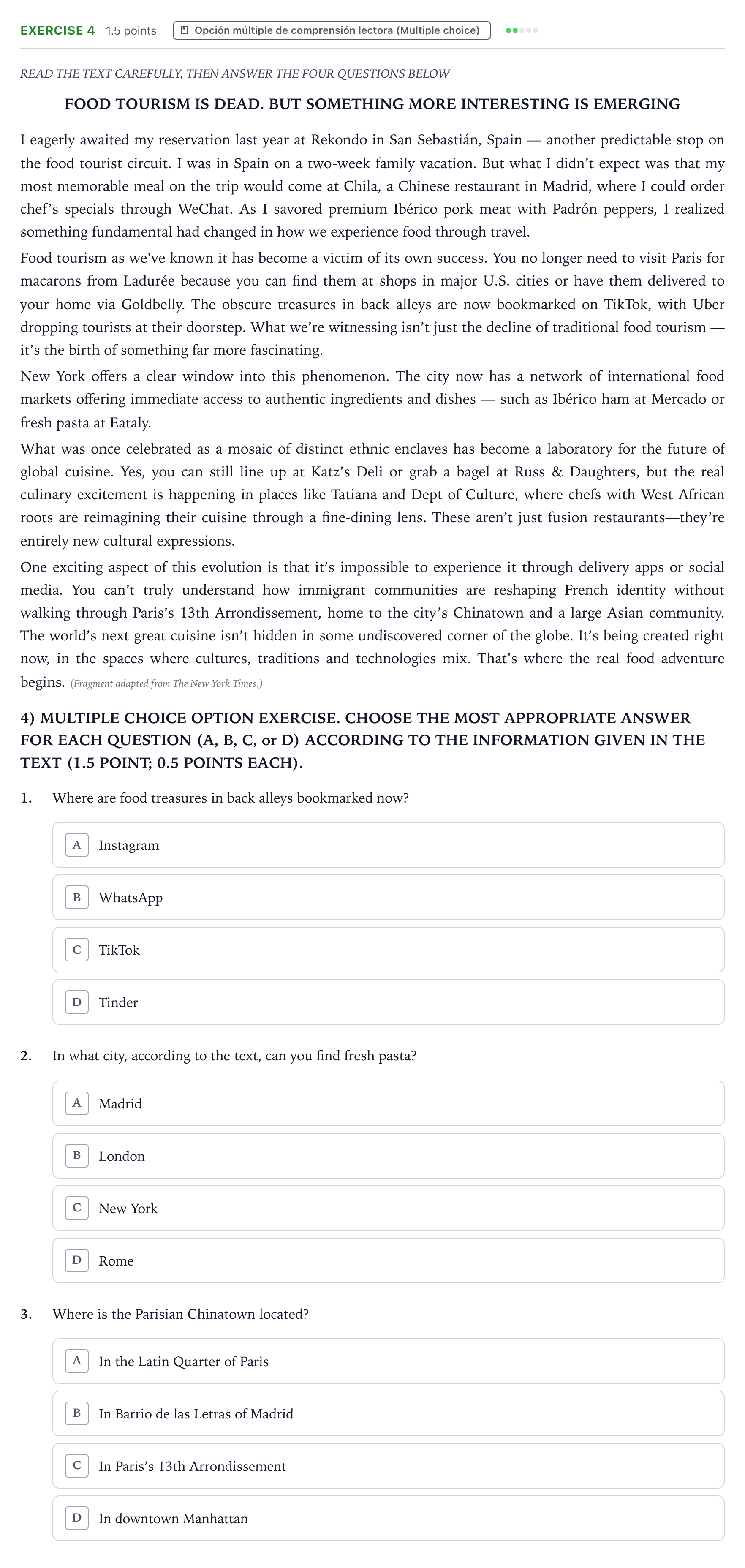
READ THE TEXT CAREFULLY, THEN ANSWER THE FOUR QUESTIONS BELOW
FOOD TOURISM IS DEAD. BUT SOMETHING MORE INTERESTING IS EMERGING
I eagerly awaited my reservation last year at Rekondo in San Sebastián, Spain — another predictable stop on the food tourist circuit. I was in Spain on a two-week family vacation. But what I didn’t expect was that my most memorable meal on the trip would come at Chila, a Chinese restaurant in Madrid, where I could order chef’s specials through WeChat. As I savored premium Ibérico pork meat with Padrón peppers, I realized something fundamental had changed in how we experience food through travel.
Food tourism as we’ve known it has become a victim of its own success. You no longer need to visit Paris for macarons from Ladurée because you can find them at shops in major U.S. cities or have them delivered to your home via Goldbelly. The obscure treasures in back alleys are now bookmarked on TikTok, with Uber dropping tourists at their doorstep. What we’re witnessing isn’t just the decline of traditional food tourism — it’s the birth of something far more fascinating.
New York offers a clear window into this phenomenon. The city now has a network of international food markets offering immediate access to authentic ingredients and dishes — such as Ibérico ham at Mercado or fresh pasta at Eataly.
What was once celebrated as a mosaic of distinct ethnic enclaves has become a laboratory for the future of global cuisine. Yes, you can still line up at Katz’s Deli or grab a bagel at Russ & Daughters, but the real culinary excitement is happening in places like Tatiana and Dept of Culture, where chefs with West African roots are reimagining their cuisine through a fine-dining lens. These aren’t just fusion restaurants—they’re entirely new cultural expressions.
One exciting aspect of this evolution is that it’s impossible to experience it through delivery apps or social media. You can’t truly understand how immigrant communities are reshaping French identity without walking through Paris’s 13th Arrondissement, home to the city’s Chinatown and a large Asian community. The world’s next great cuisine isn’t hidden in some undiscovered corner of the globe. It’s being created right now, in the spaces where cultures, traditions and technologies mix. That’s where the real food adventure begins. (Fragment adapted from The New York Times.)
4) MULTIPLE CHOICE OPTION EXERCISE. CHOOSE THE MOST APPROPRIATE ANSWER FOR EACH QUESTION (A, B, C, or D) ACCORDING TO THE INFORMATION GIVEN IN THE TEXT (1.5 POINT; 0.5 POINTS EACH).
1.
Where are food treasures in back alleys bookmarked now?
2.
In what city, according to the text, can you find fresh pasta?
3.
Where is the Parisian Chinatown located?
Solución
Según los criterios oficiales de corrección
1. Where are food treasures in back alleys bookmarked now?
Solución: C) TikTok
2. In what city, according to the text, can you find fresh pasta?
Solución: C) New York
3. Where is the Parisian Chinatown located?
Solución: C) In Paris’s 13th Arrondissement
La explicación paso a paso, hecha con IA, es Premium. Premium
Resuélvelo aquí mismo: corrección automática, pistas y solución paso a paso.
‹ Problema 4 · Extraordinaria 2026 · Problema 4 · Extraordinaria 2025 ›
Más ejercicios de Opción múltiple de comprensión lectora (Multiple choice)
- Problema 4 · Extraordinaria 2026
- Problema 4 · Extraordinaria 2025
- Problema 4 · Ordinaria 2025
- Opción A - 3 · Extraordinaria 2024
- Opción B - 3 · Extraordinaria 2024
- Opción A - 3 · Extraordinaria (Fase Mejora de Nota) 2024
- Opción B - 3 · Extraordinaria (Fase Mejora de Nota) 2024
- Opción A - 3 · Ordinaria 2024
- Opción B - 3 · Ordinaria 2024
- Opción A - 3 · Ordinaria (Fase Mejora de Nota) 2024