Problema 4 · Inglés PAU Castilla y León Extraordinaria 2025
Tema: Opción múltiple de comprensión lectora (Multiple choice) · Del examen Extraordinaria (2025)
Enunciado
READ THE TEXT CAREFULLY, THEN ANSWER THE FOUR QUESTIONS BELOW
WHAT IS YOUR ‘BIOLOGICAL AGE’?
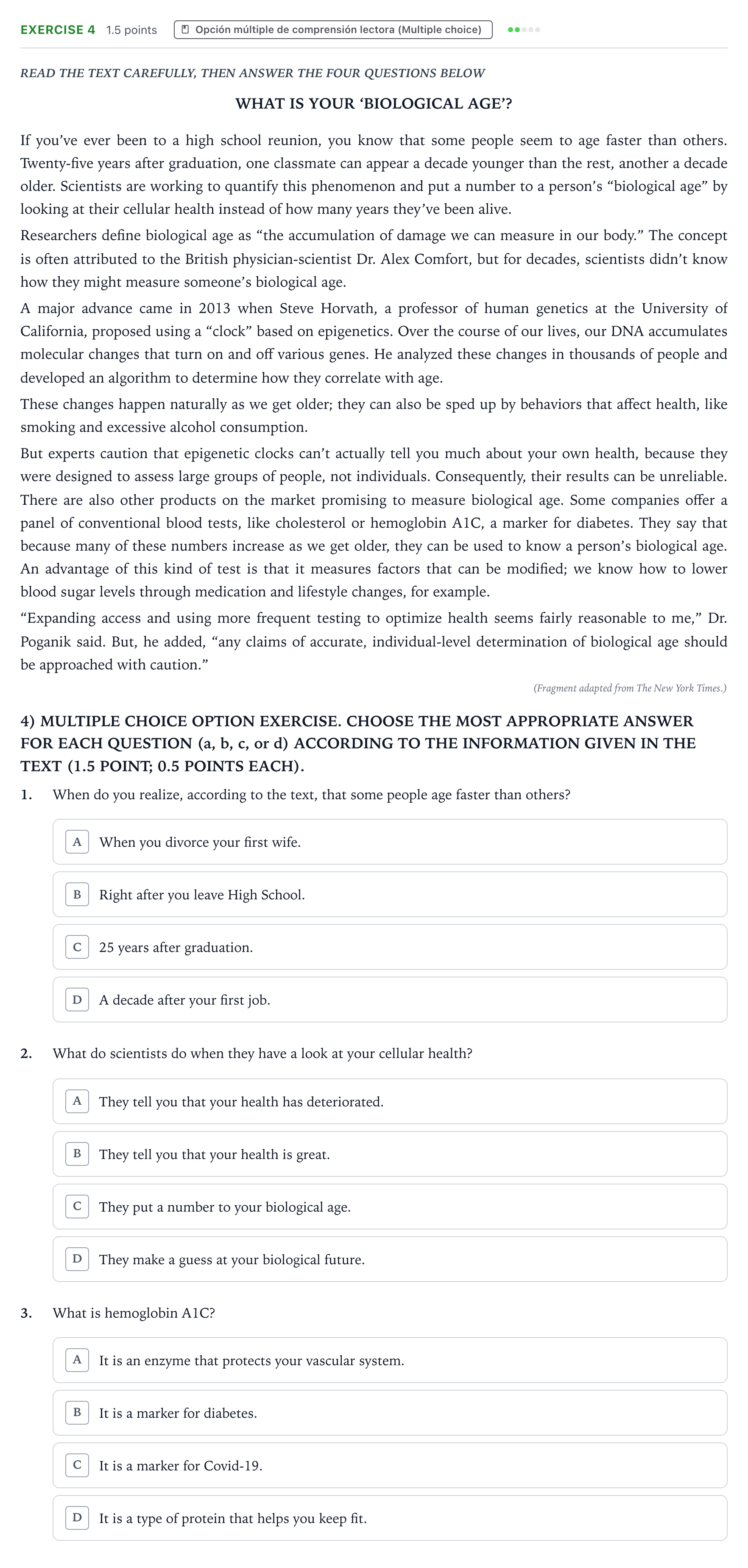
If you’ve ever been to a high school reunion, you know that some people seem to age faster than others. Twenty-five years after graduation, one classmate can appear a decade younger than the rest, another a decade older. Scientists are working to quantify this phenomenon and put a number to a person’s “biological age” by looking at their cellular health instead of how many years they’ve been alive.
Researchers define biological age as “the accumulation of damage we can measure in our body.” The concept is often attributed to the British physician-scientist Dr. Alex Comfort, but for decades, scientists didn’t know how they might measure someone’s biological age.
A major advance came in 2013 when Steve Horvath, a professor of human genetics at the University of California, proposed using a “clock” based on epigenetics. Over the course of our lives, our DNA accumulates molecular changes that turn on and off various genes. He analyzed these changes in thousands of people and developed an algorithm to determine how they correlate with age.
These changes happen naturally as we get older; they can also be sped up by behaviors that affect health, like smoking and excessive alcohol consumption.
But experts caution that epigenetic clocks can’t actually tell you much about your own health, because they were designed to assess large groups of people, not individuals. Consequently, their results can be unreliable. There are also other products on the market promising to measure biological age. Some companies offer a panel of conventional blood tests, like cholesterol or hemoglobin A1C, a marker for diabetes. They say that because many of these numbers increase as we get older, they can be used to know a person’s biological age. An advantage of this kind of test is that it measures factors that can be modified; we know how to lower blood sugar levels through medication and lifestyle changes, for example.
“Expanding access and using more frequent testing to optimize health seems fairly reasonable to me,” Dr. Poganik said. But, he added, “any claims of accurate, individual-level determination of biological age should be approached with caution.”
(Fragment adapted from The New York Times.)
4) MULTIPLE CHOICE OPTION EXERCISE. CHOOSE THE MOST APPROPRIATE ANSWER FOR EACH QUESTION (a, b, c, or d) ACCORDING TO THE INFORMATION GIVEN IN THE TEXT (1.5 POINT; 0.5 POINTS EACH).
1.
When do you realize, according to the text, that some people age faster than others?
2.
What do scientists do when they have a look at your cellular health?
3.
What is hemoglobin A1C?
Solución
Según los criterios oficiales de corrección
1. When do you realize, according to the text, that some people age faster than others?
Solución: C) 25 years after graduation.
2. What do scientists do when they have a look at your cellular health?
Solución: C) They put a number to your biological age.
3. What is hemoglobin A1C?
Solución: B) It is a marker for diabetes.
La explicación paso a paso, hecha con IA, es Premium. Premium
Resuélvelo aquí mismo: corrección automática, pistas y solución paso a paso.
‹ Problema 4 · Ordinaria 2026 · Problema 4 · Ordinaria 2025 ›
Más ejercicios de Opción múltiple de comprensión lectora (Multiple choice)
- Problema 4 · Extraordinaria 2026
- Problema 4 · Ordinaria 2026
- Problema 4 · Ordinaria 2025
- Opción A - 3 · Extraordinaria 2024
- Opción B - 3 · Extraordinaria 2024
- Opción A - 3 · Extraordinaria (Fase Mejora de Nota) 2024
- Opción B - 3 · Extraordinaria (Fase Mejora de Nota) 2024
- Opción A - 3 · Ordinaria 2024
- Opción B - 3 · Ordinaria 2024
- Opción A - 3 · Ordinaria (Fase Mejora de Nota) 2024