Problema 2 · Inglés PAU Canarias Junio (Humanidades) 2026
Tema: Reading comprehension: short questions answered by quoting the text · Del examen Junio (Humanidades) (2026)
Enunciado
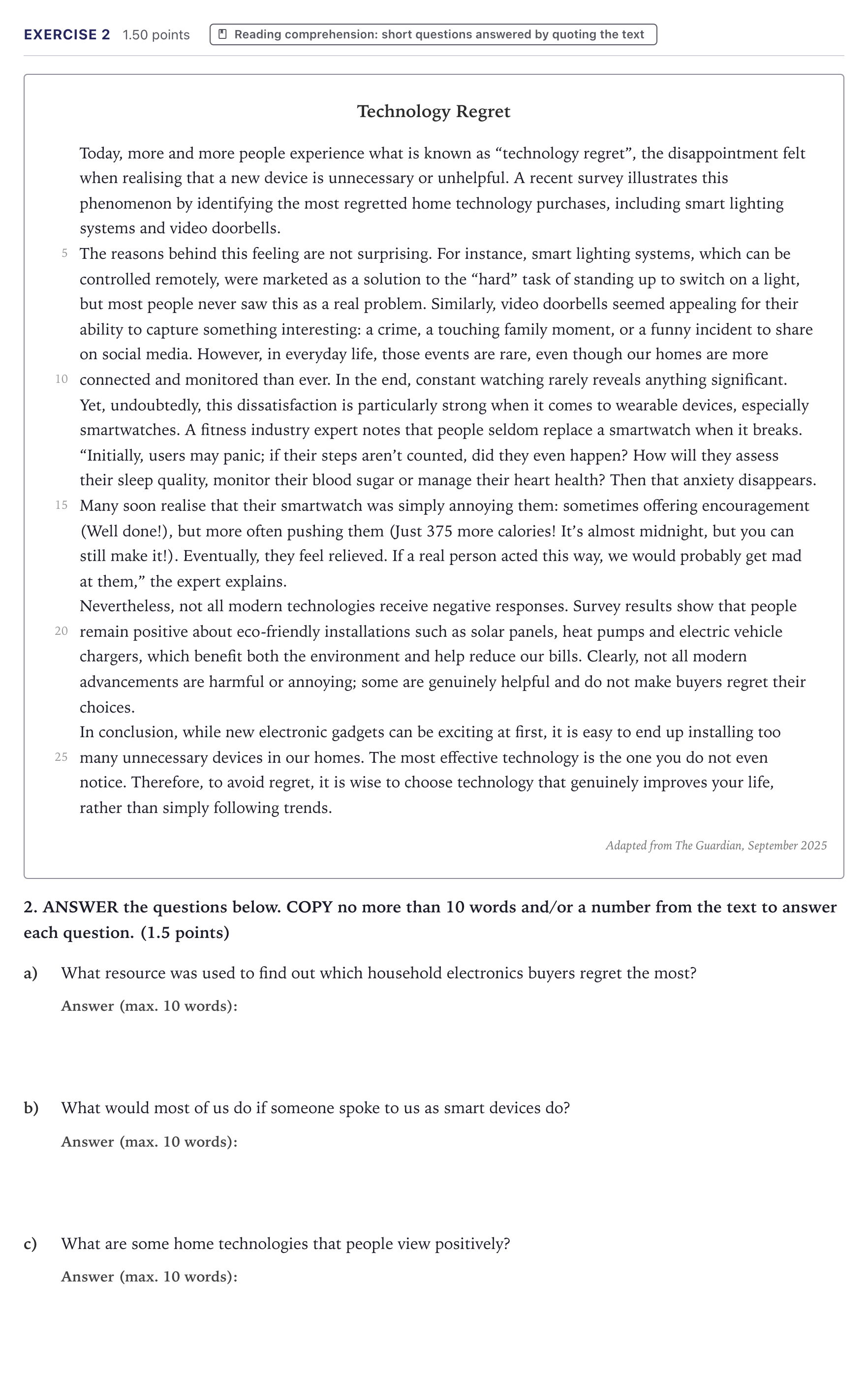
Technology Regret
Today, more and more people experience what is known as “technology regret”, the disappointment felt
when realising that a new device is unnecessary or unhelpful. A recent survey illustrates this
phenomenon by identifying the most regretted home technology purchases, including smart lighting
systems and video doorbells.
5 The reasons behind this feeling are not surprising. For instance, smart lighting systems, which can be
controlled remotely, were marketed as a solution to the “hard” task of standing up to switch on a light,
but most people never saw this as a real problem. Similarly, video doorbells seemed appealing for their
ability to capture something interesting: a crime, a touching family moment, or a funny incident to share
on social media. However, in everyday life, those events are rare, even though our homes are more
10 connected and monitored than ever. In the end, constant watching rarely reveals anything significant.
Yet, undoubtedly, this dissatisfaction is particularly strong when it comes to wearable devices, especially
smartwatches. A fitness industry expert notes that people seldom replace a smartwatch when it breaks.
“Initially, users may panic; if their steps aren’t counted, did they even happen? How will they assess
their sleep quality, monitor their blood sugar or manage their heart health? Then that anxiety disappears.
15 Many soon realise that their smartwatch was simply annoying them: sometimes offering encouragement
(Well done!), but more often pushing them (Just 375 more calories! It’s almost midnight, but you can
still make it!). Eventually, they feel relieved. If a real person acted this way, we would probably get mad
at them,” the expert explains.
Nevertheless, not all modern technologies receive negative responses. Survey results show that people
20 remain positive about eco-friendly installations such as solar panels, heat pumps and electric vehicle
chargers, which benefit both the environment and help reduce our bills. Clearly, not all modern
advancements are harmful or annoying; some are genuinely helpful and do not make buyers regret their
choices.
In conclusion, while new electronic gadgets can be exciting at first, it is easy to end up installing too
25 many unnecessary devices in our homes. The most effective technology is the one you do not even
notice. Therefore, to avoid regret, it is wise to choose technology that genuinely improves your life,
rather than simply following trends.
Adapted from The Guardian, September 2025
2. ANSWER the questions below. COPY no more than 10 words and/or a number from the text to answer each question. (1.5 points)
a)
What resource was used to find out which household electronics buyers regret the most?
b)
What would most of us do if someone spoke to us as smart devices do?
c)
What are some home technologies that people view positively?
Solución
Según los criterios oficiales de corrección
a) What resource was used to find out which household electronics buyers regret the most?
Solución: (A) recent survey
b) What would most of us do if someone spoke to us as smart devices do?
Solución: (We would) probably get mad at them
c) What are some home technologies that people view positively?
Solución: Solar panels, heat pumps and electric vehicle chargers / eco-friendly installations
La explicación paso a paso, hecha con IA, es Premium. Premium
Resuélvelo aquí mismo: corrección automática, pistas y solución paso a paso.
‹ Problema 2 · Junio (Ciencias) 2026 · Problema 2 · Julio 2025 ›
Más ejercicios de Reading comprehension: short questions answered by quoting the text
- Problema 2 · Julio 2026
- Problema 2 · Julio (Reserva) 2026
- Problema 2 · Junio (Ciencias) 2026
- Problema 2 · Julio 2025
- Problema 2 · Julio (Reserva) 2025
- Problema 2 · Junio (Ciencias) 2025
- Problema 2 · Junio (Humanidades) 2025
- Ejercicio Grupo A - 2 · Julio 2024
- Ejercicio Grupo B - 2 · Julio 2024
- Ejercicio Grupo A - 2 · Junio (Ciencias) 2024