Problema 2 · Inglés PAU Canarias Junio (Ciencias) 2026
Tema: Reading comprehension: short questions answered by quoting the text · Del examen Junio (Ciencias) (2026)
Enunciado
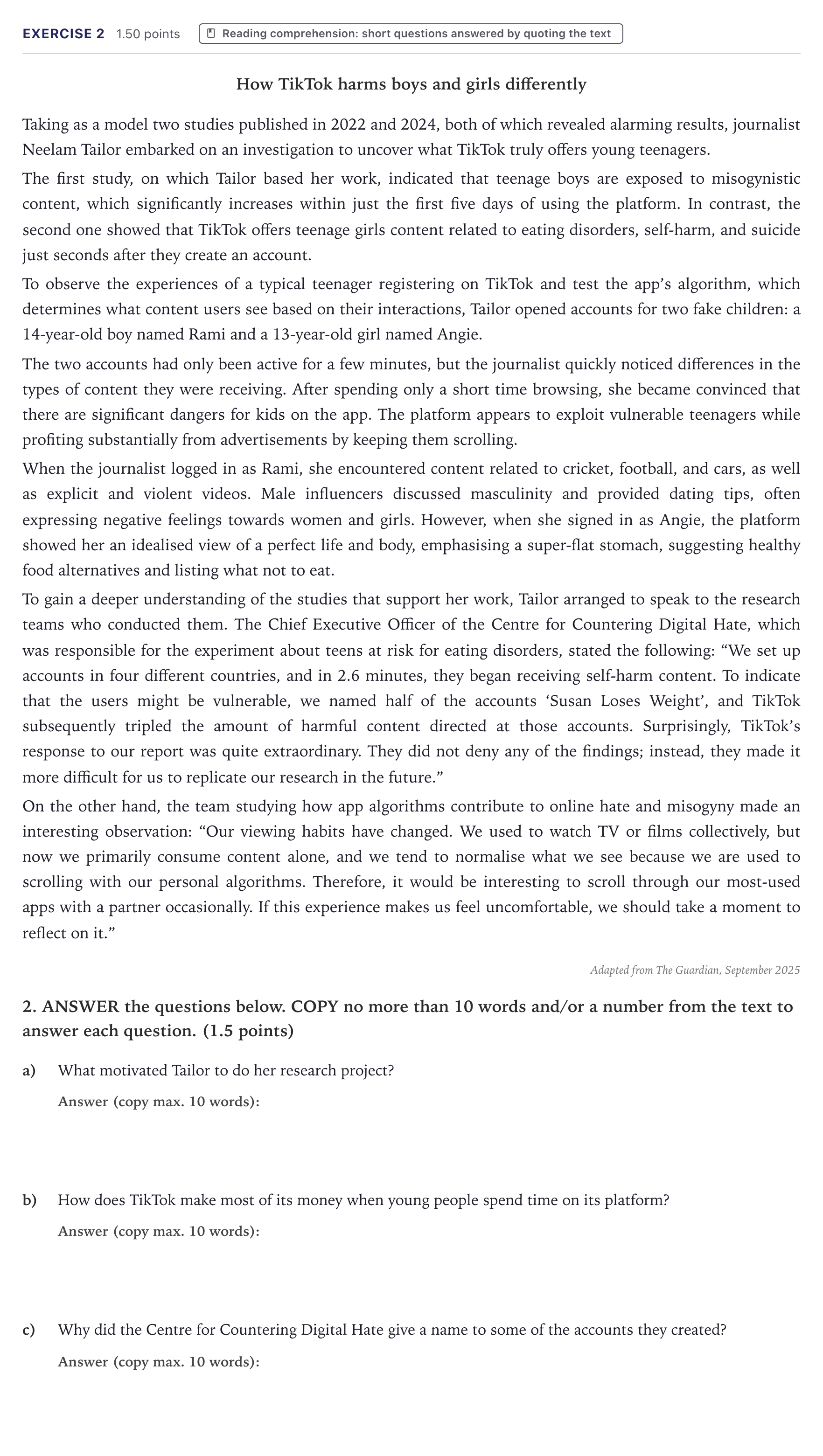
How TikTok harms boys and girls differently
Taking as a model two studies published in 2022 and 2024, both of which revealed alarming results, journalist Neelam Tailor embarked on an investigation to uncover what TikTok truly offers young teenagers.
The first study, on which Tailor based her work, indicated that teenage boys are exposed to misogynistic content, which significantly increases within just the first five days of using the platform. In contrast, the second one showed that TikTok offers teenage girls content related to eating disorders, self-harm, and suicide just seconds after they create an account.
To observe the experiences of a typical teenager registering on TikTok and test the app’s algorithm, which determines what content users see based on their interactions, Tailor opened accounts for two fake children: a 14-year-old boy named Rami and a 13-year-old girl named Angie.
The two accounts had only been active for a few minutes, but the journalist quickly noticed differences in the types of content they were receiving. After spending only a short time browsing, she became convinced that there are significant dangers for kids on the app. The platform appears to exploit vulnerable teenagers while profiting substantially from advertisements by keeping them scrolling.
When the journalist logged in as Rami, she encountered content related to cricket, football, and cars, as well as explicit and violent videos. Male influencers discussed masculinity and provided dating tips, often expressing negative feelings towards women and girls. However, when she signed in as Angie, the platform showed her an idealised view of a perfect life and body, emphasising a super-flat stomach, suggesting healthy food alternatives and listing what not to eat.
To gain a deeper understanding of the studies that support her work, Tailor arranged to speak to the research teams who conducted them. The Chief Executive Officer of the Centre for Countering Digital Hate, which was responsible for the experiment about teens at risk for eating disorders, stated the following: “We set up accounts in four different countries, and in 2.6 minutes, they began receiving self-harm content. To indicate that the users might be vulnerable, we named half of the accounts ‘Susan Loses Weight’, and TikTok subsequently tripled the amount of harmful content directed at those accounts. Surprisingly, TikTok’s response to our report was quite extraordinary. They did not deny any of the findings; instead, they made it more difficult for us to replicate our research in the future.”
On the other hand, the team studying how app algorithms contribute to online hate and misogyny made an interesting observation: “Our viewing habits have changed. We used to watch TV or films collectively, but now we primarily consume content alone, and we tend to normalise what we see because we are used to scrolling with our personal algorithms. Therefore, it would be interesting to scroll through our most-used apps with a partner occasionally. If this experience makes us feel uncomfortable, we should take a moment to reflect on it.”
Adapted from The Guardian, September 2025
2. ANSWER the questions below. COPY no more than 10 words and/or a number from the text to answer each question. (1.5 points)
a)
What motivated Tailor to do her research project?
b)
How does TikTok make most of its money when young people spend time on its platform?
c)
Why did the Centre for Countering Digital Hate give a name to some of the accounts they created?
Solución
Según los criterios oficiales de corrección
a) What motivated Tailor to do her research project?
Solución: two studies published in 2022 and 2024 / (Taking as a model) two studies published in 2022 and 2024
b) How does TikTok make most of its money when young people spend time on its platform?
Solución: (from) advertisements by keeping them scrolling / profiting substantially from advertisements by keeping them scrolling
c) Why did the Centre for Countering Digital Hate give a name to some of the accounts they created?
Solución: To indicate that the users might be vulnerable
La explicación paso a paso, hecha con IA, es Premium. Premium
Resuélvelo aquí mismo: corrección automática, pistas y solución paso a paso.
‹ Problema 2 · Julio (Reserva) 2026 · Problema 2 · Junio (Humanidades) 2026 ›
Más ejercicios de Reading comprehension: short questions answered by quoting the text
- Problema 2 · Julio 2026
- Problema 2 · Julio (Reserva) 2026
- Problema 2 · Junio (Humanidades) 2026
- Problema 2 · Julio 2025
- Problema 2 · Julio (Reserva) 2025
- Problema 2 · Junio (Ciencias) 2025
- Problema 2 · Junio (Humanidades) 2025
- Ejercicio Grupo A - 2 · Julio 2024
- Ejercicio Grupo B - 2 · Julio 2024
- Ejercicio Grupo A - 2 · Junio (Ciencias) 2024