Ejercicio Texto 2 - Cuestión 5 · Inglés PAU Asturias Ordinaria (2ª lengua extranjera) 2024
Tema: Texto con huecos: una palabra por hueco (Fill the gaps) · Del examen Ordinaria (2ª lengua extranjera) (2024)
Enunciado
Texto 2
Leaving home
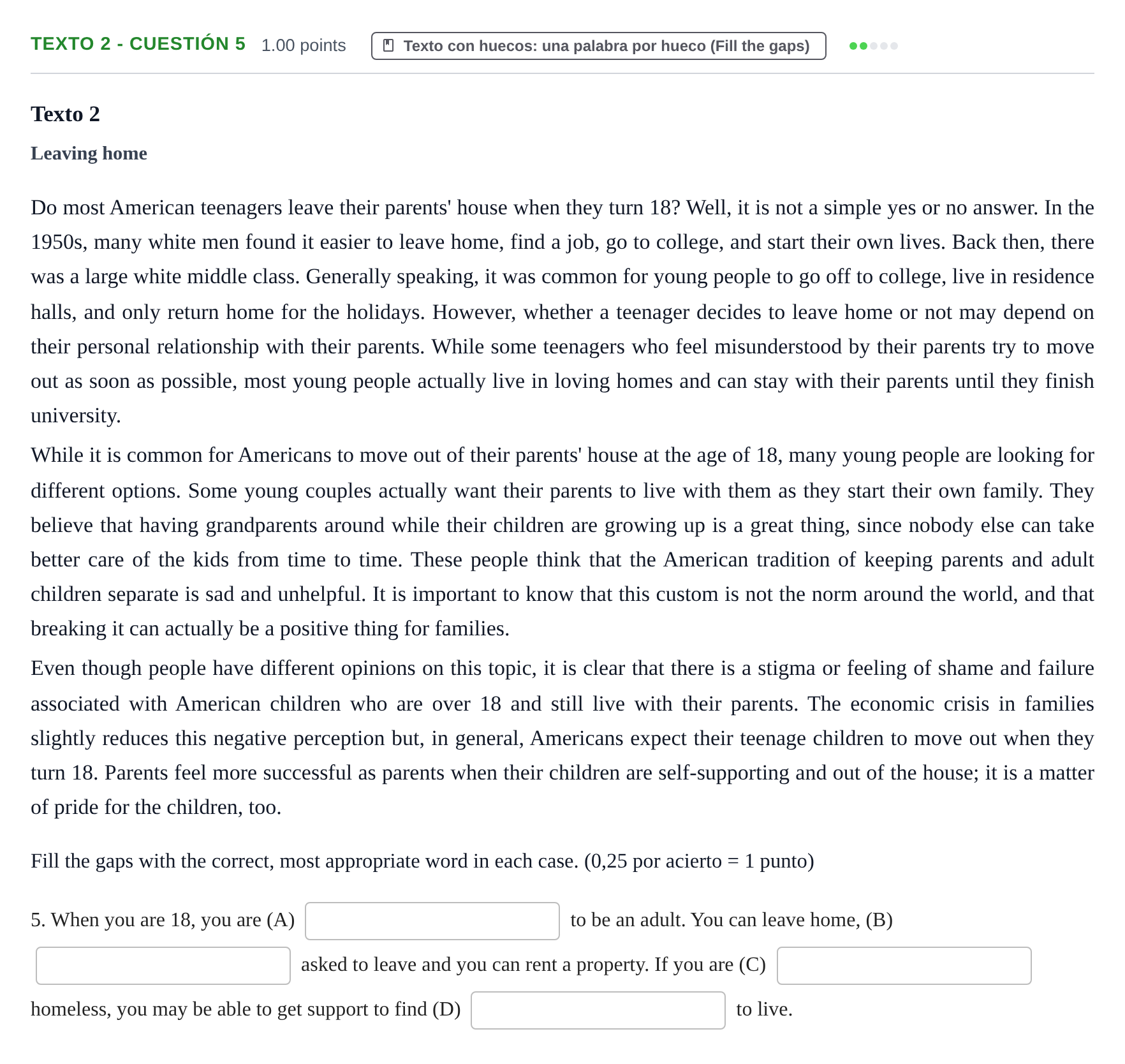
Do most American teenagers leave their parents' house when they turn 18? Well, it is not a simple yes or no answer. In the 1950s, many white men found it easier to leave home, find a job, go to college, and start their own lives. Back then, there was a large white middle class. Generally speaking, it was common for young people to go off to college, live in residence halls, and only return home for the holidays. However, whether a teenager decides to leave home or not may depend on their personal relationship with their parents. While some teenagers who feel misunderstood by their parents try to move out as soon as possible, most young people actually live in loving homes and can stay with their parents until they finish university.
While it is common for Americans to move out of their parents' house at the age of 18, many young people are looking for different options. Some young couples actually want their parents to live with them as they start their own family. They believe that having grandparents around while their children are growing up is a great thing, since nobody else can take better care of the kids from time to time. These people think that the American tradition of keeping parents and adult children separate is sad and unhelpful. It is important to know that this custom is not the norm around the world, and that breaking it can actually be a positive thing for families.
Even though people have different opinions on this topic, it is clear that there is a stigma or feeling of shame and failure associated with American children who are over 18 and still live with their parents. The economic crisis in families slightly reduces this negative perception but, in general, Americans expect their teenage children to move out when they turn 18. Parents feel more successful as parents when their children are self-supporting and out of the house; it is a matter of pride for the children, too.
Fill the gaps with the correct, most appropriate word in each case. (0,25 por acierto = 1 punto)
5. When you are 18, you are (A)
to be an adult. You can leave home, (B)
asked to leave and you can rent a property. If you are (C)
homeless, you may be able to get support to find (D)
to live.
Solución
Según los criterios oficiales de corrección
Hueco (A): When you are 18, you are (A) _____ to be an adult.
Solución: considered / regarded
Hueco (B): You can leave home, (B) _____ asked to leave and you can rent a property.
Solución: be
Hueco (C): If you are (C) _____ homeless, you may be able to get support...
Solución: made
Hueco (D): ...to find (D) _____ to live.
Solución: somewhere
La explicación paso a paso, hecha con IA, es Premium. Premium
Resuélvelo aquí mismo: corrección automática, pistas y solución paso a paso.
‹ Ejercicio Texto 1 - Cuestión 5 · Ordinaria (2ª lengua extranjera) 2024 · Ejercicio Texto 1 - Cuestión 5 · Extraordinaria 2023 ›
Más ejercicios de Texto con huecos: una palabra por hueco (Fill the gaps)
- Ejercicio Texto 1 - Cuestión 5 · Extraordinaria (2ª lengua extranjera) 2024
- Ejercicio Texto 2 - Cuestión 5 · Extraordinaria (2ª lengua extranjera) 2024
- Ejercicio Texto 1 - Cuestión 5 · Ordinaria 2024
- Ejercicio Texto 2 - Cuestión 5 · Ordinaria 2024
- Ejercicio Texto 1 - Cuestión 5 · Ordinaria (2ª lengua extranjera) 2024
- Ejercicio Texto 1 - Cuestión 5 · Extraordinaria 2023
- Ejercicio Texto 2 - Cuestión 5 · Extraordinaria 2023
- Ejercicio Texto 1 - Cuestión 5 · Extraordinaria (2ª lengua extranjera) 2023
- Ejercicio Texto 2 - Cuestión 5 · Extraordinaria (2ª lengua extranjera) 2023
- Ejercicio Texto 1 - Cuestión 5 · Ordinaria 2023