Ejercicio Texto 2 - Cuestión 5 · Inglés PAU Asturias Extraordinaria (2ª lengua extranjera) 2023
Tema: Texto con huecos: una palabra por hueco (Fill the gaps) · Del examen Extraordinaria (2ª lengua extranjera) (2023)
Enunciado
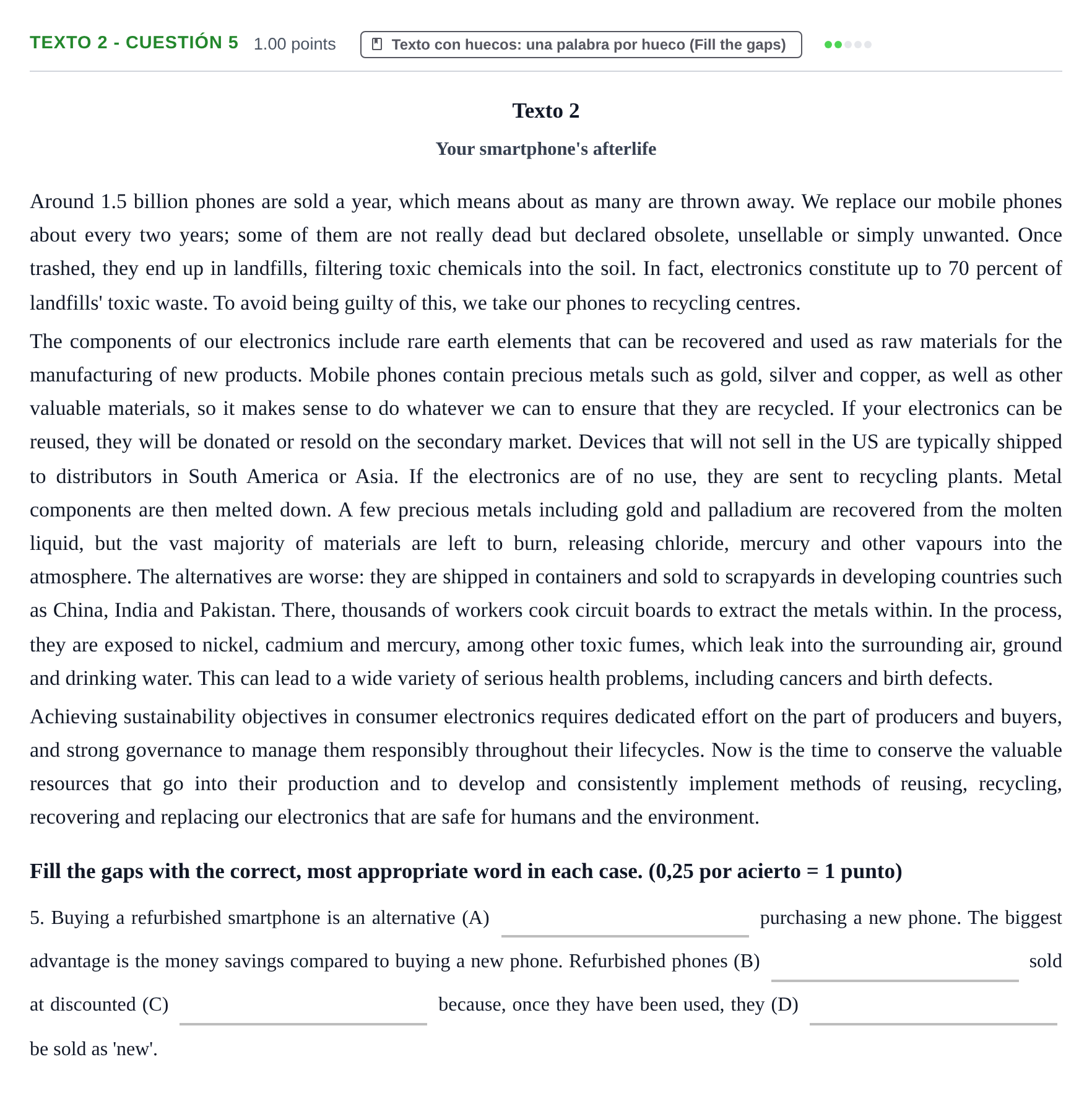
Texto 2
Your smartphone's afterlife
Around 1.5 billion phones are sold a year, which means about as many are thrown away. We replace our mobile phones about every two years; some of them are not really dead but declared obsolete, unsellable or simply unwanted. Once trashed, they end up in landfills, filtering toxic chemicals into the soil. In fact, electronics constitute up to 70 percent of landfills' toxic waste. To avoid being guilty of this, we take our phones to recycling centres.
The components of our electronics include rare earth elements that can be recovered and used as raw materials for the manufacturing of new products. Mobile phones contain precious metals such as gold, silver and copper, as well as other valuable materials, so it makes sense to do whatever we can to ensure that they are recycled. If your electronics can be reused, they will be donated or resold on the secondary market. Devices that will not sell in the US are typically shipped to distributors in South America or Asia. If the electronics are of no use, they are sent to recycling plants. Metal components are then melted down. A few precious metals including gold and palladium are recovered from the molten liquid, but the vast majority of materials are left to burn, releasing chloride, mercury and other vapours into the atmosphere. The alternatives are worse: they are shipped in containers and sold to scrapyards in developing countries such as China, India and Pakistan. There, thousands of workers cook circuit boards to extract the metals within. In the process, they are exposed to nickel, cadmium and mercury, among other toxic fumes, which leak into the surrounding air, ground and drinking water. This can lead to a wide variety of serious health problems, including cancers and birth defects.
Achieving sustainability objectives in consumer electronics requires dedicated effort on the part of producers and buyers, and strong governance to manage them responsibly throughout their lifecycles. Now is the time to conserve the valuable resources that go into their production and to develop and consistently implement methods of reusing, recycling, recovering and replacing our electronics that are safe for humans and the environment.
Fill the gaps with the correct, most appropriate word in each case. (0,25 por acierto = 1 punto)
5. Buying a refurbished smartphone is an alternative (A)
purchasing a new phone. The biggest advantage is the money savings compared to buying a new phone. Refurbished phones (B)
sold at discounted (C)
because, once they have been used, they (D)
be sold as 'new'.
Solución
Según los criterios oficiales de corrección
Gap (A): an alternative (A) purchasing a new phone
Solución: to
Gap (B): Refurbished phones (B) sold at
Solución: are
Gap (C): discounted (C) because
Solución: prices / rates
Gap (D): they (D) be sold as 'new'
Solución: cannot / can't
La explicación paso a paso, hecha con IA, es Premium. Premium
Resuélvelo aquí mismo: corrección automática, pistas y solución paso a paso.
‹ Ejercicio Texto 1 - Cuestión 5 · Extraordinaria (2ª lengua extranjera) 2023 · Ejercicio Texto 1 - Cuestión 5 · Ordinaria 2023 ›
Más ejercicios de Texto con huecos: una palabra por hueco (Fill the gaps)
- Ejercicio Texto 1 - Cuestión 5 · Ordinaria (2ª lengua extranjera) 2024
- Ejercicio Texto 2 - Cuestión 5 · Ordinaria (2ª lengua extranjera) 2024
- Ejercicio Texto 1 - Cuestión 5 · Extraordinaria 2023
- Ejercicio Texto 2 - Cuestión 5 · Extraordinaria 2023
- Ejercicio Texto 1 - Cuestión 5 · Extraordinaria (2ª lengua extranjera) 2023
- Ejercicio Texto 1 - Cuestión 5 · Ordinaria 2023
- Ejercicio Texto 2 - Cuestión 5 · Ordinaria 2023
- Ejercicio Texto 1 - Cuestión 5 · Ordinaria (2ª lengua extranjera) 2023
- Ejercicio Texto 2 - Cuestión 5 · Ordinaria (2ª lengua extranjera) 2023
- Ejercicio Texto A - 5 · Extraordinaria 2022