Ejercicio Texto 2 - Cuestiones 1 a 4 · Inglés PAU Asturias Ordinaria (2ª lengua extranjera) 2023
Tema: Preguntas de comprensión con tus propias palabras (Questions on the text) · Del examen Ordinaria (2ª lengua extranjera) (2023)
Enunciado
Texto 2
Everyday life in times of COVID-19
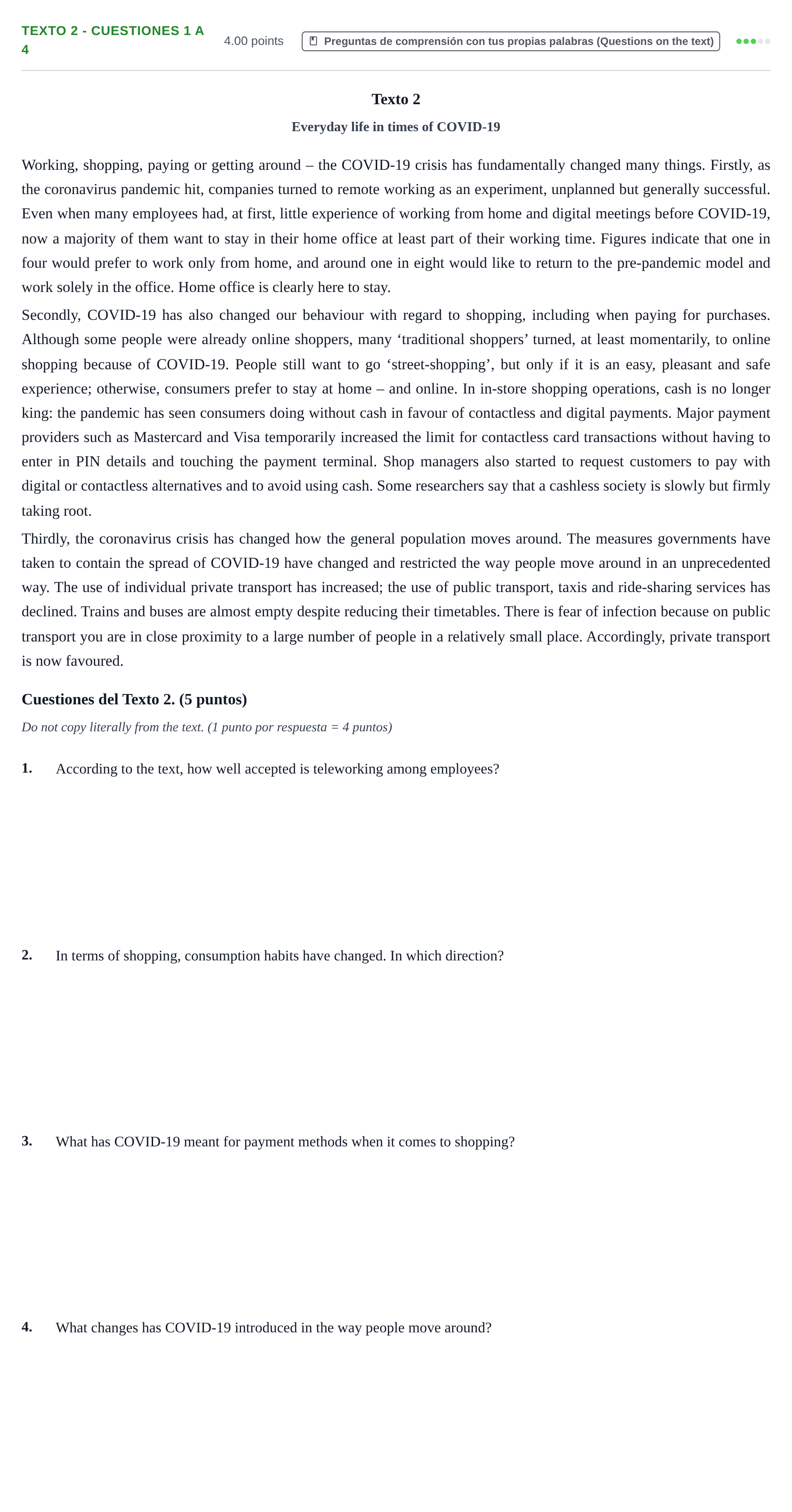
Working, shopping, paying or getting around – the COVID-19 crisis has fundamentally changed many things. Firstly, as the coronavirus pandemic hit, companies turned to remote working as an experiment, unplanned but generally successful. Even when many employees had, at first, little experience of working from home and digital meetings before COVID-19, now a majority of them want to stay in their home office at least part of their working time. Figures indicate that one in four would prefer to work only from home, and around one in eight would like to return to the pre-pandemic model and work solely in the office. Home office is clearly here to stay.
Secondly, COVID-19 has also changed our behaviour with regard to shopping, including when paying for purchases. Although some people were already online shoppers, many ‘traditional shoppers’ turned, at least momentarily, to online shopping because of COVID-19. People still want to go ‘street-shopping’, but only if it is an easy, pleasant and safe experience; otherwise, consumers prefer to stay at home – and online. In in-store shopping operations, cash is no longer king: the pandemic has seen consumers doing without cash in favour of contactless and digital payments. Major payment providers such as Mastercard and Visa temporarily increased the limit for contactless card transactions without having to enter in PIN details and touching the payment terminal. Shop managers also started to request customers to pay with digital or contactless alternatives and to avoid using cash. Some researchers say that a cashless society is slowly but firmly taking root.
Thirdly, the coronavirus crisis has changed how the general population moves around. The measures governments have taken to contain the spread of COVID-19 have changed and restricted the way people move around in an unprecedented way. The use of individual private transport has increased; the use of public transport, taxis and ride-sharing services has declined. Trains and buses are almost empty despite reducing their timetables. There is fear of infection because on public transport you are in close proximity to a large number of people in a relatively small place. Accordingly, private transport is now favoured.
Cuestiones del Texto 2. (5 puntos)
Do not copy literally from the text. (1 punto por respuesta = 4 puntos)
1.
According to the text, how well accepted is teleworking among employees?
2.
In terms of shopping, consumption habits have changed. In which direction?
3.
What has COVID-19 meant for payment methods when it comes to shopping?
4.
What changes has COVID-19 introduced in the way people move around?
Solución
Según los criterios oficiales de corrección
1. According to the text, how well accepted is teleworking among employees?
Solución: Even though it was an experiment that was not planned, and workers did not have much experience of working from home and meeting remotely, teleworking was well received by workers. Nowadays, 25 % of them prefer working exclusively from home, whereas half of that amount (12,5 %) would like to return to the office for work.
2. In terms of shopping, consumption habits have changed. In which direction?
Solución: Many traditional shoppers have, at least for the time being, switched to e-commerce, especially if street-shopping does not guarantee a convenient, pleasing and safe experience. They prefer to stay at home and shop online.
3. What has COVID-19 meant for payment methods when it comes to shopping?
Solución: At the time of payment of purchases, whether made online or in physical shops, the most commonly-used payment method is the contactless, digital alternative (which is even encouraged by shop owners), avoiding cash altogether. Companies such as Mastercard and Visa have made it easier for shoppers to use this contactless payment method.
4. What changes has COVID-19 introduced in the way people move around?
Solución: COVID-19 has meant that individual private transport has become more common and not so much public transport (trains, buses, taxis) or ride-sharing services. Travelling with a lot of people in a small space increases the fear of infection, which is why private transport is encouraged.
La explicación paso a paso, hecha con IA, es Premium. Premium
Resuélvelo aquí mismo: corrección automática, pistas y solución paso a paso.
‹ Ejercicio Texto 1 - Cuestiones 1 a 4 · Ordinaria (2ª lengua extranjera) 2023 · Ejercicio Texto A - Preguntas 1-4 · Extraordinaria 2022 ›
Más ejercicios de Preguntas de comprensión con tus propias palabras (Questions on the text)
- Ejercicio Texto 1 - Cuestiones 1-4 · Extraordinaria (2ª lengua extranjera) 2023
- Ejercicio Texto 2 - Cuestiones 1-4 · Extraordinaria (2ª lengua extranjera) 2023
- Ejercicio Texto 1 - Cuestiones 1-4 · Ordinaria 2023
- Ejercicio Texto 2 - Cuestiones 1-4 · Ordinaria 2023
- Ejercicio Texto 1 - Cuestiones 1 a 4 · Ordinaria (2ª lengua extranjera) 2023
- Ejercicio Texto A - Preguntas 1-4 · Extraordinaria 2022
- Ejercicio Texto B - Preguntas 1-4 · Extraordinaria 2022
- Ejercicio TEXTO A - Questions 1-4 · Extraordinaria (2ª lengua extranjera) 2022
- Ejercicio TEXTO B - Questions 1-4 · Extraordinaria (2ª lengua extranjera) 2022
- Ejercicio Texto A - Questions 1-4 · Ordinaria 2022