Question 10 · Complements de química URV Exam Bridging Courses in Chemistry
Tema: Sólidos, energía reticular y fuerzas intermoleculares · Del examen Exam Bridging Courses in Chemistry
Enunciado
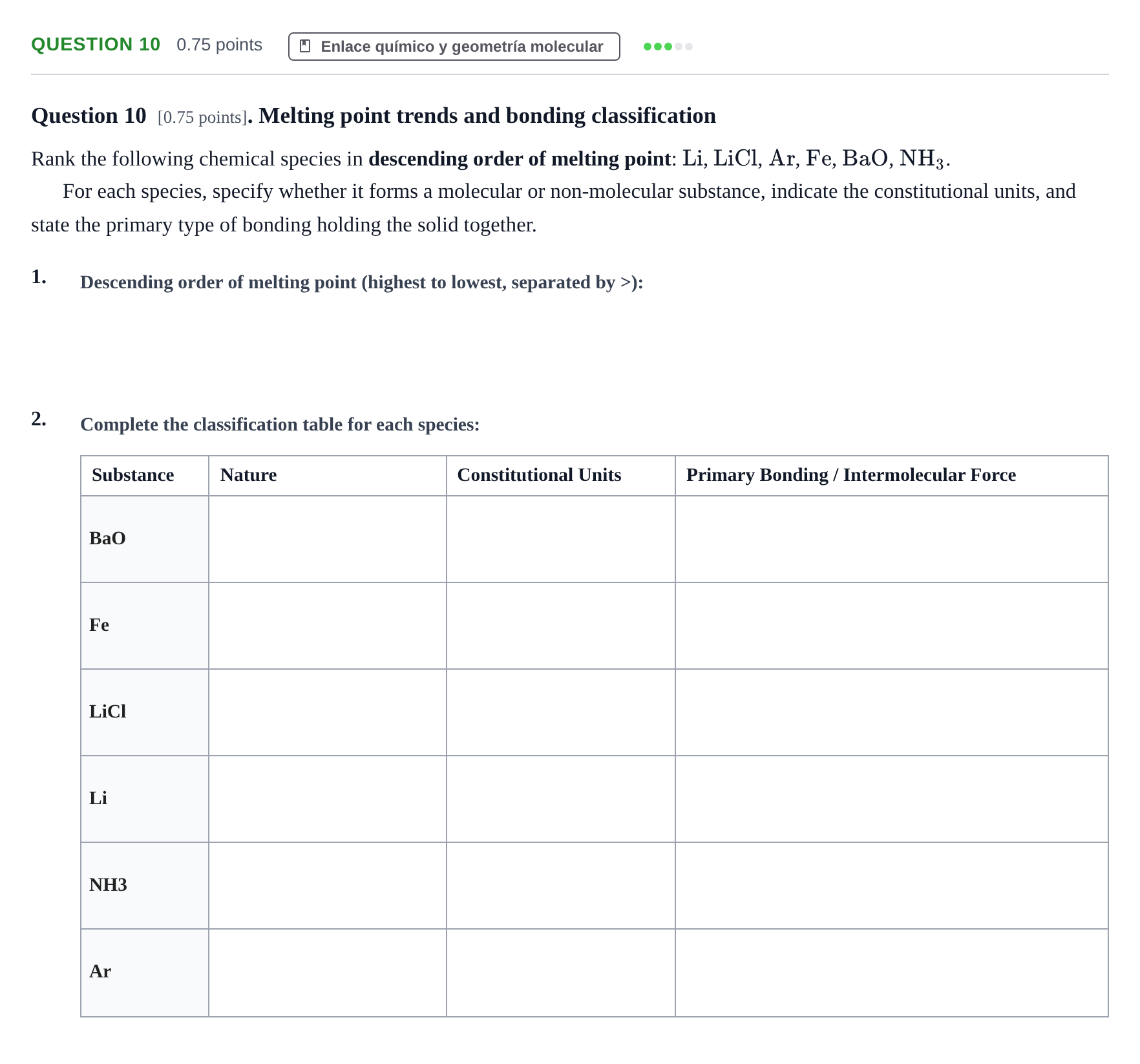
Question 10 [0.75 points]. Melting point trends and bonding classification
Rank the following chemical species in descending order of melting point: , , , , , .
For each species, specify whether it forms a molecular or non-molecular substance, indicate the constitutional units, and state the primary type of bonding holding the solid together.
1.
2.
Substance
Nature
Constitutional Units
Primary Bonding / Intermolecular Force
Solución
Según los criterios oficiales de corrección
Rank the following chemical species in descending order of melting point: Li, LiCl, Ar, Fe, BaO, NH3.
Solución:
Specify whether each substance is molecular or non-molecular.
Solución: BaO: Non-molecular; Fe: Non-molecular; LiCl: Non-molecular; Li: Non-molecular; NH3: Molecular; Ar: Molecular
Constitutional units of BaO
Solución: and ions
Primary type of bonding holding solid BaO together
Solución: Ionic bond
Constitutional units of Fe
Solución: cores in an electron sea
Primary type of bonding holding solid Fe together
Solución: Metallic bond
Constitutional units of LiCl
Solución: and ions
Primary type of bonding holding solid LiCl together
Solución: Ionic bond
Constitutional units of Li
Solución: cations in an electron sea
Primary type of bonding holding solid Li together
Solución: Metallic bond
Constitutional units of NH3
Solución: molecules
Primary type of bonding holding solid NH3 together
Solución: Hydrogen bonding / dipole-dipole interactions
Constitutional units of Ar
Solución: isolated atoms
Primary type of bonding holding solid Ar together
Solución: London dispersion forces
La explicación paso a paso, hecha con IA, es Premium. Premium
Resuélvelo aquí mismo: corrección automática, pistas y solución paso a paso.
‹ Question 9 · Exam Bridging Courses in Chemistry · Question 11 · Exam Bridging Courses in Chemistry ›