Pregunta 7 · Complements de química URV Examen Primer Parcial. Complements de Química
Tema: Sólidos, energía reticular y fuerzas intermoleculares · Del examen Examen Primer Parcial. Complements de Química
Enunciado
Pregunta 7. Periodic trends and intermolecular forces in melting points
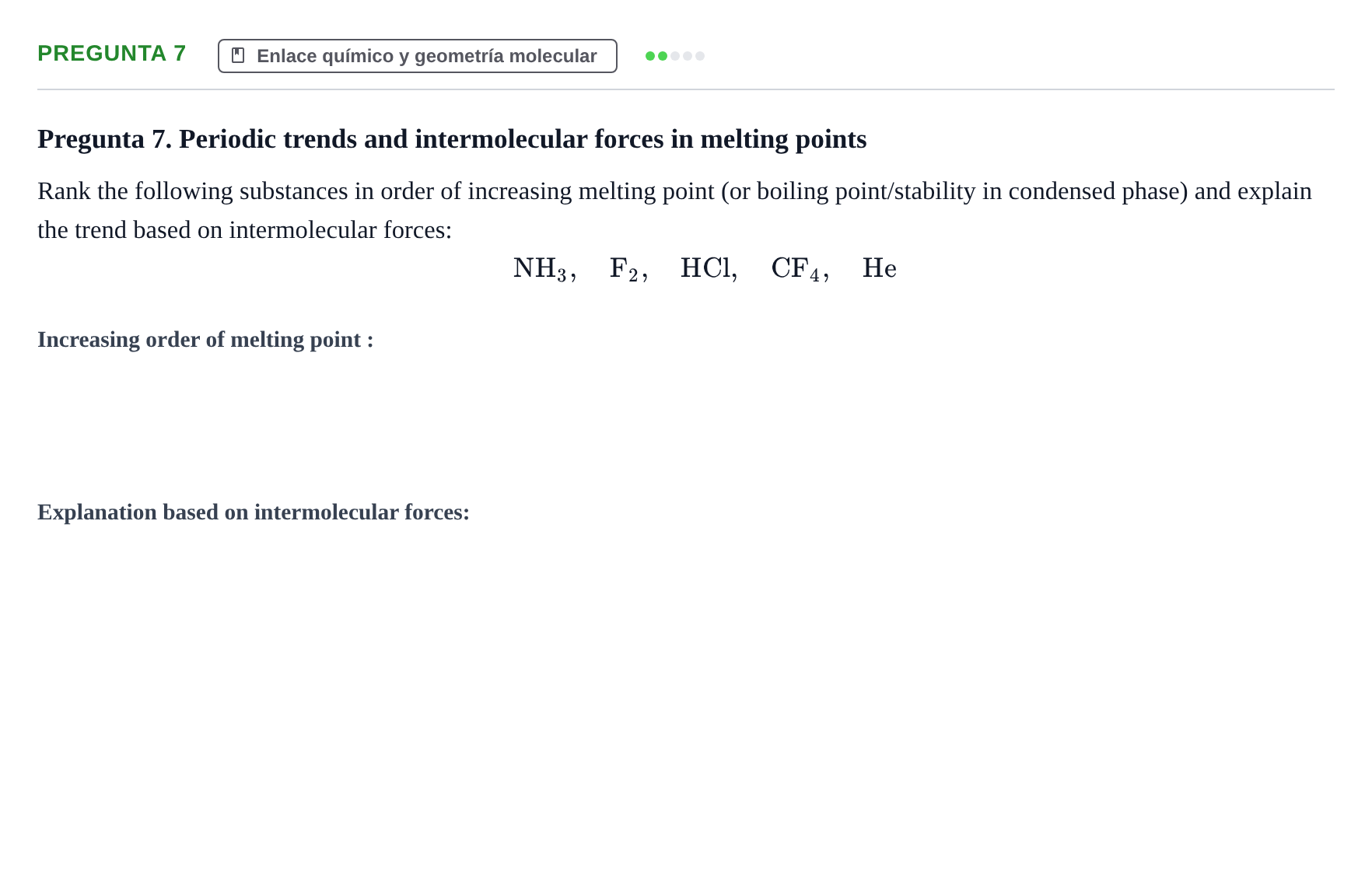
Rank the following substances in order of increasing melting point (or boiling point/stability in condensed phase) and explain the trend based on intermolecular forces:
Solución
Según los criterios oficiales de corrección
Rank the following substances in order of increasing melting point (or boiling point/stability in condensed phase): NH3, F2, HCl, CF4, He
Solución:
Explain the trend based on intermolecular forces
Solución: He: noble gas atom, extremely weak London dispersion forces (~4 K). F2: non-polar diatomic molecule held solely by weak dispersion forces (m.p. ≈ -219 °C). CF4: non-polar tetrahedral molecule, zero dipole moment, but higher polarizability/mass (m.p. ≈ -184 °C). HCl: polar molecule with dipole-dipole interactions (m.p. ≈ -114 °C). NH3: strong hydrogen bonding, highest melting point (m.p. ≈ -77.7 °C).
La explicación paso a paso, hecha con IA, es Premium. Premium
Resuélvelo aquí mismo: corrección automática, pistas y solución paso a paso.
‹ Question 11 · Exam Bridging Courses in Chemistry