Question 6 · Complements de química URV Juny 2023
Tema: Química orgánica: isomería, conformaciones y estructura · Del examen Juny (2023)
Enunciado
Question 6 (2.5 points). Short questions on organic structure and reactivity
Answer the following short questions (0.5 points each):
a.
For the acid/base reaction between but-1-yne () and potassium phenolate ():
1. Predict and draw the structures of the expected products.
2. Label the acid (A), the base (B), the conjugate base (CB), and the conjugate acid (CA).
3. Indicate the direction of the chemical equilibrium by choosing the appropriate set of arrows, and provide a brief justification based on relative acidities.
b.
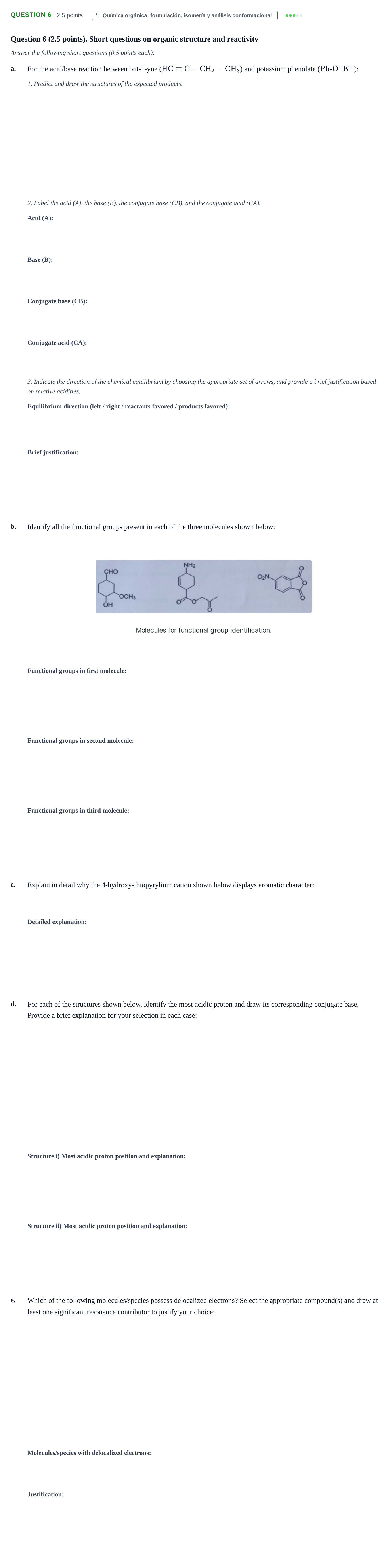
Identify all the functional groups present in each of the three molecules shown below:
c.
Explain in detail why the 4-hydroxy-thiopyrylium cation shown below displays aromatic character:
d.
For each of the structures shown below, identify the most acidic proton and draw its corresponding conjugate base. Provide a brief explanation for your selection in each case:
e.
Which of the following molecules/species possess delocalized electrons? Select the appropriate compound(s) and draw at least one significant resonance contributor to justify your choice:
Solución
Según los criterios oficiales de corrección
a.2. Label the acid (A)
Solución: But-1-yne
a.2. Label the base (B)
Solución: Potassium phenolate
a.2. Label the conjugate base (CB)
Solución: Potassium but-1-yn-1-ide
a.2. Label the conjugate acid (CA)
Solución: Phenol
a.3. Indicate the direction of the chemical equilibrium
Solución: Left (reactants favored, )
a.3. Provide a brief justification based on relative acidities
Solución: Phenol is a much stronger acid (pKa ≈ 10) than a terminal alkyne (pKa ≈ 25), so the weaker acid and weaker base predominate at equilibrium.
b. Identify all the functional groups present in the first molecule
Solución: Aldehyde (-CHO), ether (-OCH3), and secondary alcohol (-OH)
b. Identify all the functional groups present in the second molecule
Solución: Primary amine (-NH2), alkene (cyclohexene ring), ester (-COO-), and ketone (C=O)
b. Identify all the functional groups present in the third molecule
Solución: Nitro group (-NO2), aromatic ring (benzene core), and cyclic carboxylic acid anhydride
c. Explain in detail why the 4-hydroxy-thiopyrylium cation shown below displays aromatic character
Solución: The cation is planar, cyclic, fully conjugated, and obeys Hückel's rule with 6 pi electrons (4n + 2 with n = 1).
d.1. Structure i): identify the most acidic proton and explain
Solución: Protons at carbon 1 (-CH2- between the two carbonyls)
d.2. Structure ii): identify the most acidic proton and explain
Solución: Hydrogen of hydroxyl group 1 (-OH at C1)
e. Which of the following molecules/species possess delocalized electrons?
Solución: 3-methylbut-2-enenitrile and cyclohex-2-en-1-one
e. Justification for delocalized electrons
Solución: 3-methylbut-2-enenitrile has a conjugated double and triple bond; cyclohex-2-en-1-one is an α,β-unsaturated system; cyclohexanol only has σ bonds.
Drawings for parts a.1, d, and e
Solución: a.1. Products structure: d. Conjugate bases: - Structure i): deprotonated at C1 giving a resonance-stabilized enolate anion delocalized across both carbonyl oxygens. - Structure ii): deprotonated at C1 hydroxyl yielding an alkoxide stabilized by inductive electron withdrawal from fluorine. e. Resonance contributor: - For 3-methylbut-2-enenitrile: - For cyclohex-2-en-1-one: enolate with positive charge at C3 and negative on oxygen:
La explicación paso a paso, hecha con IA, es Premium. Premium
Resuélvelo aquí mismo: corrección automática, pistas y solución paso a paso.