Ejercicio Practice Case - Question 3 · Economia de L'empresa UPF 2011
Tema: Informació asimètrica: selecció adversa, risc moral i relació d'agència · Del examen Final Exam Business Economics - December 2011 (2011)
Enunciado
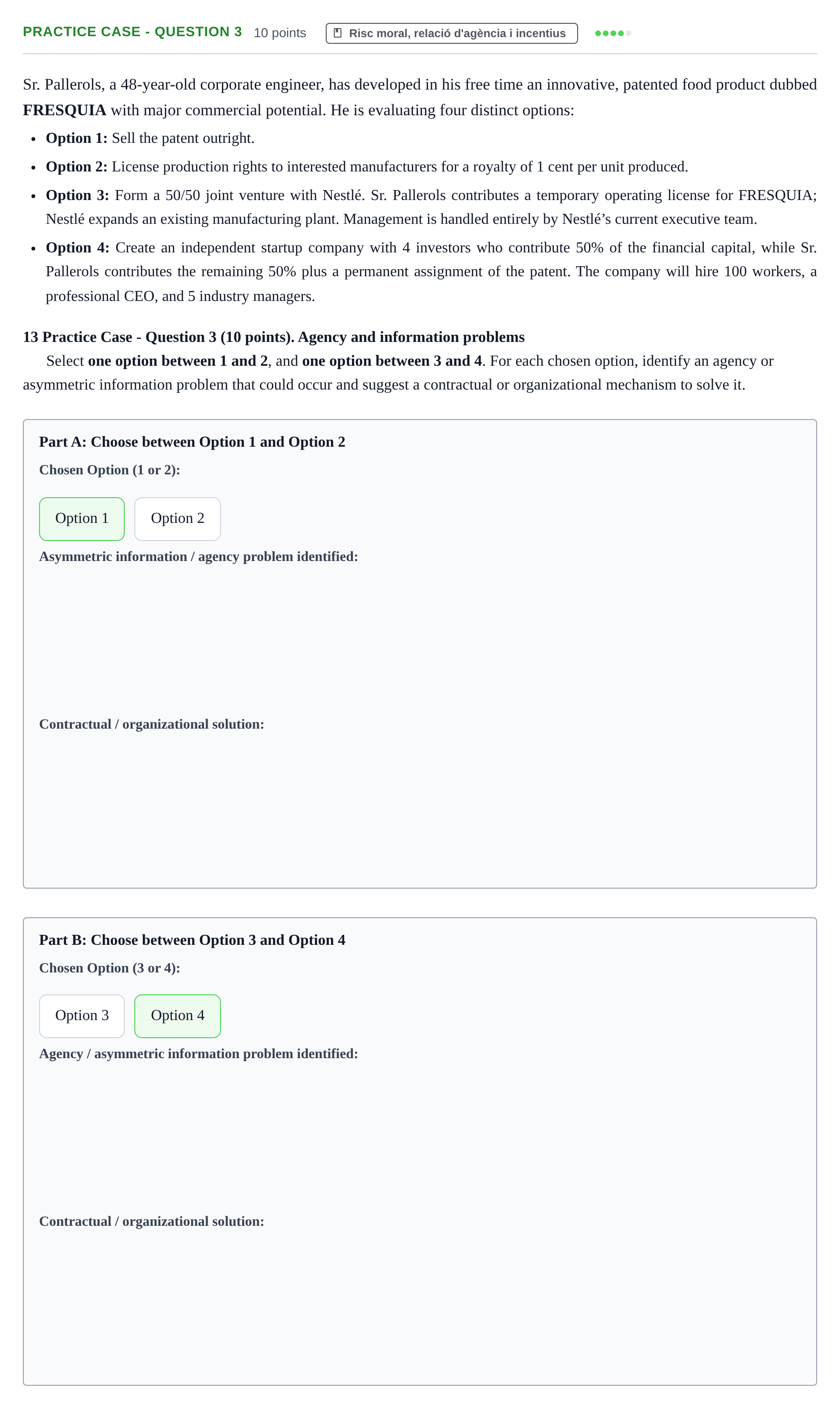
Sr. Pallerols, a 48-year-old corporate engineer, has developed in his free time an innovative, patented food product dubbed FRESQUIA with major commercial potential. He is evaluating four distinct options:
Option 1: Sell the patent outright.
Option 2: License production rights to interested manufacturers for a royalty of 1 cent per unit produced.
Option 3: Form a 50/50 joint venture with Nestlé. Sr. Pallerols contributes a temporary operating license for FRESQUIA; Nestlé expands an existing manufacturing plant. Management is handled entirely by Nestlé’s current executive team.
Option 4: Create an independent startup company with 4 investors who contribute 50% of the financial capital, while Sr. Pallerols contributes the remaining 50% plus a permanent assignment of the patent. The company will hire 100 workers, a professional CEO, and 5 industry managers.
13 Practice Case - Question 3 (10 points). Agency and information problems
Select one option between 1 and 2, and one option between 3 and 4. For each chosen option, identify an agency or asymmetric information problem that could occur and suggest a contractual or organizational mechanism to solve it.
Part A: Choose between Option 1 and Option 2
Option 1
Option 2
Part B: Choose between Option 3 and Option 4
Option 3
Option 4
Solución
Según los criterios oficiales de corrección
Part A (Option 1 or Option 2): Agency or asymmetric information problem identified.
Solución: Option 1: Asymmetric Information & Bargaining Failure (Arrow's information paradox: buyer cannot verify patent value without seeing the formula, but Pallerols fears disclosing it without payment). / Option 2: Moral hazard / output underreporting by licensees.
Part A (Option 1 or Option 2): Contractual or organizational mechanism to solve it.
Solución: Option 1: Use non-disclosure agreements (NDAs), milestone-contingent earnout payments, or third-party technical escrow/auditing. / Option 2: Third-party production audits, minimum guaranteed royalties, or quality inspections.
Part B (Option 3 or Option 4): Agency or asymmetric information problem identified.
Solución: Option 4: Principal-Agent Conflict / Managerial Moral Hazard (separation of ownership and control: hired CEO and managers may shirk, pursue perks, or empire-building). / Option 3: Goal conflict and transfer pricing disputes between JV partners.
Part B (Option 3 or Option 4): Contractual or organizational mechanism to solve it.
Solución: Option 4: Executive compensation contract with equity/stock options, board of directors oversight with milestone reporting, and performance-tied bonuses. / Option 3: Clear JV charter, dispute resolution clauses, and joint governance committees.
Select one option between 1 and 2, and one option between 3 and 4.
Solución: Option 1 (or Option 2) and Option 3 (or Option 4)
La explicación paso a paso, hecha con IA, es Premium. Premium
Resuélvelo aquí mismo: corrección automática, pistas y solución paso a paso.
‹ Ejercicio Short Question 8 · 2011