Ejercicio 4 - Section B: IS-LM-PC model · Introducció a la Macroeconomia UPF 2024
Tema: Model IS-LM-PC: del curt al mig termini · Del examen Sample Exam 2024 (2024)
Enunciado
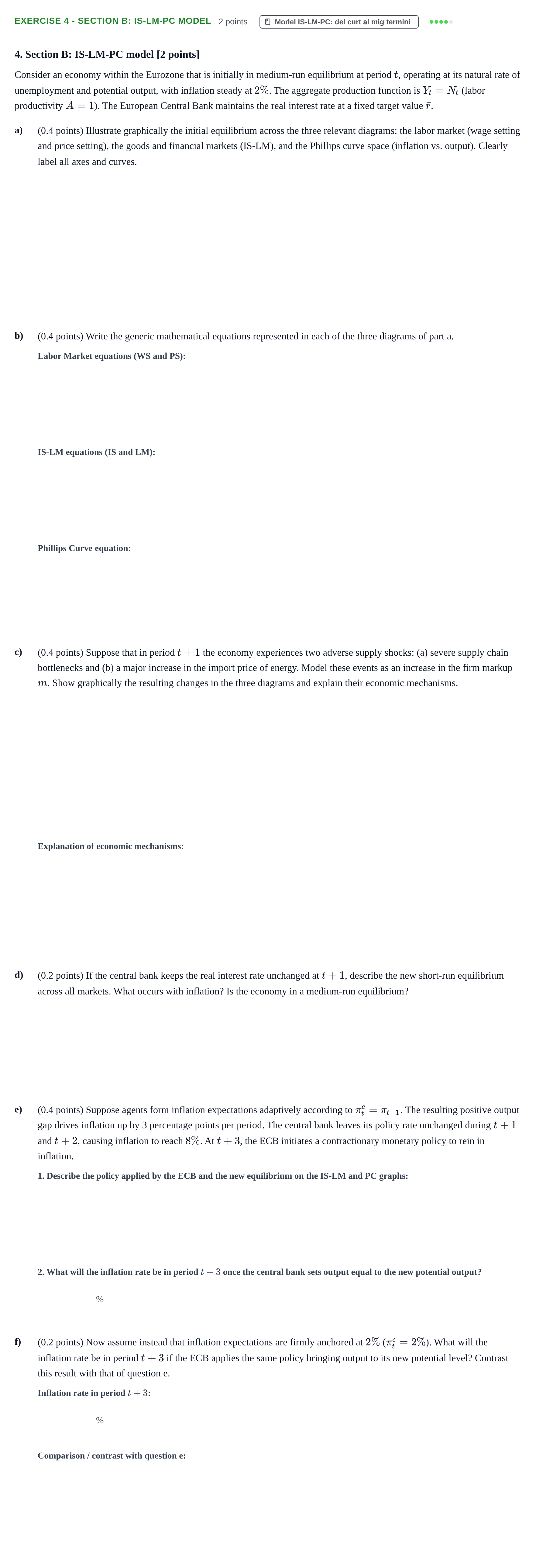
4. Section B: IS-LM-PC model [2 points]
Consider an economy within the Eurozone that is initially in medium-run equilibrium at period , operating at its natural rate of unemployment and potential output, with inflation steady at . The aggregate production function is (labor productivity ). The European Central Bank maintains the real interest rate at a fixed target value .
a)
(0.4 points) Illustrate graphically the initial equilibrium across the three relevant diagrams: the labor market (wage setting and price setting), the goods and financial markets (IS-LM), and the Phillips curve space (inflation vs. output). Clearly label all axes and curves.
b)
(0.4 points) Write the generic mathematical equations represented in each of the three diagrams of part a.
c)
(0.4 points) Suppose that in period the economy experiences two adverse supply shocks: (a) severe supply chain bottlenecks and (b) a major increase in the import price of energy. Model these events as an increase in the firm markup . Show graphically the resulting changes in the three diagrams and explain their economic mechanisms.
d)
(0.2 points) If the central bank keeps the real interest rate unchanged at , describe the new short-run equilibrium across all markets. What occurs with inflation? Is the economy in a medium-run equilibrium?
e)
(0.4 points) Suppose agents form inflation expectations adaptively according to . The resulting positive output gap drives inflation up by 3 percentage points per period. The central bank leaves its policy rate unchanged during and , causing inflation to reach . At , the ECB initiates a contractionary monetary policy to rein in inflation.
%
f)
(0.2 points) Now assume instead that inflation expectations are firmly anchored at (). What will the inflation rate be in period if the ECB applies the same policy bringing output to its new potential level? Contrast this result with that of question e.
%
Solución
Según los criterios oficiales de corrección
a) Illustrate graphically the initial equilibrium across the three relevant diagrams and c) Show graphically the resulting changes in the three diagrams
Solución: a. Initial Equilibrium Diagrams: - Labor Market: Real wage on the vertical axis, unemployment rate on the horizontal axis. Downward-sloping Wage-Setting relation and horizontal Price-Setting relation . The intersection defines the natural rate of unemployment and the equilibrium real wage . - Goods & Financial Markets (IS-LM): Real interest rate on the vertical axis, output on the horizontal axis. Downward-sloping curve and horizontal line at . Intersection occurs at . - Phillips Curve: Change in inflation (or ) on the vertical axis, output on the horizontal axis. Upward-sloping crossing the horizontal axis (where ) exactly at . c. Impact of the Supply Shock: - In the Labor Market, the increase in mark-up from to shifts the horizontal curve downward to . The intersection with moves to a higher natural rate of unemployment . - In the Goods & Financial Markets (IS-LM), potential output contracts to . The initial and curves remain unchanged. - In the Phillips Curve diagram, the curve shifts leftward/upward because the output level consistent with stable inflation is now lower ().
b) Write the generic mathematical equations represented in each of the three diagrams of part 1. (Labor market: WS and PS)
Solución: WS: W/P = F(u, z), PS: W/P = 1 / (1 + m)
b) Write the generic mathematical equations represented in each of the three diagrams of part 1. (IS-LM)
Solución: IS: Y = C(Y - T) + I(Y, r + x) + G, LM: r = \bar{r}
b) Write the generic mathematical equations represented in each of the three diagrams of part 1. (Phillips curve)
Solución: \pi_t - \pi_t^e = (\alpha / L)(Y_t - Y_n)
c) Explain their economic mechanisms.
Solución: An increase in mark-up from to shifts the horizontal curve downward to . Real wages fall, and the intersection with occurs at a higher natural rate of unemployment . Since , potential output contracts. In the PC diagram, the curve shifts leftward/upward because the output level consistent with stable inflation is now lower (). The IS and LM curves are initially unaffected by the supply-side shock.
d) If the central bank keeps the real interest rate unchanged at t+1, describe the new short-run equilibrium across all markets. What occurs with inflation? Is the economy in a medium-run equilibrium?
Solución: Because the ECB maintains and fiscal variables are unchanged, output remains at the initial level . The economy now operates with a positive output gap relative to the new lower capacity (). As a consequence, inflation rises above previous expectations (). The economy is not in medium-run equilibrium because production exceeds potential output and inflation is accelerating.
e.1. Describe the policy applied by the ECB and illustrate the new equilibrium on the IS-LM and PC graphs.
Solución: To stabilize inflation, the ECB must raise the real interest rate to , shifting the horizontal LM curve upward until output contracts from to the new potential output . In the PC space, the economy moves down along the new PC curve until the output gap is zero ().
e.2. What will the inflation rate be in period t+3 once the central bank sets output equal to the new potential output?
Solución: 8
f) What will the inflation rate be in period t+3 if the ECB applies the same policy bringing output to its new potential level?
Solución: 2
f) Contrast this result with that of question e.
Solución: With anchored expectations, stabilizing output at its natural level is sufficient to bring inflation immediately back to target without requiring an economic downturn. Under adaptive expectations, closing the output gap merely stabilizes inflation at its prevailing high rate (8%), meaning disinflation requires an engineered recession.
La explicación paso a paso, hecha con IA, es Premium. Premium
Resuélvelo aquí mismo: corrección automática, pistas y solución paso a paso.
‹ Ejercicio 2 - Model IS-LM-PC: del curt al mig termini · 2024 · Part I - Model IS-LM-PC: del curt al mig termini · 2021 ›