Question 1 · Introducció a la Macroeconomia UPF 2021
Tema: Model IS-LM a curt termini · Del examen Final Exam - March 2021 (2021)
Enunciado
Question 1 (2.0 points). Extended IS-LM Model with Pandemic Risk and Policy Responses
Consider the following extended IS-LM framework:
There is a single homogeneous good utilized for private consumption, private investment, or government expenditure. Firms satisfy whatever quantity is demanded at the prevailing price level. This model departs from the benchmark framework through two specific modifications:
captures the perceived probability/risk of a systemic economic crisis triggered by an exogenous event (such as a pandemic, conflict, or terrorist attack). Both private consumption and investment depend negatively on .
denotes the risk-free real interest rate set by the central bank (, where expected inflation is anchored and held constant).
represents the exogenous risk premium demanded by financial intermediaries over the risk-free real rate to fund business investment.
a)
[0.3 points] Draw the standard IS-LM diagram. Label both axes and clarify the slope of each schedule. Identify the point where both goods and financial markets clear simultaneously.
b)
[0.3 points] Assume the economy is hit by COVID-19, causing households and firms to fear economic collapse, which manifests as an increase in . Illustrate the impact of this exogenous shock on the IS-LM diagram and describe the qualitative adjustments in output and the real interest rate.
c)
[0.3 points] Assuming no macroeconomic policy intervention occurs, summarize the directional effect of the pandemic shock on each of the following variables by indicating ↑ (increase), ↓ (decrease), → (constant), or ? (uncertain):
Variable
Direction of Change
Consumption ()
Investment ()
Production ()
Income ()
Real interest rate ()
d)
[0.3 points] In response to the crisis, European and OECD governments rolled out substantial fiscal stabilization packages to preserve productive capacity and support household disposable income. Depict the graphical impact of these expansionary fiscal measures on the IS-LM diagram relative to the post-shock position.
e)
[0.3 points] State the impact of this expansionary fiscal package on consumption, investment, production, income, and the real interest rate using the same directional indicators (↑, ↓, →, ?):
Variable
Direction of Change
Consumption ()
Investment ()
Production ()
Income ()
Real interest rate ()
f)
[0.2 points] Consider now the monetary policy environment in the euro area:
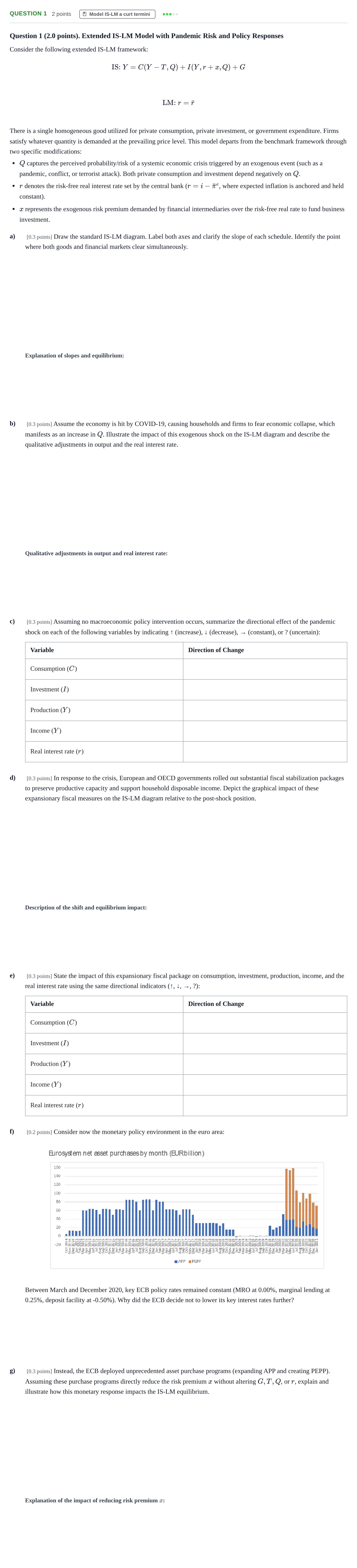
Between March and December 2020, key ECB policy rates remained constant (MRO at 0.00%, marginal lending at 0.25%, deposit facility at -0.50%). Why did the ECB decide not to lower its key interest rates further?
g)
[0.3 points] Instead, the ECB deployed unprecedented asset purchase programs (expanding APP and creating PEPP). Assuming these purchase programs directly reduce the risk premium without altering , or , explain and illustrate how this monetary response impacts the IS-LM equilibrium.
Solución
Según los criterios oficiales de corrección
Diagrams for parts (a), (b), (d), and (g)
Solución: a. Standard IS-LM: Downward-sloping IS curve, horizontal LM curve at . Equilibrium output at the intersection. b. Shock in : The IS curve shifts leftward to . Output contracts from to , while remains unchanged at . d. Fiscal expansion: Higher and lower net shift the IS curve rightward from toward , offsetting the output contraction. g. Asset purchases lowering : Stimulates investment, shifting the IS curve rightward from toward at given policy rate .
a) Clarify the slope of each schedule and identify joint equilibrium.
Solución: The vertical axis represents the real interest rate and the horizontal axis represents output/income . The LM curve is horizontal at because the central bank targets the interest rate directly through open-market operations. The IS curve is downward-sloping: a higher real rate increases the cost of capital, dampening investment and aggregate demand, which reduces equilibrium output via the multiplier. The intersection of IS and LM gives joint equilibrium in the goods and financial markets.
b) Describe the qualitative adjustments in output and the real interest rate after an increase in Q.
Solución: An increase in perceived crisis risk reduces both consumer confidence and business investment sentiment. For any given policy rate , aggregate expenditure falls, shifting the IS curve inward to the left (from IS to IS'). Because the central bank holds fixed, output contracts from to , while the real interest rate remains unchanged at .
c) Directional effect of the pandemic shock on C, I, Y, and r
Solución: Consumption (): ↓ decrease; Investment (): ↓ decrease; Production (): ↓ decrease; Income (): ↓ decrease; Real interest rate (): → constant / unchanged
d) Depict the graphical impact of expansionary fiscal measures relative to the post-shock position.
Solución: The expansionary fiscal packages (increases in and transfers / tax relief lowering net ) increase autonomous demand, shifting the IS curve rightward from IS' toward IS''. On the diagram, this partially or fully offsets the initial contraction in output, moving the equilibrium back toward the initial level of economic activity.
e) Impact of expansionary fiscal package on C, I, Y, and r
Solución: Consumption (): ↑ increase; Investment (): ↑ increase; Production (): ↑ increase; Income (): ↑ increase; Real interest rate (): → constant / unchanged
f) Why did the ECB decide not to lower its key interest rates further?
Solución: Because nominal policy rates were already at or below zero, the monetary authority was constrained by the Effective/Zero Lower Bound (liquidity trap conditions). Further expansion of conventional high-powered money supplies cannot meaningfully compress nominal policy rates any further.
g) Explain how asset purchase programs reducing the risk premium x impact the IS-LM equilibrium.
Solución: By purchasing massive quantities of private and public debt, the central bank provides liquidity and compresses credit spreads, effectively lowering the risk premium . With a lower borrowing cost , firms face cheaper financing, which stimulates investment and shifts the IS curve rightward from IS' toward IS'' at the given policy rate . Output expands toward potential without altering the policy rate.
La explicación paso a paso, hecha con IA, es Premium. Premium
Resuélvelo aquí mismo: corrección automática, pistas y solución paso a paso.
‹ Part I - Model IS-LM a curt termini · 2021 · Question 8 · 2019 ›