Question 1 · Introducció a la Macroeconomia UPF 2019
Tema: Model IS-LM a curt termini · Del examen Final Exam - March 2019 (2019)
Enunciado
Question 1 (2 points). Extended IS-LM and euro-zone fiscal policy
Read the following excerpt adapted from The Economist (March 14, 2019):
“For the first time in a decade, fiscal policy in the euro area is expected to loosen (be more expansionary) this year. The zone has no common budget — although its members’ finance ministers discussed the topic on March 11th — so overall policy is simply the sum of individual countries’ fiscal plans.
Much of the expected stimulus takes the form of tax cuts and benefit increases. Because people could choose to save rather than spend the extra cash, that lifts the economy less than public investment, which also brings the benefit of increased economic potential.
Both Germany and Italy have been hit hard, partly by slowing demand for their exports. But whereas Germany has plenty of fiscal room, Italy, with public debt of more than 130% of GDP, would risk scaring financial markets (again) if it splurged (overspend). A German boost would help Italy too.”
a)
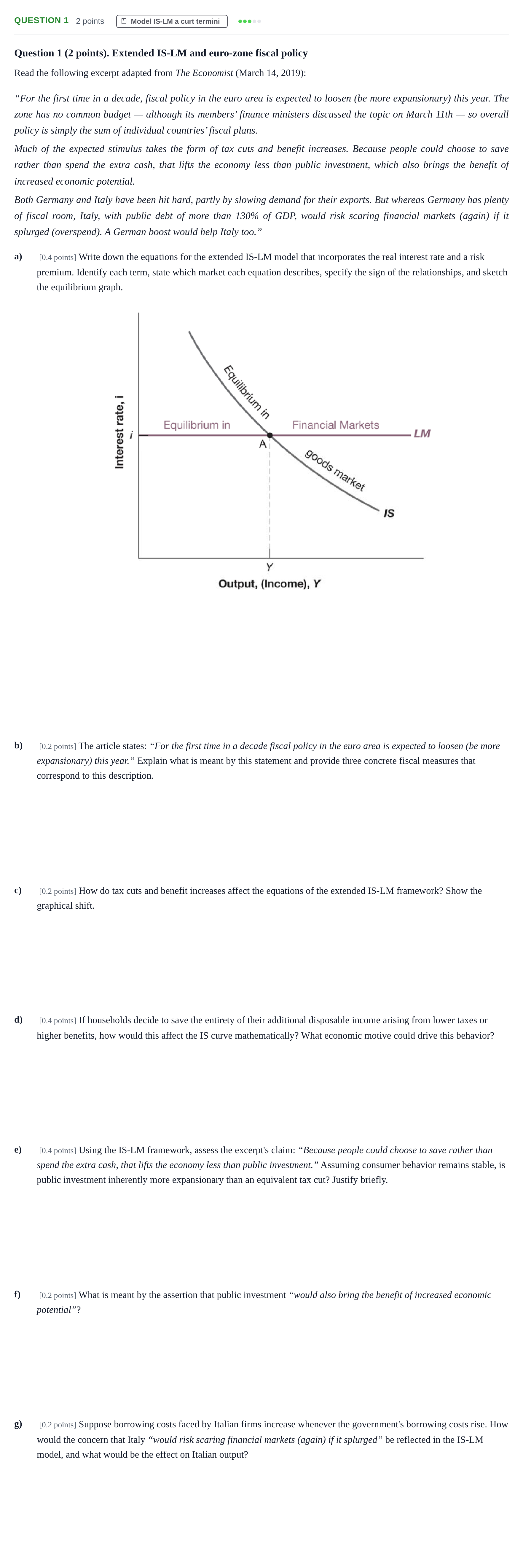
[0.4 points] Write down the equations for the extended IS-LM model that incorporates the real interest rate and a risk premium. Identify each term, state which market each equation describes, specify the sign of the relationships, and sketch the equilibrium graph.
b)
[0.2 points] The article states: “For the first time in a decade fiscal policy in the euro area is expected to loosen (be more expansionary) this year.” Explain what is meant by this statement and provide three concrete fiscal measures that correspond to this description.
c)
[0.2 points] How do tax cuts and benefit increases affect the equations of the extended IS-LM framework? Show the graphical shift.
d)
[0.4 points] If households decide to save the entirety of their additional disposable income arising from lower taxes or higher benefits, how would this affect the IS curve mathematically? What economic motive could drive this behavior?
e)
[0.4 points] Using the IS-LM framework, assess the excerpt's claim: “Because people could choose to save rather than spend the extra cash, that lifts the economy less than public investment.” Assuming consumer behavior remains stable, is public investment inherently more expansionary than an equivalent tax cut? Justify briefly.
f)
[0.2 points] What is meant by the assertion that public investment “would also bring the benefit of increased economic potential” ?
g)
[0.2 points] Suppose borrowing costs faced by Italian firms increase whenever the government's borrowing costs rise. How would the concern that Italy “would risk scaring financial markets (again) if it splurged” be reflected in the IS-LM model, and what would be the effect on Italian output?
Solución
Según los criterios oficiales de corrección
a. (0.4 points) Write down the equations for the extended IS-LM model that incorporates the real interest rate and a risk premium. Identify each term, state which market each equation describes, specify the sign of the relationships, and sketch the equilibrium graph.
Solución: Extended IS-LM Equations: * Goods market equilibrium (IS): where denotes aggregate output, is private consumption depending positively on disposable income (), represents investment spending depending positively on output and negatively on the borrowing real interest rate , is the real policy rate set by the central bank, is the financial risk premium, and is public purchases. * Financial market equilibrium (LM): The monetary authority directly targets the real policy interest rate and supplies whatever amount of money is demanded at that rate, yielding a horizontal LM curve in space.
b. (0.2 points) The article states: “For the first time in a decade fiscal policy in the euro area is expected to loosen (be more expansionary) this year.” Explain what is meant by this statement and provide three concrete fiscal measures that correspond to this description.
Solución: A loosening or expansionary fiscal stance denotes government policies designed to increase aggregate demand. Three examples include: 1. Decreasing direct income tax rates or corporate tax rates. 2. Increasing social transfers (e.g., raising unemployment subsidies or pensions). 3. Increasing direct public spending on goods and services (e.g., transport infrastructure projects).
c. (0.2 points) How do tax cuts and benefit increases affect the equations of the extended IS-LM framework? Show the graphical shift.
Solución: Tax cuts and higher transfer payments both reduce net taxes (). In the IS relation, lower raises disposable income , elevating consumption at every interest rate level. Consequently, the IS curve shifts to the right, leaving the horizontal LM unchanged.
d. (0.4 points) If households decide to save the entirety of their additional disposable income arising from lower taxes or higher benefits, how would this affect the IS curve mathematically? What economic motive could drive this behavior?
Solución: If agents save the entire incremental income, the marginal propensity to consume out of transfers/tax cuts drops to zero (). This flattens the consumption function with respect to tax changes and steepens the IS curve (or shrinks the expenditure multiplier to 1). This behavioral adjustment is consistent with *Ricardian Equivalence* or precautionary saving: consumers perceive fiscal stimulus as signaling deteriorating economic conditions or future tax hikes, depressing consumer confidence.
e. (0.4 points) Using the IS-LM framework, assess the excerpt's claim: “Because people could choose to save rather than spend the extra cash, that lifts the economy less than public investment.” Assuming consumer behavior remains stable, is public investment inherently more expansionary than an equivalent tax cut? Justify briefly.
Solución: Yes, it is true. A public investment increase of enters aggregate demand directly dollar-for-dollar (). In contrast, a tax cut of affects autonomous spending only indirectly through consumption: . Since the marginal propensity to consume satisfies , the rightward horizontal shift of the IS curve is strictly larger for public investment than for an equal-sized tax reduction.
f. (0.2 points) What is meant by the assertion that public investment “would also bring the benefit of increased economic potential”?
Solución: Beyond its short-run demand stimulus via , public investment builds productive physical and technological infrastructure. This raises the overall capital stock, enhances private-sector total factor productivity, and increases the long-run potential output () of the economy.
g. (0.2 points) Suppose borrowing costs faced by Italian firms increase whenever the government's borrowing costs rise. How would the concern that Italy “would risk scaring financial markets (again) if it splurged” be reflected in the IS-LM model, and what would be the effect on Italian output?
Solución: If Italian fiscal profligacy frightens financial markets, sovereign bond spreads widen, raising the private risk premium . In the IS equation, an increase in raises borrowing costs , depressing investment . Graphically, the IS curve shifts to the left, reducing equilibrium output .
La explicación paso a paso, hecha con IA, es Premium. Premium
Resuélvelo aquí mismo: corrección automática, pistas y solución paso a paso.
‹ Question 10 · 2019 · Part 2 - Question 16 · 2018 ›