Problem 1. Consider the linear consumption function C = c_0 + c_1(Y - T). (a) How might the COVID-19 pandemic affect…
Mercat de béns i multiplicador
Problem 1. COVID-19 shock on consumption
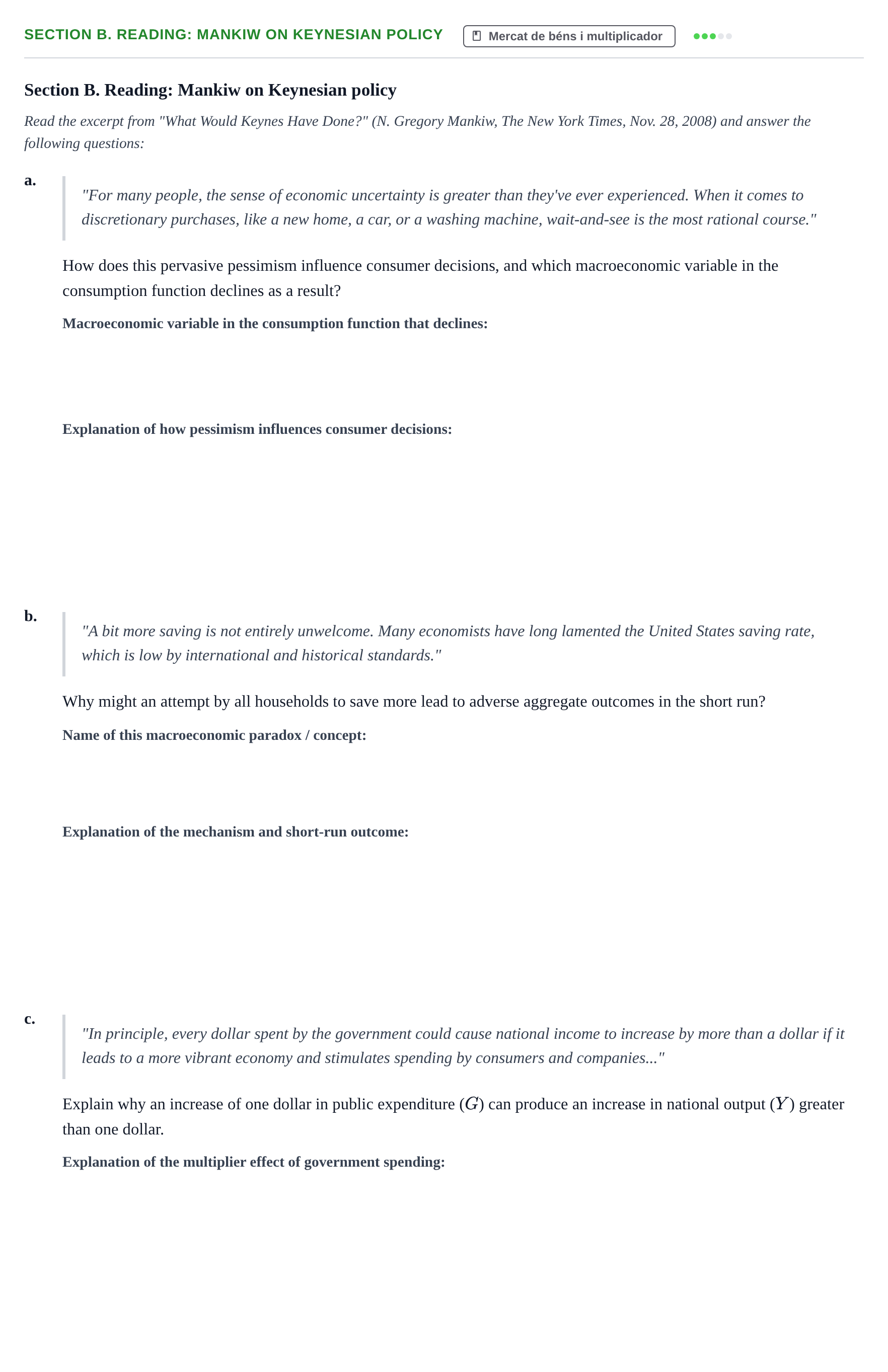
In 2020, the COVID-19 outbreak and resulting lockdowns caused a marked contraction in household consumer spending. Consider the linear consumption function .
a.
How might the pandemic and containment measures affect autonomous consumption () and the marginal propensity to consume ()?
b.
Illustrate and describe the graphical change of the consumption function between 2019 and late 2020.
c.
Briefly explain the consequences for short-run output () and the size of the expenditure multiplier.
Problem 2. Consider an economy where public spending G and investment I are constant, with C = c0 + c1(Y - T) and T =…
Mercat de béns i multiplicador
Problem 2. Goods market with proportional taxes
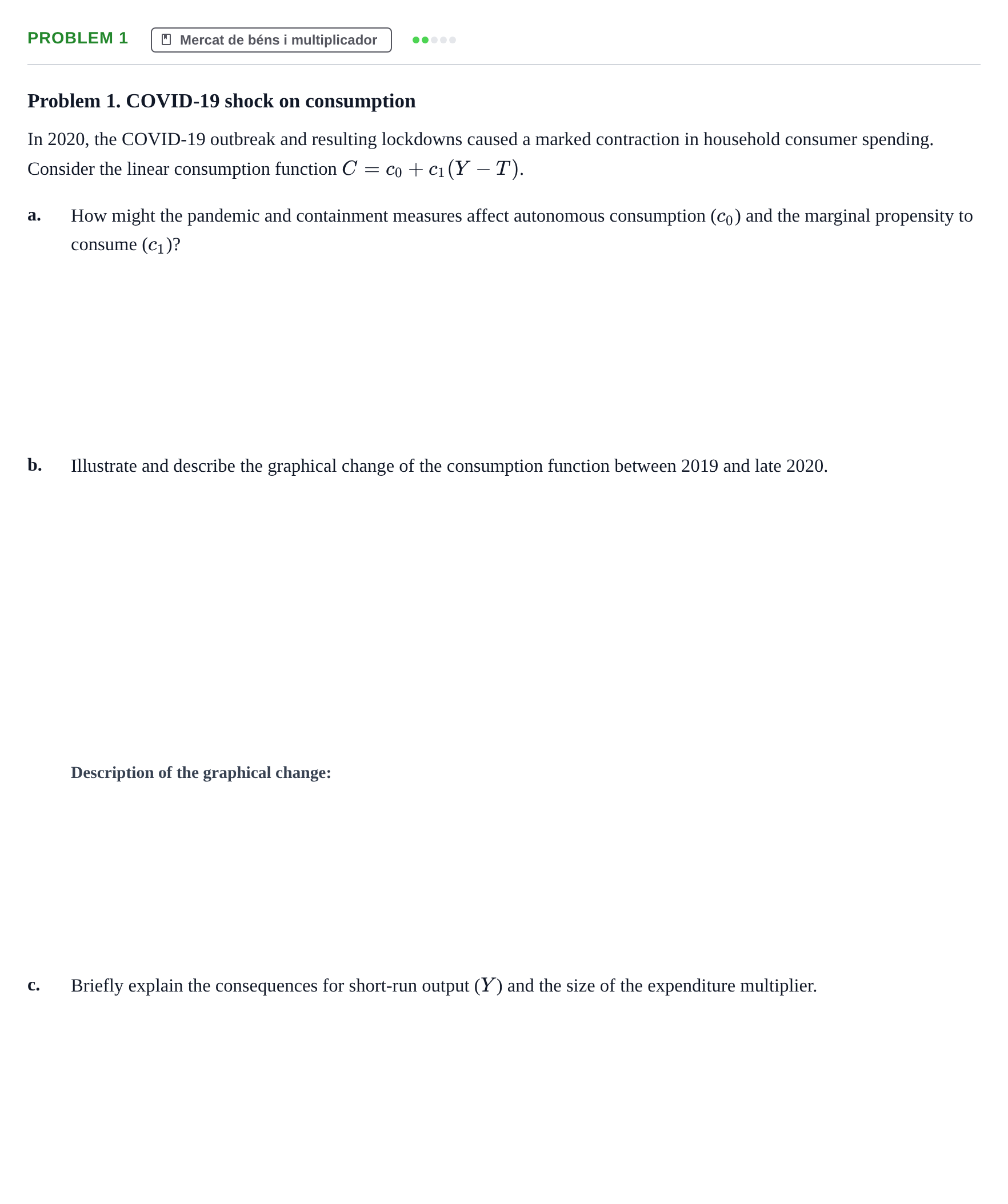
Consider an economy where public spending and investment are constant, but tax revenues depend positively on the level of income through a proportional tax rate (with ):
a.
Derive the equilibrium output level .
b.
Identify the expenditure multiplier and explain the economic mechanism behind it.
c.
Assume now that taxes are exogenous and fixed at . Determine the new multiplier and compare it with the multiplier derived in part (b).
d.
Using the previous findings, explain whether the economy responds more, less, or equally to shifts in autonomous spending when taxes depend on income compared to when they are fixed.
Problem 3. Qualitative questions on commercial bank money creation via loan origination and the distinction between…
Mercats financers: diner, bancs i política monetària
Problem 3. Money creation by commercial banks
In late 2017, an article in The Guardian reported:
"Responding to a survey commissioned by Positive Money just before the June election, 85% were unaware that new money was created every time a commercial bank extended a loan, while 70% thought that only the government had the power to create new money..."
a)
Explain briefly the mechanism behind the statement: "new money was created every time a commercial bank extended a loan".
b)
Assess the belief that "only the government had the power to create new money", distinguishing between fiscal policy and monetary/banking creation.
Problem 4. Questions explaining the impact of reserve requirement changes on the money multiplier and identifying…
Mercats financers: diner, bancs i política monetària
Problem 4. Reserve requirements and monetary policy
a)
Explain how changes in the reserve requirement ratio set for commercial banks affect the overall money supply over time.
b)
Identify and detail the policy instruments available to a Central Bank to expand the aggregate money supply in an economy.
Problem 5. Analysis of money demand dependence on interest rate as an opportunity cost, the effect of an income shock on…
Mercats financers: diner, bancs i política monetària
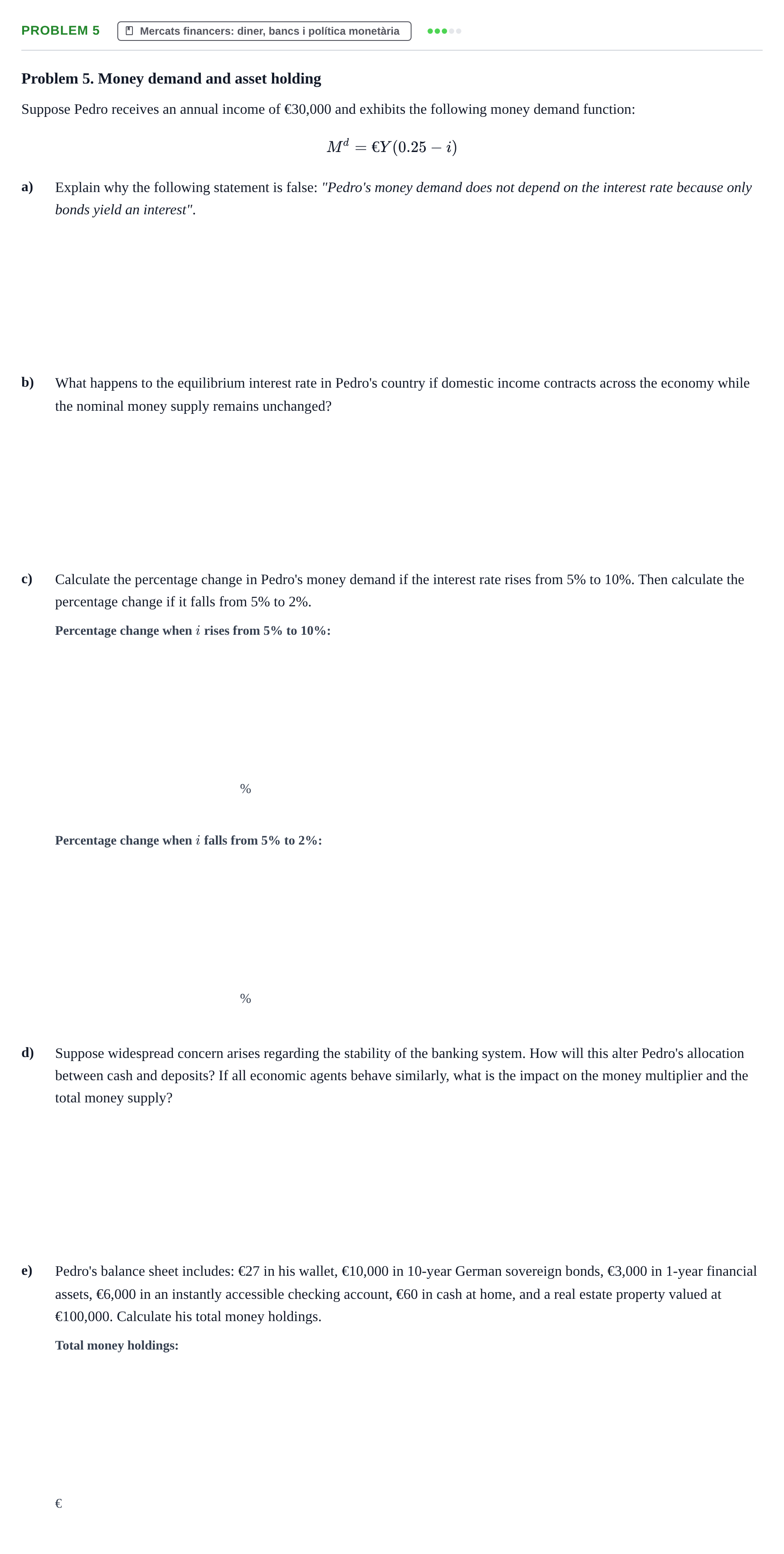
Problem 5. Money demand and asset holding
Suppose Pedro receives an annual income of €30,000 and exhibits the following money demand function:
a)
Explain why the following statement is false: "Pedro's money demand does not depend on the interest rate because only bonds yield an interest".
b)
What happens to the equilibrium interest rate in Pedro's country if domestic income contracts across the economy while the nominal money supply remains unchanged?
c)
Calculate the percentage change in Pedro's money demand if the interest rate rises from 5% to 10%. Then calculate the percentage change if it falls from 5% to 2%.
%
%
d)
Suppose widespread concern arises regarding the stability of the banking system. How will this alter Pedro's allocation between cash and deposits? If all economic agents behave similarly, what is the impact on the money multiplier and the total money supply?
e)
Pedro's balance sheet includes: €27 in his wallet, €10,000 in 10-year German sovereign bonds, €3,000 in 1-year financial assets, €6,000 in an instantly accessible checking account, €60 in cash at home, and a real estate property valued at €100,000. Calculate his total money holdings.
€
Problem 6. Problem 6: Given c = 0, theta = 0.02, M^d = €Y(0.8 - 2i), H = €61 billion, and €Y = €4,200 billion. a) Derive…
Mercats financers: diner, bancs i política monetària
Problem 6. Central bank money equilibrium and multiplier
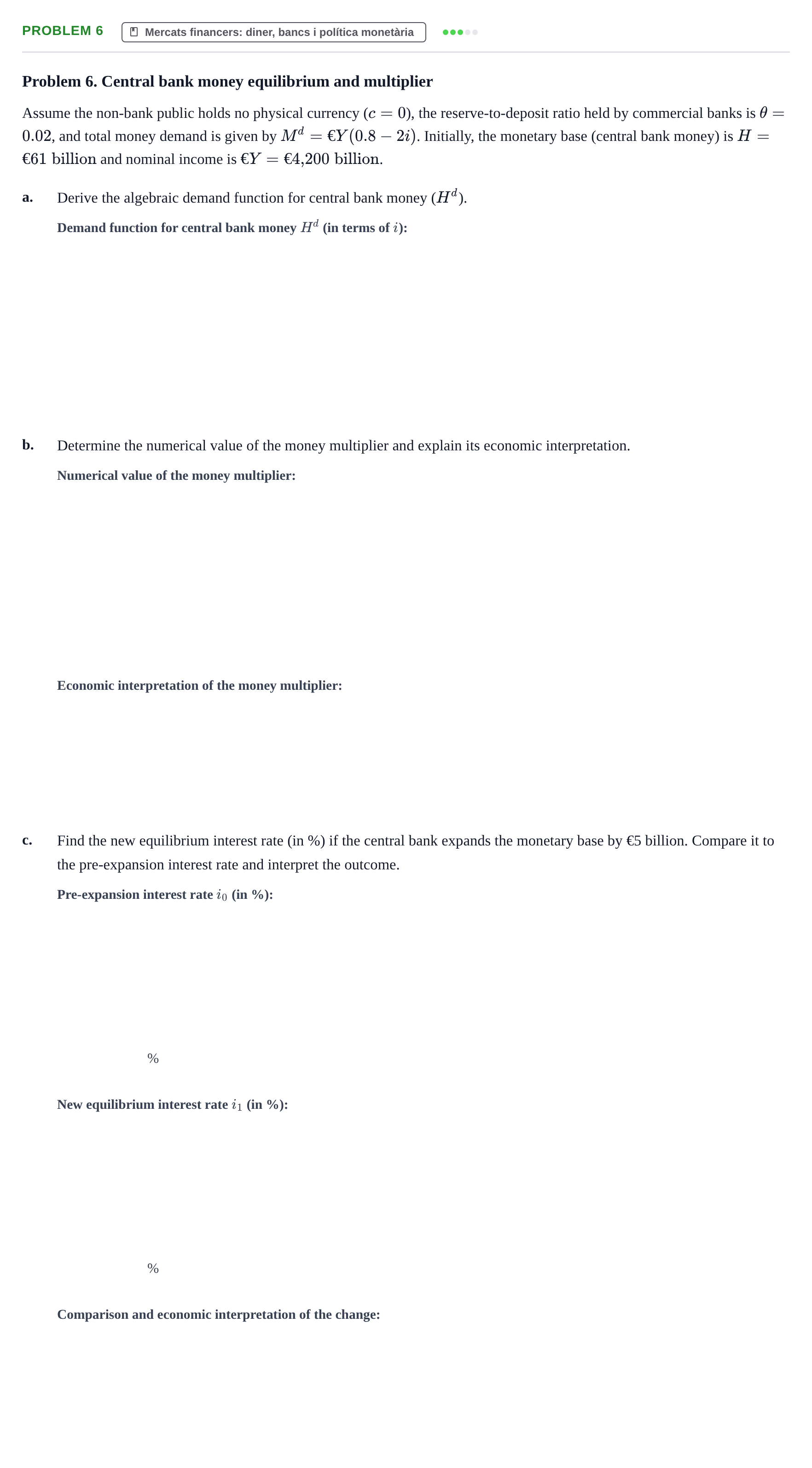
Assume the non-bank public holds no physical currency (), the reserve-to-deposit ratio held by commercial banks is , and total money demand is given by . Initially, the monetary base (central bank money) is and nominal income is .
a.
Derive the algebraic demand function for central bank money ().
b.
Determine the numerical value of the money multiplier and explain its economic interpretation.
c.
Find the new equilibrium interest rate (in %) if the central bank expands the monetary base by €5 billion. Compare it to the pre-expansion interest rate and interpret the outcome.
%
%
Section B. Reading: Mankiw on Keynesian policy. Section B. Reading: Mankiw on Keynesian policy. a) How pessimism affects consumer decisions and which…
Mercat de béns i multiplicador
Section B. Reading: Mankiw on Keynesian policy
Read the excerpt from "What Would Keynes Have Done?" (N. Gregory Mankiw, The New York Times, Nov. 28, 2008) and answer the following questions:
a.
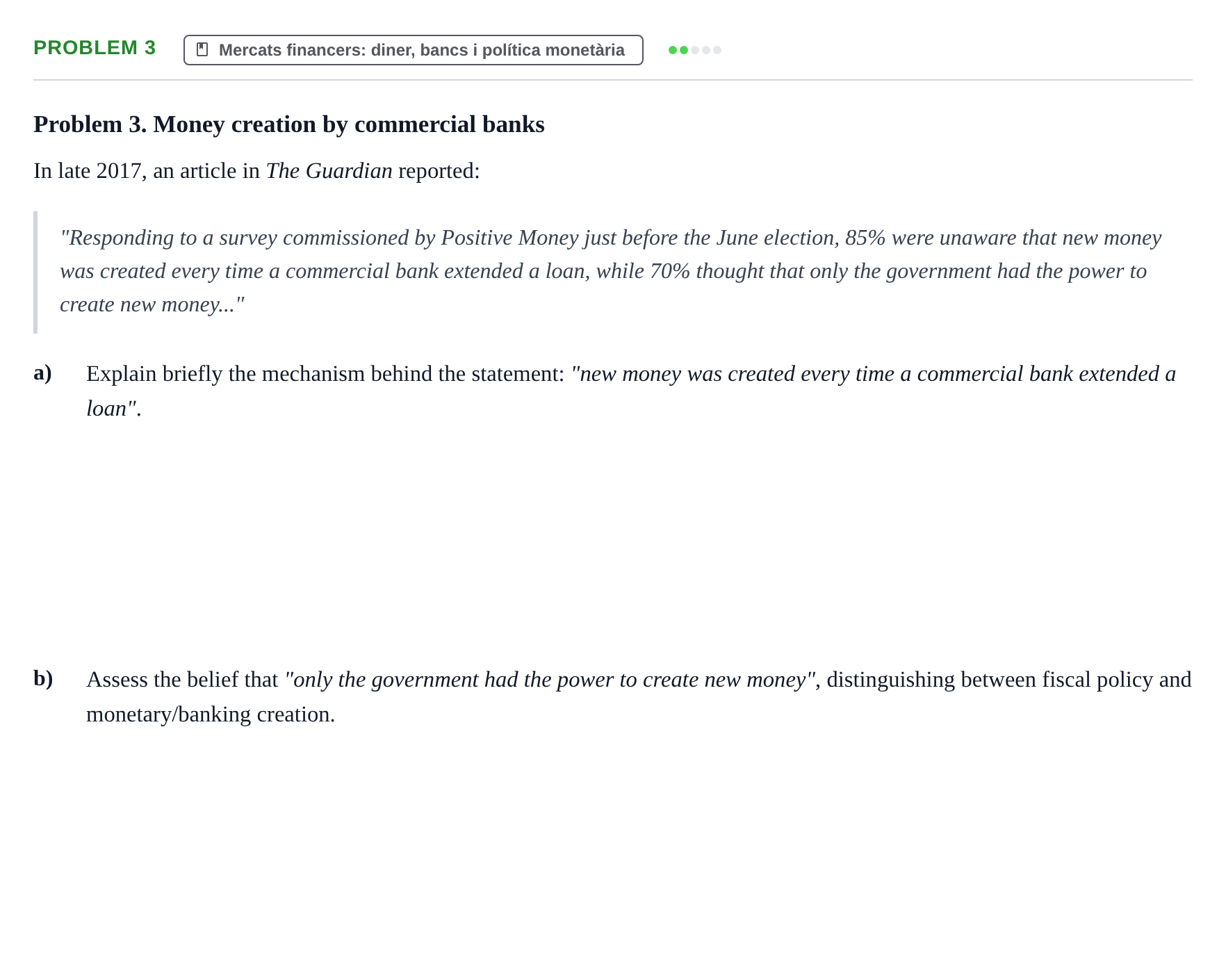
"For many people, the sense of economic uncertainty is greater than they've ever experienced. When it comes to discretionary purchases, like a new home, a car, or a washing machine, wait-and-see is the most rational course."
How does this pervasive pessimism influence consumer decisions, and which macroeconomic variable in the consumption function declines as a result?
b.
"A bit more saving is not entirely unwelcome. Many economists have long lamented the United States saving rate, which is low by international and historical standards."
Why might an attempt by all households to save more lead to adverse aggregate outcomes in the short run?
c.
"In principle, every dollar spent by the government could cause national income to increase by more than a dollar if it leads to a more vibrant economy and stimulates spending by consumers and companies..."
Explain why an increase of one dollar in public expenditure () can produce an increase in national output () greater than one dollar.