Sujet 2 - Partie 1 · Bac Anglais, monde contemporain Métropole remplacement 2024
Thème : Relation au monde – Puissance et influence · Tiré du sujet Métropole France remplacement (2024)
Énoncé
Sujet 2 — Partie 1
Le sujet porte sur la thématique « Relation au monde ».
Document A
Queen Elizabeth II epitomised Britain's soft power
Like the monarchy itself, Queen Elizabeth II, who adorned the throne of Great Britain for over 70 years as the country's longest ever serving monarch, became an institution herself. Indeed, very few people across the globe will remember a period in time when she was not the Queen of the United Kingdom.
The continuity she brought, uniting Britain, particularly, over generations and eras and the ease with which she interacted with leaders and common people across the globe is what made her the epitome and ultimate symbol of Britain's soft power. [...]
It is this longevity that made the Queen unique. She appointed 15 British prime ministers as head of that Constitutional monarchy, she saw and interacted with 14 Presidents of the United States, from President Dwight D. Eisenhower to Joe Biden and she presided over a Great Britain which lost much of its greatness as most of its erstwhile colonies became independent and threw off the colonial yoke. 1
Yet the 'Maharani' 2 managed to cobble together the former colonies into a "Commonwealth," which now comprises 54 nations. [...]
India, which also threw off the yoke of colonial authority under her Father's tenure as King, voluntarily chose to be a part of the Commonwealth and has found it a useful international forum. Queen Elizabeth [...] was a bridge between the first leaders of an India which had just gained independence from British rule and the present leadership.
India's first Prime Minister Jawaharlal Nehru attended her coronation in 1953 and, when she visited India in 1961, India's first President, Rajendra Prasad, was her host. When Queen Elizabeth last presided over the Commonwealth heads of government meeting in 2018, she hosted and met Prime Minister Narendra Modi. [...]
Although she never apologised to India for the extreme excesses of the British Empire, [...] she made efforts to portray Britain's most benignant 3 face and concern not just toward Indians and India, but most of the 120 countries she visited. [...]
Robin Oakley in Foreign Policy best summed up Queen Elizabeth II's era, saying she "may be best remembered as a leader who provided a model of constancy in a rapidly shifting world. She was admired by monarchists and republicans alike for her unswerving devotion to duty."
India News Stream, September 9, 2022
1 A yoke ( un joug) symbolises oppression.
2 Indian word for princess. Here, Queen Elizabeth II.
3 gentle
Document B
President Biden and King Charles' marriage of convenience
On the way to a NATO summit in Lithuania, President Joe Biden today made a quick stopover in England for tea with King Charles III — and an unusual discussion of policy.
Biden's first bilateral reception with Charles since he ascended the throne last September was devoted to a dialogue on environmental issues that included a joint briefing from Britain's Energy Secretary Grant Shapps and U.S. special climate envoy John Kerry on trans-Atlantic attempts to "accelerate the deployment of literally trillions of dollars" of climate change investment, according to Kerry.
Historically, visits between U.S. presidents and English monarchy have been more ceremonial than policy-oriented. [...]
In 2021, Biden told then-Prince Charles that "we need you badly" to help with climate targets at COP26. And on Sunday, before their meeting, National Security Advisor Jake Sullivan told reporters that Biden has long considered Charles a "clarion 1 voice" on climate issues.
To some degree, it is a marriage of convenience. While the official website for the British monarchy says that "The Sovereign no longer has a political or executive role," Charles isn't about to pause his lifelong work of advocating for sustainability just because he's finally on the throne. Meeting with the American president on the issue burnishes his credentials 2 on a matter he cares deeply about.
For Biden, the meeting offered an opportunity to showcase his commitment to climate issues just as his reelection campaign starts cranking — and his team has decided that investment in green technology is a winning issue.
The two were determined enough to establish a new kind of relationship that they broke protocol in other ways as well. When Biden met Charles at Windsor Castle earlier today, he patted the king on the back — a gesture that violates royal norms, though one that's commonplace for the often physically affectionate Biden. [...]
Responding to the contact, a source inside Buckingham Palace said, "His Majesty the King is entirely comfortable with that kind of contact — and what a wonderful symbol of warmth and affection it was between both the individuals and their nations." [...]
It's too early to tell if the meeting will lead to any progress on climate or significant diplomatic promises to one another. Symbolism remains at the heart of Biden and Charles' meeting today.
Politico [US edition], July 10, 2023
1 loud and clear
2 ici: renforce sa crédibilité
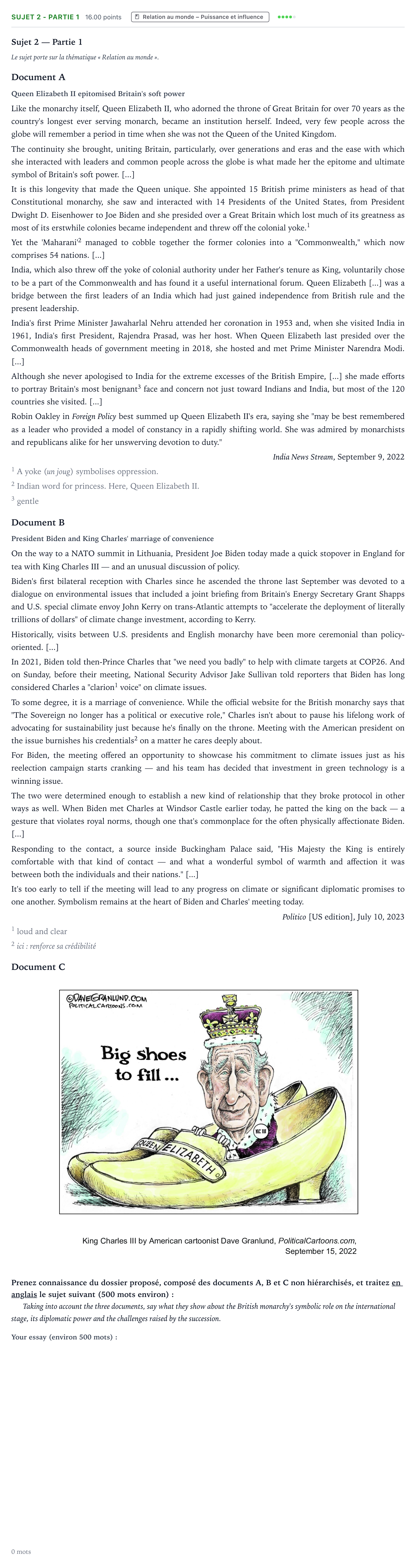
Document C
Prenez connaissance du dossier proposé, composé des documents A, B et C non hiérarchisés, et traitez en anglais le sujet suivant (500 mots environ):
Taking into account the three documents, say what they show about the British monarchy's symbolic role on the international stage, its diplomatic power and the challenges raised by the succession.
mots
Corrigé
Corrigé proposé par AprenAI (non officiel)
Taking into account the three documents, say what they show about the British monarchy's symbolic role on the international stage, its diplomatic power and the challenges raised by the succession.
Réponse : Model essay (about 500 words): The three documents highlight complementary facets of the British monarchy's relationship with the world: its symbolic influence, its informal diplomatic power, and the difficulties raised by a new monarch succeeding a long and revered reign. First, Document A shows that Queen Elizabeth II embodied Britain's soft power. Her seventy-year reign gave her unique continuity: she appointed fifteen British prime ministers, met fourteen American presidents and witnessed the decolonisation of most of the Empire. Yet this loss of formal power did not erase Britain's global standing, since she held the former colonies together in the Commonwealth, a voluntary association of 54 nations. India is a striking example: although she never apologised for the excesses of colonial rule, Elizabeth II was 'a bridge' between the first leaders of independent India and its present leadership, from Nehru to Modi. As Robin Oakley notes, she was 'a model of constancy in a rapidly shifting world', admired by monarchists and republicans alike. The monarchy's international role is thus less about hard power than about continuity, trust and image. Document B illustrates the diplomatic usefulness of the monarchy, even though the Sovereign officially 'no longer has a political or executive role'. Biden's stopover to see Charles III on his way to a NATO summit, devoted to climate investment, shows that a royal meeting can serve concrete purposes. For Charles, a long-standing environmental campaigner, it 'burnishes his credentials'; for Biden, it showcases his green commitment ahead of his reelection campaign: a 'marriage of convenience'. Biden patting the king on the back broke protocol but was welcomed by the Palace as 'a wonderful symbol of warmth', proving that the monarchy adds a personal dimension to international relations, even if, as the article admits, 'it's too early to tell' whether real progress will follow and 'symbolism remains at the heart' of the meeting. Finally, Document C, a cartoon by Dave Granlund published shortly after the Queen's death, focuses on the challenge of succession. Charles III, crowned and wearing his ermine robe, sits inside a gigantic yellow shoe labelled 'Queen Elizabeth', under the caption 'Big shoes to fill...'. His shy, uncertain smile and the disproportionate size of the shoe humorously suggest that the new king may struggle to match his mother's stature and the decades of prestige she accumulated. The challenges are clear: Charles is older, less consensual, and inherits a Commonwealth in which some countries question the Crown and its colonial past. In conclusion, the documents show that the British monarchy remains an instrument of soft power, built on symbolism, continuity and personal relationships rather than on political authority. Document B suggests that Charles III may redefine this role by using his convictions, especially on climate, to give the Crown a new diplomatic relevance. Whether he can truly fill his mother's 'big shoes' and preserve the monarchy's international appeal remains, however, an open question.
L’explication pas à pas, faite avec l’IA, est réservée aux membres Premium. Premium
Résous-le ici : correction automatique, indices et corrigé détaillé.
Sujet 1 - Partie 1 · Métropole 2022 ›