Sujet 2 - Partie 1 · Bac Anglais, monde contemporain Métropole 2025
Thème : Environnements en mutation – Repenser la ville · Tiré du sujet Métropole France (2025)
Énoncé
SUJET 2
Le sujet porte sur la thématique « Environnements en mutation ».
Document A
Detroit, Then and Now
A hundred and ten years ago, a symphony of machinery whirred as workers assembled the first Model T vehicles, regarded as the first broadly affordable car, at the bustling Ford Piquette Avenue Plant. Today, tourists stroll the aged wooden planks of the former factory floor, snapping photos of antique cars; the place that was once a symbol of American modernization now functions as a museum, and a love letter to Detroit’s past. The Motor City, the eponymous home of Motown Records, has been inextricably linked to the auto-manufacturing industry ever since Henry Ford débuted those cars at his factory.
In the nineteen-forties, Detroit was the fourth-largest city in America, drawing in workers with opportunities for stable employment on the assembly lines at the Ford, General Motors, and Chrysler plants. Starting in the fifties, however, the auto industry spread beyond Detroit: factories closed, and jobs vanished from the city that had been the center of the industry. The effects of that shift are still visible. […] Many facilities, now unused, serve as vandalized monuments to deindustrialization. The city rapidly became the textbook example of urban decay. Although more than 1.8 million people lived in the Motor City at its peak, fewer than seven hundred thousand now call Detroit home. In 2013, the city filed for the largest municipal bankruptcy in U.S. history.
Select areas of Detroit are now in the midst of another radical transformation. In the city’s core, developers have converted crumbling buildings into upscale apartments and have launched a new streetcar system. Coffee shops and trendy restaurants with Instagram-friendly offerings populate formerly abandoned streets. In Brooklyn and Manhattan, billboards 1 have popped up with messages attempting to lure gentrifiers 2 to Detroit. Many note that the revitalization of “America’s Comeback City” has been primarily confined to the downtown and midtown areas; blight and depression still loom in predominantly black neighborhoods outside the city center. Some argue that this focus on developing the city’s core has drawn attention and resources from communities that are still dealing with a housing crisis, a lack of city services, and widespread displacement. Amid the ongoing change, there is cautious optimism, among some, that Detroit’s motto— Speramus meliora; resurget cineribus (We hope for better things; it shall arise from the ashes)—will prove to be prescient.
The New Yorker, June 19, 2018
1 advertising panels
2 attract people who have money
Document B
Rising costs and gentrification force locals out of Detroit’s downtown and Midtown
Detroit is one of the poorest cities in the country, but it has one of the fastest growing rental rates 1 in the country, according to several market research reports. Since 2017, the average rent in Detroit has increased a staggering 46.2%, from 1,215, according to rent.com, which tracks apartment rates. During that period, the average annual income in Detroit has risen a modest 11%, from 34,762, according to census estimates.
Some of the steepest increases in rent occurred during the COVID-19 pandemic, at a time when Black Detroiters were disproportionately hit hard by unemployment.
Rising rental costs are especially worrisome in Detroit because about half of the city’s residents are renters, not owners.
HUD 2 recommends that renters spend no more than 30% of their income on rent. For the average Detroit household, that means spending no more than $869 a month, a rate that is exceedingly difficult to find. […]
Over the past decade, dozens of apartment buildings have been renovated or built downtown and in surrounding neighborhoods, attracting predominantly young, white, suburban professionals who can afford to pay high rents that often exceed $1,800 a month. As a result, these areas are losing their diversity and becoming inaccessible to lower-income and even middle-income Detroiters. […]
“Real estate speculation is driving gentrification,” says Linda Campbell, director of the Detroit People’s Platform, an activist group that promotes a more equitable city. “The disappointment for us is that the city government has failed majority Black Detroit. It feels like our community planning process is being driven by real estate speculation, as opposed to thoughtful, long-term planning for stabilization.” […]
The escalating housing costs are a key factor driving people out of Detroit, housing advocates say.
“We look at the latest trends at what’s happening in Detroit, and we see that Black Detroiters are leaving,” Campbell says. “They are finding that Detroit is no longer a place they want to call home. A model of economic development that is more equitable would lend itself 3 in the long-term to attracting residents back to the city.”
Detroit Metro Times, July 19, 2023
1 prices
2 US Department of Housing and Urban Development
3 contribute
Document C
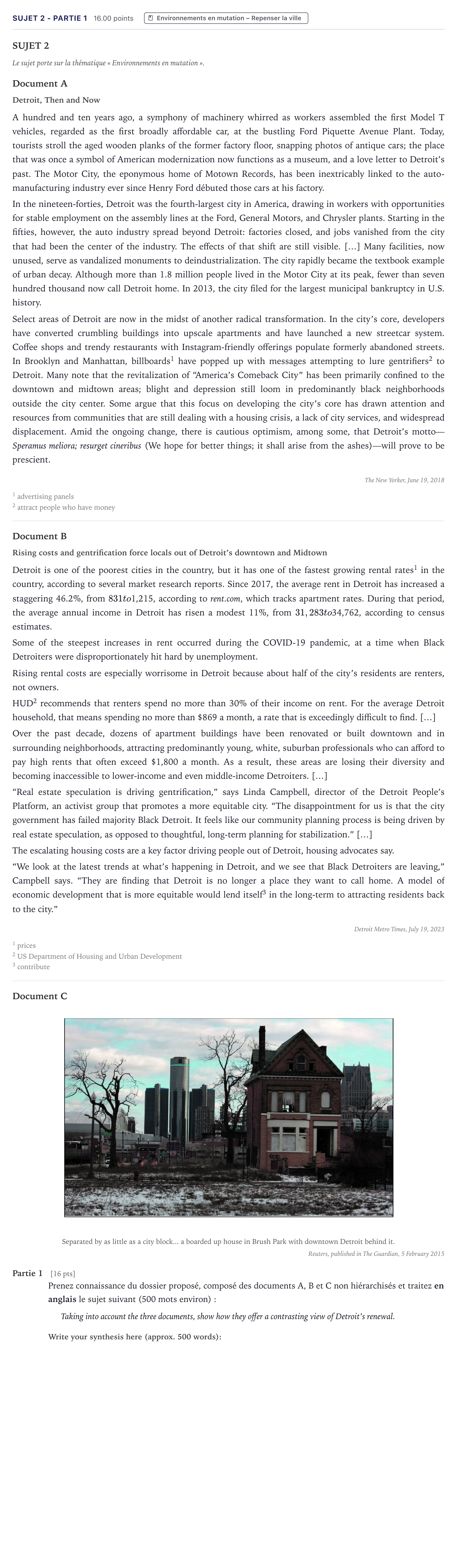
Separated by as little as a city block... a boarded up house in Brush Park with downtown Detroit behind it.
Reuters, published in The Guardian, 5 February 2015
Partie 1
[16 pts]
Prenez connaissance du dossier proposé, composé des documents A, B et C non hiérarchisés et traitez en anglais le sujet suivant (500 mots environ):
Taking into account the three documents, show how they offer a contrasting view of Detroit’s renewal.
Corrigé
Corrigé proposé par AprenAI (non officiel)
Taking into account the three documents, show how they offer a contrasting view of Detroit’s renewal.
Réponse : Once celebrated as the thriving heart of American industrial might, Detroit experienced one of the most dramatic urban decays in modern history, culminating in the nation's largest municipal bankruptcy in 2013. In recent years, a powerful narrative of rebirth has emerged. However, the three documents in the dossier collectively challenge this simplistic triumphant story, highlighting deep economic, spatial, and racial disparities. On the surface, Detroit appears to be experiencing an extraordinary revival. Document A highlights the transformation of former industrial landmarks into tourist attractions—such as the Ford Piquette Avenue Plant becoming a museum—and points to the bustling urban core where private developers have restored historic buildings into high-end apartments. Trendy coffee shops, upscale restaurants, and a new streetcar line symbolize this newfound vitality, which is actively marketed to affluent newcomers from cities like New York. This gleaming skyline is strikingly captured in Document C, where the futuristic glass towers of the Renaissance Center rise prominently in the background, projecting modern corporate confidence and metropolitan recovery. Yet, this optimistic façade masks a far bleaker reality for longtime residents. Both Document A and Document B underscore that this renaissance is strictly circumscribed to downtown and Midtown, leaving outlying, predominantly African American neighborhoods mired in blight, poverty, and urban neglect. As Linda Campbell of the Detroit People's Platform argues in Document B, municipal planning has prioritized real estate speculation over equitable community development. The revitalization has fueled aggressive gentrification: average rents surged by 46.2% between 2017 and 2023, while household incomes rose by merely 11%. With median rent requirements vastly exceeding the recommended 30% of income threshold, lower- and middle-income Detroiters find themselves priced out of their own city, prompting an exodus of native Black residents. This profound geographical and social fissure is visually epitomized by Document C. In the foreground stands an abandoned, boarded-up brick house in Brush Park, surrounded by barren, snow-covered wasteland. In the immediate background, merely a block away, loom the shiny downtown skyscrapers. This juxtaposition visually crystallizes Detroit's "tale of two cities": an island of affluent redevelopment surrounded by persistent structural abandonment. In conclusion, while marketing campaigns and media reports celebrate Detroit as "America's Comeback City," the documents reveal a deeply fragmented transformation. The city's renewal does not represent an inclusive rebirth, but rather an unequal process of gentrification that benefits wealthy outsiders and corporate interests while exacerbating displacement, economic hardship, and racial segregation for the majority of Detroiters.
L’explication pas à pas, faite avec l’IA, est réservée aux membres Premium. Premium
Résous-le ici : correction automatique, indices et corrigé détaillé.
Sujet 2 - Partie 1 · Métropole 2024 ›