Sujet 1 - Partie 1 · Bac Anglais, monde contemporain Métropole 2023
Thème : Environnements en mutation – Protection de la nature et transition écologique · Tiré du sujet Métropole France (2023)
Énoncé
Document A
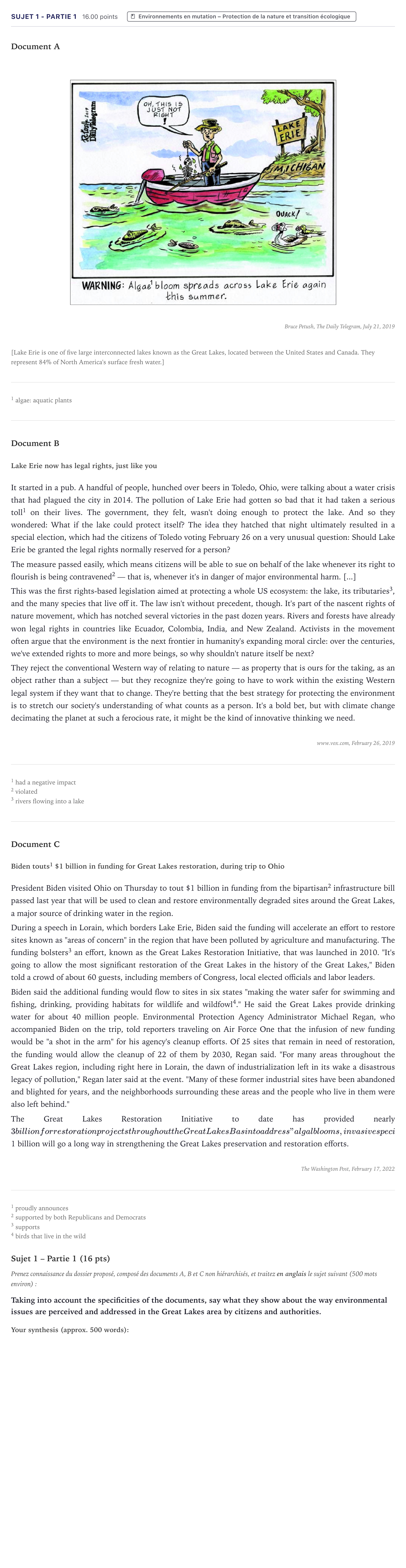
Bruce Petush, The Daily Telegram, July 21, 2019
[Lake Erie is one of five large interconnected lakes known as the Great Lakes, located between the United States and Canada. They represent 84% of North America's surface fresh water.]
1 algae: aquatic plants
Document B
Lake Erie now has legal rights, just like you
It started in a pub. A handful of people, hunched over beers in Toledo, Ohio, were talking about a water crisis that had plagued the city in 2014. The pollution of Lake Erie had gotten so bad that it had taken a serious toll 1 on their lives. The government, they felt, wasn't doing enough to protect the lake. And so they wondered: What if the lake could protect itself? The idea they hatched that night ultimately resulted in a special election, which had the citizens of Toledo voting February 26 on a very unusual question: Should Lake Erie be granted the legal rights normally reserved for a person?
The measure passed easily, which means citizens will be able to sue on behalf of the lake whenever its right to flourish is being contravened 2 — that is, whenever it's in danger of major environmental harm. [...]
This was the first rights-based legislation aimed at protecting a whole US ecosystem: the lake, its tributaries 3, and the many species that live off it. The law isn't without precedent, though. It's part of the nascent rights of nature movement, which has notched several victories in the past dozen years. Rivers and forests have already won legal rights in countries like Ecuador, Colombia, India, and New Zealand. Activists in the movement often argue that the environment is the next frontier in humanity's expanding moral circle: over the centuries, we've extended rights to more and more beings, so why shouldn't nature itself be next?
They reject the conventional Western way of relating to nature — as property that is ours for the taking, as an object rather than a subject — but they recognize they're going to have to work within the existing Western legal system if they want that to change. They're betting that the best strategy for protecting the environment is to stretch our society's understanding of what counts as a person. It's a bold bet, but with climate change decimating the planet at such a ferocious rate, it might be the kind of innovative thinking we need.
www.vox.com, February 26, 2019
1 had a negative impact
2 violated
3 rivers flowing into a lake
Document C
Biden touts 1 $1 billion in funding for Great Lakes restoration, during trip to Ohio
President Biden visited Ohio on Thursday to tout $1 billion in funding from the bipartisan 2 infrastructure bill passed last year that will be used to clean and restore environmentally degraded sites around the Great Lakes, a major source of drinking water in the region.
During a speech in Lorain, which borders Lake Erie, Biden said the funding will accelerate an effort to restore sites known as "areas of concern" in the region that have been polluted by agriculture and manufacturing. The funding bolsters 3 an effort, known as the Great Lakes Restoration Initiative, that was launched in 2010. "It's going to allow the most significant restoration of the Great Lakes in the history of the Great Lakes," Biden told a crowd of about 60 guests, including members of Congress, local elected officials and labor leaders.
Biden said the additional funding would flow to sites in six states "making the water safer for swimming and fishing, drinking, providing habitats for wildlife and wildfowl 4." He said the Great Lakes provide drinking water for about 40 million people. Environmental Protection Agency Administrator Michael Regan, who accompanied Biden on the trip, told reporters traveling on Air Force One that the infusion of new funding would be "a shot in the arm" for his agency's cleanup efforts. Of 25 sites that remain in need of restoration, the funding would allow the cleanup of 22 of them by 2030, Regan said. "For many areas throughout the Great Lakes region, including right here in Lorain, the dawn of industrialization left in its wake a disastrous legacy of pollution," Regan later said at the event. "Many of these former industrial sites have been abandoned and blighted for years, and the neighborhoods surrounding these areas and the people who live in them were also left behind."
The Great Lakes Restoration Initiative to date has provided nearly 1 billion will go a long way in strengthening the Great Lakes preservation and restoration efforts.
The Washington Post, February 17, 2022
1 proudly announces
2 supported by both Republicans and Democrats
3 supports
4 birds that live in the wild
Sujet 1 – Partie 1 (16 pts)
Prenez connaissance du dossier proposé, composé des documents A, B et C non hiérarchisés, et traitez en anglais le sujet suivant (500 mots environ):
Taking into account the specificities of the documents, say what they show about the way environmental issues are perceived and addressed in the Great Lakes area by citizens and authorities.
Corrigé
Corrigé proposé par AprenAI (non officiel)
Taking into account the specificities of the documents, say what they show about the way environmental issues are perceived and addressed in the Great Lakes area by citizens and authorities.
Réponse : ### Sample Synthesis The Great Lakes basin, holding 84% of North America's surface fresh water, is a critical ecological resource now facing severe human-made degradation. The dossier examines how this environmental problem is perceived and addressed, through a political cartoon by Bruce Petush (Doc A, 2019), a *Vox* article on grassroots legal activism in Toledo (Doc B, 2019) and a *Washington Post* report on federal environmental policy (Doc C, 2022). First, the documents portray an alarming ecological crisis marked by chronic pollution and threatened biodiversity. Document A uses dark humour to convey urgency. A fisherman pulls a fish skeleton out of green, algae-choked water. Dead fish float around him and a duck seems to wear a protective mask. His understatement ("Oh, this is just not right!") expresses both bewilderment and a kind of resignation, and the caption's word "again" stresses that the algae bloom is recurrent. Document B explains that the pollution reached a breaking point during the 2014 Toledo water crisis, which "took a serious toll" on residents' lives. In Document C, EPA Administrator Michael Regan points to the historical roots of the problem. Agriculture and manufacturing have left a "disastrous legacy of pollution" that endangers the drinking water of about 40 million people and has left whole neighbourhoods behind. Faced with this threat, citizens and authorities respond in very different ways. For ordinary residents, the feeling that the government "wasn't doing enough" led to a bold, unconventional initiative. As Document B reports, a handful of people in a pub came up with an idea that led to a special election. Toledo voters then granted Lake Erie legal rights normally reserved for persons. Citizens can now sue on behalf of the lake whenever its right to flourish is violated. This rights-of-nature approach, already adopted in Ecuador, Colombia, India and New Zealand, rejects the Western view of nature as property. Instead, it treats nature as a subject with rights, while still working within the existing legal system. By contrast, the authorities rely on conventional, top-down action and massive financial investment. Document C shows President Biden proudly announcing 3 billion. Here the lakes are presented above all as a resource and a public-health issue: drinking water, swimming, fishing and wildlife habitats. The visit also has an obvious political dimension, staged before elected officials and labour leaders. The approach is one of remediation: cleaning up 22 of the 25 remaining "areas of concern" by 2030. In conclusion, the dossier reveals a shared awareness of a serious and recurring environmental crisis in the Great Lakes area, but two contrasting responses. Citizens, frustrated and directly affected, see the crisis as an emergency that calls for a radical rethinking of humanity's relationship with nature, embodied in legal personhood for the lake. The authorities, after years of perceived inaction, prioritise pragmatic, consensual and well-funded restoration programmes focused on human needs and economic revival. Each document, whether satirical, activist or journalistic, thus sheds light on a complementary facet of the same challenge. Grassroots pressure and public money may both be needed to save the Great Lakes.
L’explication pas à pas, faite avec l’IA, est réservée aux membres Premium. Premium
Résous-le ici : correction automatique, indices et corrigé détaillé.
Sujet 2 - Partie 1 · Métropole remplacement 2022 ›