Sujet 2 - 2e partie · Bac Anglais Métropole 2023
Thème : Traduction en français d'un passage du dossier · Tiré du sujet Métropole France (2023)
Énoncé
Document A
Holly is a devoted mother and a writer. She is waking up late on Christmas morning.
And then Holly thought, I must write this down before it slips away. It was that feeling she used to have when she was younger – the almost panicked desire to write about something she’d half glimpsed, to get it on the page before it dashed away again. Sometimes it had felt nearly nauseating, that desire to yank it out of herself and put it into written words before it hid away behind some organ deep inside her – some maroonish, liverish, gillish organ she’d have to pry behind, as if fingering it out a turkey carcass, ever to get at it again. That’s what writing a poem used to feel like to Holly, and why she’d quit writing poems.
My God, though, this thought was like a poem – a secret, a truth, just out of reach. Holly would need this time to pluck this out and examine in the light, but it was in her, whether she’d known or not until now. Like a poem, that wanted to be written. A truth insisting on recognition. […]
Holly needed to write down these things, this evidence! […]
How long it had been since she’d woken up needing to write? God, how Holly used to need to write. Now she needed to write again. What time was it? She was still in bed, or in bed again. Had she already risen, looked in on her daughter? Or had that been a dream? She’d come back to bed and slipped again into sleep? Perhaps. Now she didn’t need to open her eyes to know that it was morning, that it was snowing.
Was there a pen in this room? If she found a pen before Eric and Tatiana woke up, would she be able to actually sit down and write? That broken habit. That abandoned necessity.
Holly thought she could. She would be able to write. She could feel it – the bitter ache of it. There was some awful pressure on her lungs. There was, she felt, something stoppered up in her torso. She imagined vomiting it out of herself, like vomiting up a swan—something with a long, tangled throat nestled inside her own throat – choking on its feathers and all its bony quills. How relieved she would feel afterward, lying on the bedroom floor beside the swan she’d vomited out of herself into the world.
Laura KASISCHKE, Mind of Winter, 2015.
Document B
Here in this rural-suburban community in New Jersey where I was born fifty-three years ago, and where I have lived with my dear wife, Irina, for more than seventeen years, I am known as “Andrew J. Rush”—arguably the most famous of local residents, author of bestselling mystery-suspense novels with a touch of the macabre. (Not an excessive touch, not nasty-mean, or disturbing. Never obscene, nor even sexist. Women are treated graciously in my mysteries, apart from a few obligatory noir performances. Corpses are likely to be white adult males.) With my third bestseller in the 1990s it began to be said about me in the media— Andrew J. Rush is the gentleman’s Stephen King.
Of course, I was flattered. Sales of my novels, though in the millions after a quarter-century of effort, are yet in the double-digit millions and not the triple digit like Stephen King’s. And though my novels have been translated into as many as thirty languages—(quite a surprise to me who knows only one language)—I am sure that Stephen King’s books have been translated into even more, and more profitably. And only three of my novels have been adapted into (quickly forgotten) films, and only two into (less-than-premium cable) TV dramas—unlike King, whose adaptations are too many to count.
So far as money is concerned there is no comparing Andrew J. Rush and Stephen King. But when you have made, after taxes, somewhere in excess of thirty million dollars, you simply stopped thinking about money, as perhaps, a serial killer simply stops thinking about how many people he has killed, after a few dozen victims.
(Excuse me! I think that must have been a callous 1 remark, which I’m sure would provoke my dear Irina to kick my ankle in reprimand as she sometimes does when I misspeak in public. I did not mean to be callous at all but only just ‘witty’—in my clumsy way.)
Joyce Carol OATES, Jack of Spades, 2015.
1 callous: who feels no emotion.
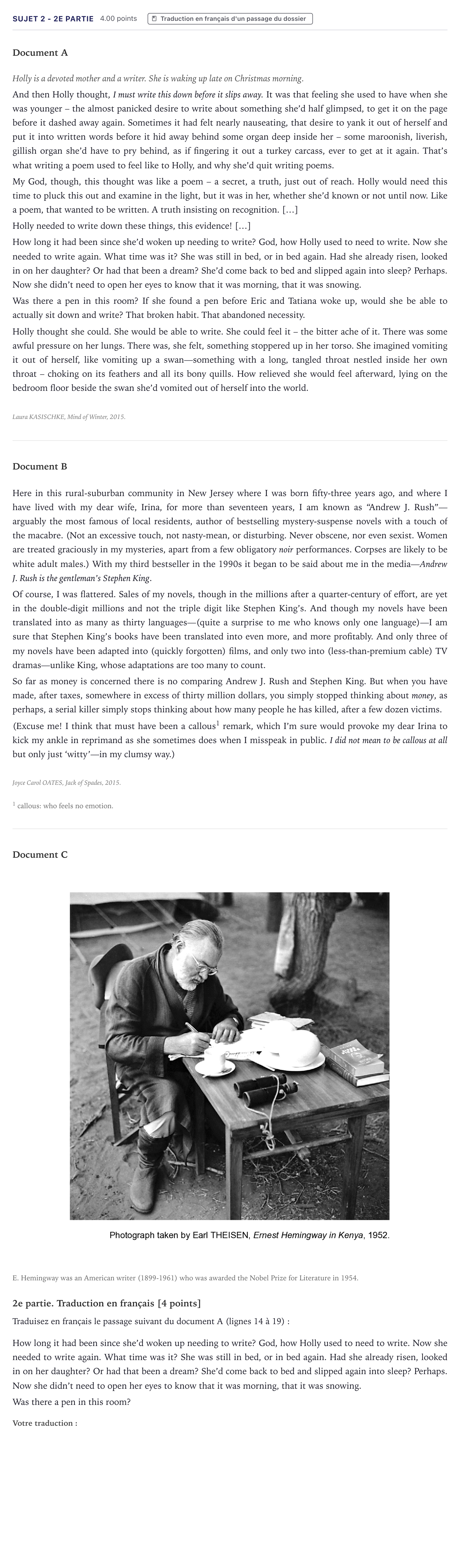
Document C
E. Hemingway was an American writer (1899-1961) who was awarded the Nobel Prize for Literature in 1954.
2e partie. Traduction en français [4 points]
Traduisez en français le passage suivant du document A (lignes 14 à 19):
How long it had been since she’d woken up needing to write? God, how Holly used to need to write. Now she needed to write again. What time was it? She was still in bed, or in bed again. Had she already risen, looked in on her daughter? Or had that been a dream? She’d come back to bed and slipped again into sleep? Perhaps. Now she didn’t need to open her eyes to know that it was morning, that it was snowing.
Was there a pen in this room?
Corrigé
Corrigé proposé par AprenAI (non officiel)
Traduisez en français le passage suivant du document A (lignes 14 à 19) :
Réponse : Combien de temps s'était-il écoulé depuis qu'elle s'était réveillée avec le besoin d'écrire ? Mon Dieu, à quel point Holly avait eu besoin d'écrire autrefois. À présent, elle avait de nouveau besoin d'écrire. Quelle heure était-il ? Elle était toujours au lit, ou de nouveau au lit. S'était-elle déjà levée, était-elle allée voir sa fille ? Ou bien n'était-ce qu'un rêve ? Était-elle revenue se coucher et avait-elle replongé dans le sommeil ? Peut-être. Désormais, elle n'avait pas besoin d'ouvrir les yeux pour savoir que c'était le matin, qu'il neigeait. Y avait-il un stylo dans cette pièce ?
L’explication pas à pas, faite avec l’IA, est réservée aux membres Premium. Premium
Résous-le ici : correction automatique, indices et corrigé détaillé.
‹ Sujet 1 - 2e partie · Métropole 2023 · Sujet 1 - 2e partie : Traduction · Métropole 2022 ›
Plus d’exercices de Traduction en français d'un passage du dossier
- Sujet 1 - Partie 2 · Métropole 2024
- Sujet 2 - Partie 2 · Métropole 2024
- Sujet 1 - Partie 2 · Métropole remplacement 2024
- Sujet 2 - Partie 2 · Métropole remplacement 2024
- Sujet 1 - 2e partie · Métropole 2023
- Sujet 1 - 2e partie : Traduction · Métropole 2022
- Sujet 2 - 2e partie : Traduction · Métropole 2022
- Sujet 2 - 2e partie · Métropole remplacement 2022
- Sujet 1 - Partie 2 · Métropole Candidat libre 2021 (sujet 2)
- Sujet 2 - Partie 2 · Métropole Candidat libre 2021 (sujet 2)