Aufgabe 1 · Abitur NRW Englisch LK · Landrieu: Speech on the Removal of 2020
Thema: Textverständnis: Inhalte wiedergeben (Outline / Sum up) · Aus der Prüfung LK · Landrieu: Speech on the Removal of Confederate Monuments in New Orleans (2020)
Aufgabenstellung
Material
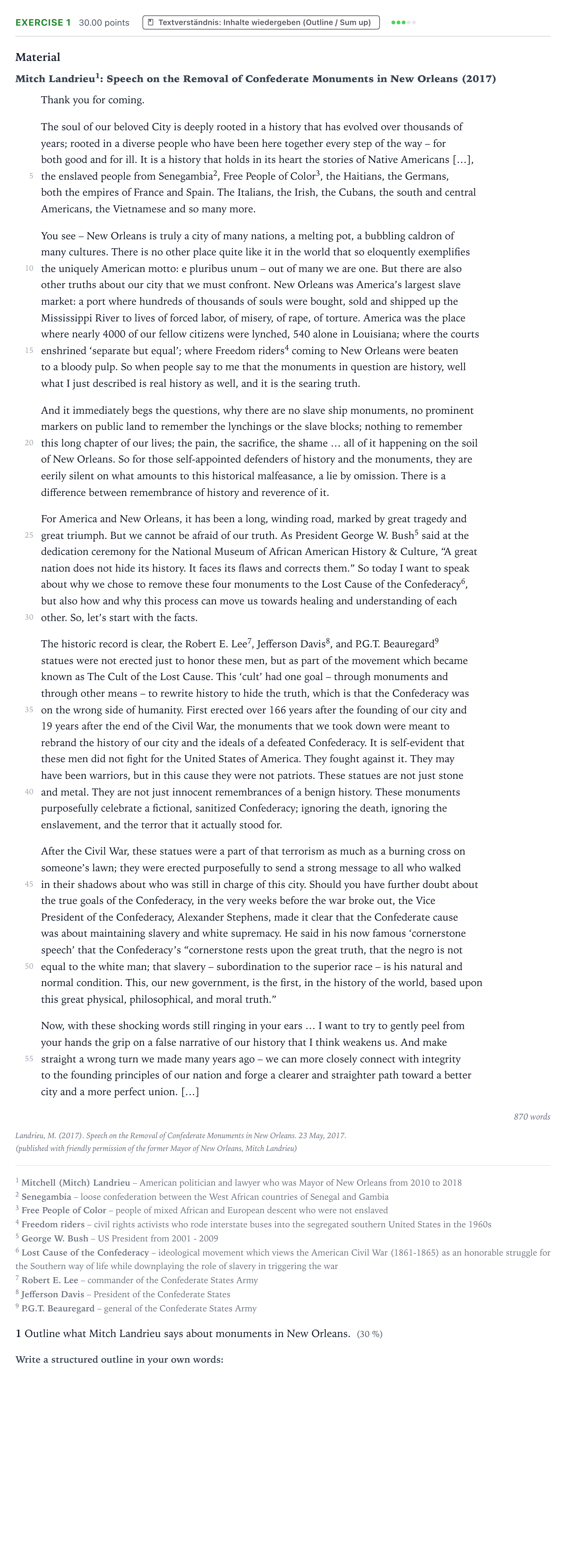
Mitch Landrieu 1: Speech on the Removal of Confederate Monuments in New Orleans (2017)
Thank you for coming.
The soul of our beloved City is deeply rooted in a history that has evolved over thousands of
years; rooted in a diverse people who have been here together every step of the way – for
both good and for ill. It is a history that holds in its heart the stories of Native Americans […],
5 the enslaved people from Senegambia 2, Free People of Color 3, the Haitians, the Germans,
both the empires of France and Spain. The Italians, the Irish, the Cubans, the south and central
Americans, the Vietnamese and so many more.
You see – New Orleans is truly a city of many nations, a melting pot, a bubbling caldron of
many cultures. There is no other place quite like it in the world that so eloquently exemplifies
10 the uniquely American motto: e pluribus unum – out of many we are one. But there are also
other truths about our city that we must confront. New Orleans was America’s largest slave
market: a port where hundreds of thousands of souls were bought, sold and shipped up the
Mississippi River to lives of forced labor, of misery, of rape, of torture. America was the place
where nearly 4000 of our fellow citizens were lynched, 540 alone in Louisiana; where the courts
15 enshrined ‘separate but equal’; where Freedom riders 4 coming to New Orleans were beaten
to a bloody pulp. So when people say to me that the monuments in question are history, well
what I just described is real history as well, and it is the searing truth.
And it immediately begs the questions, why there are no slave ship monuments, no prominent
markers on public land to remember the lynchings or the slave blocks; nothing to remember
20 this long chapter of our lives; the pain, the sacrifice, the shame … all of it happening on the soil
of New Orleans. So for those self-appointed defenders of history and the monuments, they are
eerily silent on what amounts to this historical malfeasance, a lie by omission. There is a
difference between remembrance of history and reverence of it.
For America and New Orleans, it has been a long, winding road, marked by great tragedy and
25 great triumph. But we cannot be afraid of our truth. As President George W. Bush 5 said at the
dedication ceremony for the National Museum of African American History & Culture, “A great
nation does not hide its history. It faces its flaws and corrects them.” So today I want to speak
about why we chose to remove these four monuments to the Lost Cause of the Confederacy 6,
but also how and why this process can move us towards healing and understanding of each
30 other. So, let’s start with the facts.
The historic record is clear, the Robert E. Lee 7, Jefferson Davis 8, and P.G.T. Beauregard 9
statues were not erected just to honor these men, but as part of the movement which became
known as The Cult of the Lost Cause. This ‘cult’ had one goal – through monuments and
through other means – to rewrite history to hide the truth, which is that the Confederacy was
35 on the wrong side of humanity. First erected over 166 years after the founding of our city and
19 years after the end of the Civil War, the monuments that we took down were meant to
rebrand the history of our city and the ideals of a defeated Confederacy. It is self-evident that
these men did not fight for the United States of America. They fought against it. They may
have been warriors, but in this cause they were not patriots. These statues are not just stone
40 and metal. They are not just innocent remembrances of a benign history. These monuments
purposefully celebrate a fictional, sanitized Confederacy; ignoring the death, ignoring the
enslavement, and the terror that it actually stood for.
After the Civil War, these statues were a part of that terrorism as much as a burning cross on
someone’s lawn; they were erected purposefully to send a strong message to all who walked
45 in their shadows about who was still in charge of this city. Should you have further doubt about
the true goals of the Confederacy, in the very weeks before the war broke out, the Vice
President of the Confederacy, Alexander Stephens, made it clear that the Confederate cause
was about maintaining slavery and white supremacy. He said in his now famous ‘cornerstone
speech’ that the Confederacy’s “cornerstone rests upon the great truth, that the negro is not
50 equal to the white man; that slavery – subordination to the superior race – is his natural and
normal condition. This, our new government, is the first, in the history of the world, based upon
this great physical, philosophical, and moral truth.”
Now, with these shocking words still ringing in your ears … I want to try to gently peel from
your hands the grip on a false narrative of our history that I think weakens us. And make
55 straight a wrong turn we made many years ago – we can more closely connect with integrity
to the founding principles of our nation and forge a clearer and straighter path toward a better
city and a more perfect union. […]
870 words
Landrieu, M. (2017). Speech on the Removal of Confederate Monuments in New Orleans. 23 May, 2017.
(published with friendly permission of the former Mayor of New Orleans, Mitch Landrieu)
1 Mitchell (Mitch) Landrieu – American politician and lawyer who was Mayor of New Orleans from 2010 to 2018
2 Senegambia – loose confederation between the West African countries of Senegal and Gambia
3 Free People of Color – people of mixed African and European descent who were not enslaved
4 Freedom riders – civil rights activists who rode interstate buses into the segregated southern United States in the 1960s
5 George W. Bush – US President from 2001 - 2009
6 Lost Cause of the Confederacy – ideological movement which views the American Civil War (1861-1865) as an honorable struggle for the Southern way of life while downplaying the role of slavery in triggering the war
7 Robert E. Lee – commander of the Confederate States Army
8 Jefferson Davis – President of the Confederate States
9 P.G.T. Beauregard – general of the Confederate States Army
1 Outline what Mitch Landrieu says about monuments in New Orleans. (30 %)
Lösung
Nach den offiziellen Korrekturhinweisen
1 Outline what Mitch Landrieu says about monuments in New Orleans.
Lösung: Based on the speech, Mitch Landrieu points out the following key aspects regarding monuments in New Orleans: - There are no monuments or prominent public markers dedicated to the suffering, lynching, slave blocks, and oppression of enslaved African-Americans in New Orleans. - Existing Confederate monuments represent only one, wrong side of American history, failing to acknowledge the victims of slavery and violence. - These statues were not erected simply to honor historical figures, but as part of "The Cult of the Lost Cause" designed to rewrite history, hide the truth, and conceal the fact that the Confederacy fought against the United States. - They purposefully celebrate a fictional, sanitized Confederacy while ignoring the brutality, death, and terror of slavery and white supremacy. - Erected decades after the Civil War, they served as a clear intimidation and warning to African-Americans about who still held power in the city. - Removing the monuments is an essential step toward facing historical flaws, reconnecting with the nation's true founding principles, and moving toward healing and a better future.
Die ausführliche Erklärung Schritt für Schritt (mit KI) gibt es mit Premium. Premium
Löse sie direkt hier: automatische Korrektur, Hinweise und Lösung Schritt für Schritt.
‹ Aufgabe 1 · GK · Vick: Where Did America's Summer Jo 2020