Aufgabe 1 · Abitur NRW Englisch GK · Vick: Where Did America's Summer Jo 2020
Thema: Textverständnis: Inhalte wiedergeben (Outline / Sum up) · Aus der Prüfung GK · Vick: Where Did America's Summer Jobs Go? (2020)
Aufgabenstellung
Material 1
Karl Vick: Where Did America's Summer Jobs Go? (2017)
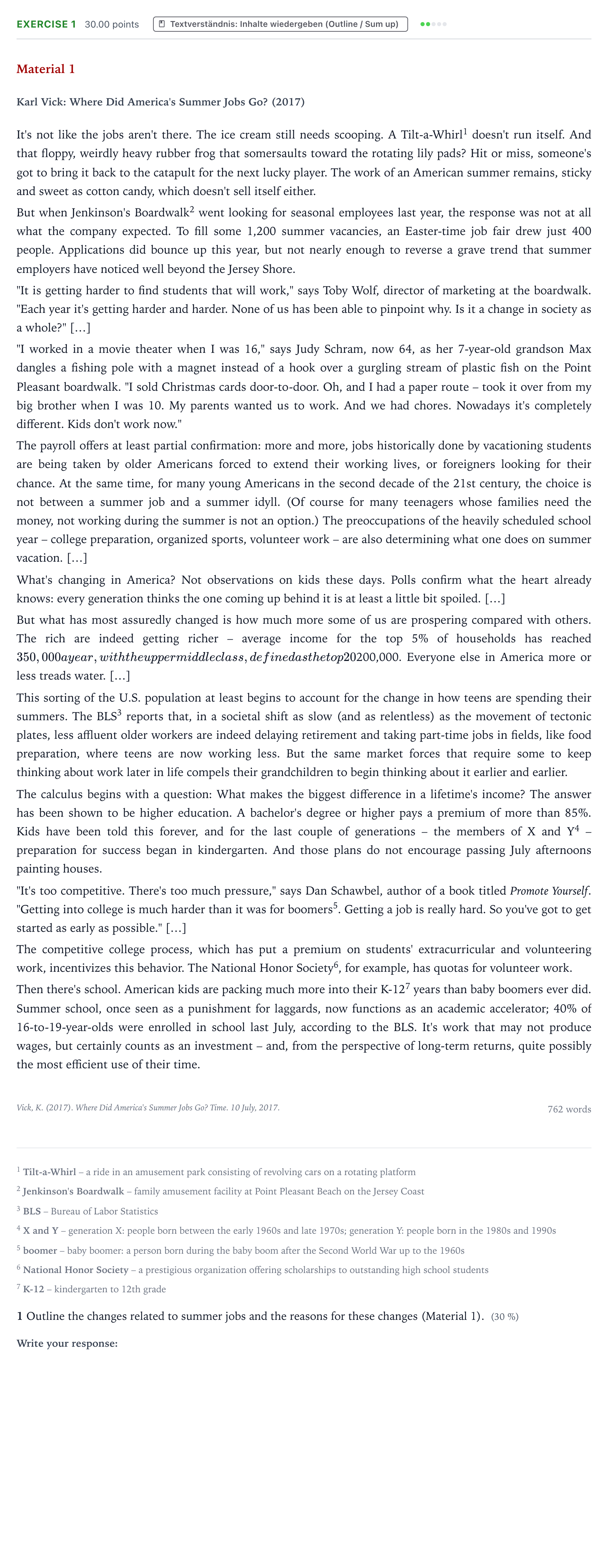
It's not like the jobs aren't there. The ice cream still needs scooping. A Tilt-a-Whirl 1 doesn't run itself. And that floppy, weirdly heavy rubber frog that somersaults toward the rotating lily pads? Hit or miss, someone's got to bring it back to the catapult for the next lucky player. The work of an American summer remains, sticky and sweet as cotton candy, which doesn't sell itself either.
But when Jenkinson's Boardwalk 2 went looking for seasonal employees last year, the response was not at all what the company expected. To fill some 1,200 summer vacancies, an Easter-time job fair drew just 400 people. Applications did bounce up this year, but not nearly enough to reverse a grave trend that summer employers have noticed well beyond the Jersey Shore.
"It is getting harder to find students that will work," says Toby Wolf, director of marketing at the boardwalk. "Each year it's getting harder and harder. None of us has been able to pinpoint why. Is it a change in society as a whole?" […]
"I worked in a movie theater when I was 16," says Judy Schram, now 64, as her 7-year-old grandson Max dangles a fishing pole with a magnet instead of a hook over a gurgling stream of plastic fish on the Point Pleasant boardwalk. "I sold Christmas cards door-to-door. Oh, and I had a paper route – took it over from my big brother when I was 10. My parents wanted us to work. And we had chores. Nowadays it's completely different. Kids don't work now."
The payroll offers at least partial confirmation: more and more, jobs historically done by vacationing students are being taken by older Americans forced to extend their working lives, or foreigners looking for their chance. At the same time, for many young Americans in the second decade of the 21st century, the choice is not between a summer job and a summer idyll. (Of course for many teenagers whose families need the money, not working during the summer is not an option.) The preoccupations of the heavily scheduled school year – college preparation, organized sports, volunteer work – are also determining what one does on summer vacation. […]
What's changing in America? Not observations on kids these days. Polls confirm what the heart already knows: every generation thinks the one coming up behind it is at least a little bit spoiled. […]
But what has most assuredly changed is how much more some of us are prospering compared with others. The rich are indeed getting richer – average income for the top 5% of households has reached 200,000. Everyone else in America more or less treads water. […]
This sorting of the U.S. population at least begins to account for the change in how teens are spending their summers. The BLS 3 reports that, in a societal shift as slow (and as relentless) as the movement of tectonic plates, less affluent older workers are indeed delaying retirement and taking part-time jobs in fields, like food preparation, where teens are now working less. But the same market forces that require some to keep thinking about work later in life compels their grandchildren to begin thinking about it earlier and earlier.
The calculus begins with a question: What makes the biggest difference in a lifetime's income? The answer has been shown to be higher education. A bachelor's degree or higher pays a premium of more than 85%. Kids have been told this forever, and for the last couple of generations – the members of X and Y 4 – preparation for success began in kindergarten. And those plans do not encourage passing July afternoons painting houses.
"It's too competitive. There's too much pressure," says Dan Schawbel, author of a book titled Promote Yourself. "Getting into college is much harder than it was for boomers 5. Getting a job is really hard. So you've got to get started as early as possible." […]
The competitive college process, which has put a premium on students' extracurricular and volunteering work, incentivizes this behavior. The National Honor Society 6, for example, has quotas for volunteer work.
Then there's school. American kids are packing much more into their K-12 7 years than baby boomers ever did. Summer school, once seen as a punishment for laggards, now functions as an academic accelerator; 40% of 16-to-19-year-olds were enrolled in school last July, according to the BLS. It's work that may not produce wages, but certainly counts as an investment – and, from the perspective of long-term returns, quite possibly the most efficient use of their time.
Vick, K. (2017). Where Did America's Summer Jobs Go? Time. 10 July, 2017.
762 words
1 Tilt-a-Whirl – a ride in an amusement park consisting of revolving cars on a rotating platform
2 Jenkinson's Boardwalk – family amusement facility at Point Pleasant Beach on the Jersey Coast
3 BLS – Bureau of Labor Statistics
4 X and Y – generation X: people born between the early 1960s and late 1970s; generation Y: people born in the 1980s and 1990s
5 boomer – baby boomer: a person born during the baby boom after the Second World War up to the 1960s
6 National Honor Society – a prestigious organization offering scholarships to outstanding high school students
7 K-12 – kindergarten to 12th grade
1 Outline the changes related to summer jobs and the reasons for these changes (Material 1). (30 %)
Lösung
Nach den offiziellen Korrekturhinweisen
1 Outline the changes related to summer jobs and the reasons for these changes (Material 1).
Lösung: The summary should address both changes and reasons: Changes: - Fewer students apply for traditional summer jobs. - Students are increasingly being replaced by elderly individuals postponing retirement and by foreign workers. Reasons: - Teenagers focus on efficient time management, prioritizing career planning and academic/personal advancement. - Due to the widening wealth gap, less affluent seniors must supplement their income with low-paid part-time jobs. - Higher education is seen as crucial for financial success, driving teens to invest summer time into college prep (summer school, volunteering, extracurriculars).
Die ausführliche Erklärung Schritt für Schritt (mit KI) gibt es mit Premium. Premium
Löse sie direkt hier: automatische Korrektur, Hinweise und Lösung Schritt für Schritt.
‹ Aufgabe NT 3 - 1 · LK · Nachtermin · Weiterbildungskolleg 2021 · Aufgabe 1 · LK · Landrieu: Speech on the Removal of 2020 ›
Mehr Aufgaben zu Textverständnis: Inhalte wiedergeben (Outline / Sum up)
- Aufgabe NT 2 - Aufgabe 1 · LK · Nachtermin 2021
- Aufgabe NT 3 - Aufgabe 1 · LK · Nachtermin 2021
- Aufgabe NT 1 - 1 · LK · Nachtermin · Weiterbildungskolleg 2021
- Aufgabe NT 2 - 1 · LK · Nachtermin · Weiterbildungskolleg 2021
- Aufgabe NT 3 - 1 · LK · Nachtermin · Weiterbildungskolleg 2021
- Aufgabe 1 · LK · Landrieu: Speech on the Removal of 2020