Aufgabe HT 2 - Aufgabe 3.1 · Abitur NRW Englisch GK · Haupttermin 2022
Thema: Stellungnahme und Erörterung (Comment / Discuss / Assess) · Aus der Prüfung GK · Haupttermin (2022)
Aufgabenstellung
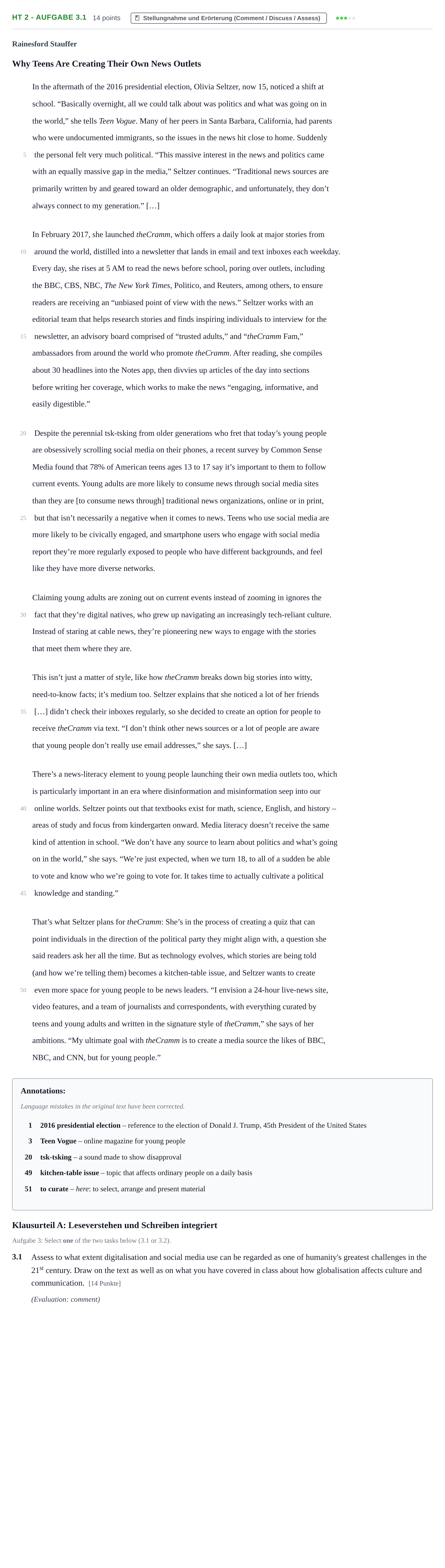
Rainesford Stauffer
Why Teens Are Creating Their Own News Outlets
In the aftermath of the 2016 presidential election, Olivia Seltzer, now 15, noticed a shift at
school. “Basically overnight, all we could talk about was politics and what was going on in
the world,” she tells Teen Vogue. Many of her peers in Santa Barbara, California, had parents
who were undocumented immigrants, so the issues in the news hit close to home. Suddenly
5 the personal felt very much political. “This massive interest in the news and politics came
with an equally massive gap in the media,” Seltzer continues. “Traditional news sources are
primarily written by and geared toward an older demographic, and unfortunately, they don’t
always connect to my generation.” […]
In February 2017, she launched theCramm, which offers a daily look at major stories from
10 around the world, distilled into a newsletter that lands in email and text inboxes each weekday.
Every day, she rises at 5 AM to read the news before school, poring over outlets, including
the BBC, CBS, NBC, The New York Times, Politico, and Reuters, among others, to ensure
readers are receiving an “unbiased point of view with the news.” Seltzer works with an
editorial team that helps research stories and finds inspiring individuals to interview for the
15 newsletter, an advisory board comprised of “trusted adults,” and “ theCramm Fam,”
ambassadors from around the world who promote theCramm. After reading, she compiles
about 30 headlines into the Notes app, then divvies up articles of the day into sections
before writing her coverage, which works to make the news “engaging, informative, and
easily digestible.”
20 Despite the perennial tsk-tsking from older generations who fret that today’s young people
are obsessively scrolling social media on their phones, a recent survey by Common Sense
Media found that 78% of American teens ages 13 to 17 say it’s important to them to follow
current events. Young adults are more likely to consume news through social media sites
than they are [to consume news through] traditional news organizations, online or in print,
25 but that isn’t necessarily a negative when it comes to news. Teens who use social media are
more likely to be civically engaged, and smartphone users who engage with social media
report they’re more regularly exposed to people who have different backgrounds, and feel
like they have more diverse networks.
Claiming young adults are zoning out on current events instead of zooming in ignores the
30 fact that they’re digital natives, who grew up navigating an increasingly tech-reliant culture.
Instead of staring at cable news, they’re pioneering new ways to engage with the stories
that meet them where they are.
This isn’t just a matter of style, like how theCramm breaks down big stories into witty,
need-to-know facts; it’s medium too. Seltzer explains that she noticed a lot of her friends
35 […] didn’t check their inboxes regularly, so she decided to create an option for people to
receive theCramm via text. “I don’t think other news sources or a lot of people are aware
that young people don’t really use email addresses,” she says. […]
There’s a news-literacy element to young people launching their own media outlets too, which
is particularly important in an era where disinformation and misinformation seep into our
40 online worlds. Seltzer points out that textbooks exist for math, science, English, and history –
areas of study and focus from kindergarten onward. Media literacy doesn’t receive the same
kind of attention in school. “We don’t have any source to learn about politics and what’s going
on in the world,” she says. “We’re just expected, when we turn 18, to all of a sudden be able
to vote and know who we’re going to vote for. It takes time to actually cultivate a political
45 knowledge and standing.”
That’s what Seltzer plans for theCramm: She’s in the process of creating a quiz that can
point individuals in the direction of the political party they might align with, a question she
said readers ask her all the time. But as technology evolves, which stories are being told
(and how we’re telling them) becomes a kitchen-table issue, and Seltzer wants to create
50 even more space for young people to be news leaders. “I envision a 24-hour live-news site,
video features, and a team of journalists and correspondents, with everything curated by
teens and young adults and written in the signature style of theCramm,” she says of her
ambitions. “My ultimate goal with theCramm is to create a media source the likes of BBC,
NBC, and CNN, but for young people.”
Annotations:
Language mistakes in the original text have been corrected.
1 · 2016 presidential election – reference to the election of Donald J. Trump, 45th President of the United States
3 · Teen Vogue – online magazine for young people
20 · tsk-tsking – a sound made to show disapproval
49 · kitchen-table issue – topic that affects ordinary people on a daily basis
51 · to curate – here: to select, arrange and present material
Klausurteil A: Leseverstehen und Schreiben integriert
Aufgabe 3: Select one of the two tasks below (3.1 or 3.2).
3.1
Assess to what extent digitalisation and social media use can be regarded as one of humanity's greatest challenges in the 21 st century. Draw on the text as well as on what you have covered in class about how globalisation affects culture and communication. [14 Punkte]
(Evaluation: comment)
Lösung
Nach den offiziellen Korrekturhinweisen
3.1 Assess to what extent digitalisation and social media use can be regarded as one of humanity's greatest challenges in the 21st century. Draw on the text as well as on what you have covered in class about how globalisation affects culture and communication. (Evaluation: comment)
Lösung: A structured evaluative comment discussing whether digitalisation and social media represent one of humanity's foremost challenges: - Introduction: Defines the scope of rapid digitalisation and pervasive social media use in globalised 21st-century society. - Challenges & Risks: - Spread of fake news, misinformation, and algorithmic echo chambers endangering democratic processes. - Threat to traditional news outlets and professional investigative journalism. - Social alienation, mental health concerns, and constant pressure from online self-presentation. - Digital surveillance, privacy violations, and corporate monopolies over global communication channels. - Opportunities & Counterarguments: - Empowerment of individuals and youth (as illustrated by Olivia Seltzer creating *theCramm*). - Democratisation of information and global awareness/connectivity across borders. - Opportunities for civic engagement, activism (e.g., Fridays for Future), and diverse representation. - Conclusion / Verdict: Balanced evaluation highlighting that while digitalisation presents monumental ethical, political, and educational challenges requiring institutional regulation and media literacy, it is simultaneously an indispensable tool for global collaboration and cultural exchange.
Die ausführliche Erklärung Schritt für Schritt (mit KI) gibt es mit Premium. Premium
Löse sie direkt hier: automatische Korrektur, Hinweise und Lösung Schritt für Schritt.
‹ Aufgabe HT 1 - Aufgabe 3.1 · GK · Haupttermin 2022 · Aufgabe HT 3 - Aufgabe 3.1 · GK · Haupttermin 2022 ›
Mehr Aufgaben zu Stellungnahme und Erörterung (Comment / Discuss / Assess)
- Aufgabe NT 2 - Aufgabe 3.1 · LK · Nachtermin 2023
- Aufgabe NT 1 - Aufgabe 3.1 · LK · Nachtermin · Weiterbildungskolleg 2023
- Aufgabe NT 2 - Aufgabe 3.1 · LK · Nachtermin · Weiterbildungskolleg 2023
- Aufgabe 3.1 · LK · Neem: Unbecoming American 2023
- Aufgabe HT 1 - Aufgabe 3.1 · GK · Haupttermin 2022
- Aufgabe HT 3 - Aufgabe 3.1 · GK · Haupttermin 2022
- Aufgabe HT 1 - Aufgabe 3.1 · GK · Haupttermin · Weiterbildungskolleg 2022
- Aufgabe HT 2 - Aufgabe 3.1 · GK · Haupttermin · Weiterbildungskolleg 2022
- Aufgabe HT 3 - Aufgabe 3.1 · GK · Haupttermin · Weiterbildungskolleg 2022
- Aufgabe 3.1 (NT 1) · GK · Nachtermin 2022