Aufgabe HT 1 - Aufgabe 3.1 · Abitur NRW Englisch GK · Haupttermin 2022
Thema: Stellungnahme und Erörterung (Comment / Discuss / Assess) · Aus der Prüfung GK · Haupttermin (2022)
Aufgabenstellung
Klausurteil A: Leseverstehen und Schreiben integriert
Klausurteil A
Laila Lalami
The Other Americans
The novel takes place in California, where the Moroccan Guerraoui family has settled after emigrating.
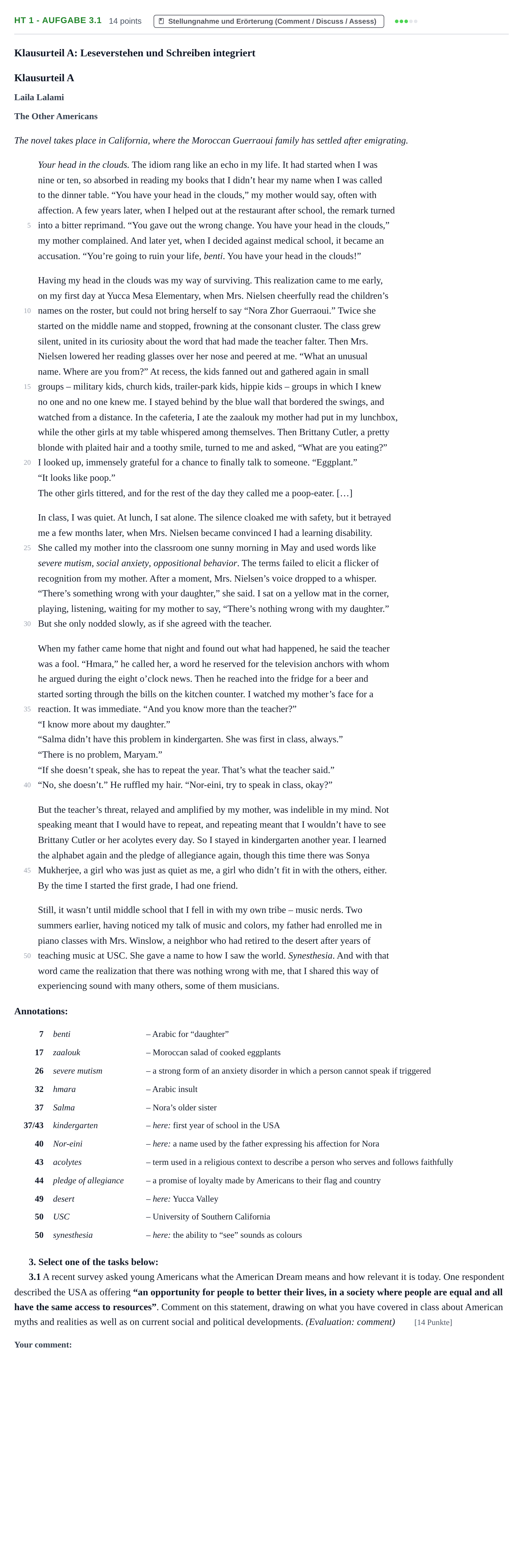
Your head in the clouds. The idiom rang like an echo in my life. It had started when I was
nine or ten, so absorbed in reading my books that I didn’t hear my name when I was called
to the dinner table. “You have your head in the clouds,” my mother would say, often with
affection. A few years later, when I helped out at the restaurant after school, the remark turned
5 into a bitter reprimand. “You gave out the wrong change. You have your head in the clouds,”
my mother complained. And later yet, when I decided against medical school, it became an
accusation. “You’re going to ruin your life, benti. You have your head in the clouds!”
Having my head in the clouds was my way of surviving. This realization came to me early,
on my first day at Yucca Mesa Elementary, when Mrs. Nielsen cheerfully read the children’s
10 names on the roster, but could not bring herself to say “Nora Zhor Guerraoui.” Twice she
started on the middle name and stopped, frowning at the consonant cluster. The class grew
silent, united in its curiosity about the word that had made the teacher falter. Then Mrs.
Nielsen lowered her reading glasses over her nose and peered at me. “What an unusual
name. Where are you from?” At recess, the kids fanned out and gathered again in small
15 groups – military kids, church kids, trailer-park kids, hippie kids – groups in which I knew
no one and no one knew me. I stayed behind by the blue wall that bordered the swings, and
watched from a distance. In the cafeteria, I ate the zaalouk my mother had put in my lunchbox,
while the other girls at my table whispered among themselves. Then Brittany Cutler, a pretty
blonde with plaited hair and a toothy smile, turned to me and asked, “What are you eating?”
20 I looked up, immensely grateful for a chance to finally talk to someone. “Eggplant.”
“It looks like poop.”
The other girls tittered, and for the rest of the day they called me a poop-eater. […]
In class, I was quiet. At lunch, I sat alone. The silence cloaked me with safety, but it betrayed
me a few months later, when Mrs. Nielsen became convinced I had a learning disability.
25 She called my mother into the classroom one sunny morning in May and used words like
severe mutism, social anxiety, oppositional behavior. The terms failed to elicit a flicker of
recognition from my mother. After a moment, Mrs. Nielsen’s voice dropped to a whisper.
“There’s something wrong with your daughter,” she said. I sat on a yellow mat in the corner,
playing, listening, waiting for my mother to say, “There’s nothing wrong with my daughter.”
30 But she only nodded slowly, as if she agreed with the teacher.
When my father came home that night and found out what had happened, he said the teacher
was a fool. “Hmara,” he called her, a word he reserved for the television anchors with whom
he argued during the eight o’clock news. Then he reached into the fridge for a beer and
started sorting through the bills on the kitchen counter. I watched my mother’s face for a
35 reaction. It was immediate. “And you know more than the teacher?”
“I know more about my daughter.”
“Salma didn’t have this problem in kindergarten. She was first in class, always.”
“There is no problem, Maryam.”
“If she doesn’t speak, she has to repeat the year. That’s what the teacher said.”
40 “No, she doesn’t.” He ruffled my hair. “Nor-eini, try to speak in class, okay?”
But the teacher’s threat, relayed and amplified by my mother, was indelible in my mind. Not
speaking meant that I would have to repeat, and repeating meant that I wouldn’t have to see
Brittany Cutler or her acolytes every day. So I stayed in kindergarten another year. I learned
the alphabet again and the pledge of allegiance again, though this time there was Sonya
45 Mukherjee, a girl who was just as quiet as me, a girl who didn’t fit in with the others, either.
By the time I started the first grade, I had one friend.
Still, it wasn’t until middle school that I fell in with my own tribe – music nerds. Two
summers earlier, having noticed my talk of music and colors, my father had enrolled me in
piano classes with Mrs. Winslow, a neighbor who had retired to the desert after years of
50 teaching music at USC. She gave a name to how I saw the world. Synesthesia. And with that
word came the realization that there was nothing wrong with me, that I shared this way of
experiencing sound with many others, some of them musicians.
Annotations:
7 · benti · – Arabic for “daughter”
17 · zaalouk · – Moroccan salad of cooked eggplants
26 · severe mutism · – a strong form of an anxiety disorder in which a person cannot speak if triggered
32 · hmara · – Arabic insult
37 · Salma · – Nora’s older sister
37/43 · kindergarten · – here: first year of school in the USA
40 · Nor-eini · – here: a name used by the father expressing his affection for Nora
43 · acolytes · – term used in a religious context to describe a person who serves and follows faithfully
44 · pledge of allegiance · – a promise of loyalty made by Americans to their flag and country
49 · desert · – here: Yucca Valley
50 · USC · – University of Southern California
50 · synesthesia · – here: the ability to “see” sounds as colours
3. Select one of the tasks below:
3.1 A recent survey asked young Americans what the American Dream means and how relevant it is today. One respondent described the USA as offering “an opportunity for people to better their lives, in a society where people are equal and all have the same access to resources”. Comment on this statement, drawing on what you have covered in class about American myths and realities as well as on current social and political developments. (Evaluation: comment) [14 Punkte]
Lösung
Nach den offiziellen Korrekturhinweisen
3.1 A recent survey asked young Americans what the American Dream means and how relevant it is today. One respondent described the USA as offering “an opportunity for people to better their lives, in a society where people are equal and all have the same access to resources”. Comment on this statement, drawing on what you have covered in class about American myths and realities as well as on current social and political developments. (Evaluation: comment) [14 Punkte]
Lösung: Structure and main arguments for the comment: - Introduction / Explanation of the quote (4 points): The quote reflects the traditional, idealistic notion of the American Dream — equality of opportunity, social mobility, and access to resources regardless of background. - Discussion of Arguments (8 points): * Supporting arguments: Constitutional ideals ('all men are created equal'), entrepreneurship, success stories of immigrants, freedom of self-actualization. * Critical counterarguments: Reality of growing social and economic inequality; educational gaps (funding tied to property taxes); systemic racism, discrimination, and marginalization of minorities (as mirrored in Nora's school experience); limited upward mobility ('glass ceiling'). - Conclusion (2 points): A balanced summary judging whether the American Dream remains a viable promise or has largely become an illusion for many contemporary Americans.
Die ausführliche Erklärung Schritt für Schritt (mit KI) gibt es mit Premium. Premium
Löse sie direkt hier: automatische Korrektur, Hinweise und Lösung Schritt für Schritt.
‹ Aufgabe 3.1 · LK · Neem: Unbecoming American 2023 · Aufgabe HT 2 - Aufgabe 3.1 · GK · Haupttermin 2022 ›
Mehr Aufgaben zu Stellungnahme und Erörterung (Comment / Discuss / Assess)
- Aufgabe NT 1 - Aufgabe 3.1 · LK · Nachtermin 2023
- Aufgabe NT 2 - Aufgabe 3.1 · LK · Nachtermin 2023
- Aufgabe NT 1 - Aufgabe 3.1 · LK · Nachtermin · Weiterbildungskolleg 2023
- Aufgabe NT 2 - Aufgabe 3.1 · LK · Nachtermin · Weiterbildungskolleg 2023
- Aufgabe 3.1 · LK · Neem: Unbecoming American 2023
- Aufgabe HT 2 - Aufgabe 3.1 · GK · Haupttermin 2022
- Aufgabe HT 3 - Aufgabe 3.1 · GK · Haupttermin 2022
- Aufgabe HT 1 - Aufgabe 3.1 · GK · Haupttermin · Weiterbildungskolleg 2022
- Aufgabe HT 2 - Aufgabe 3.1 · GK · Haupttermin · Weiterbildungskolleg 2022
- Aufgabe HT 3 - Aufgabe 3.1 · GK · Haupttermin · Weiterbildungskolleg 2022