Aufgabe HT 3 - 3.1 · Abitur NRW Englisch LK · Haupttermin 2021
Thema: Stellungnahme und Erörterung (Comment / Discuss / Assess) · Aus der Prüfung LK · Haupttermin (2021)
Aufgabenstellung
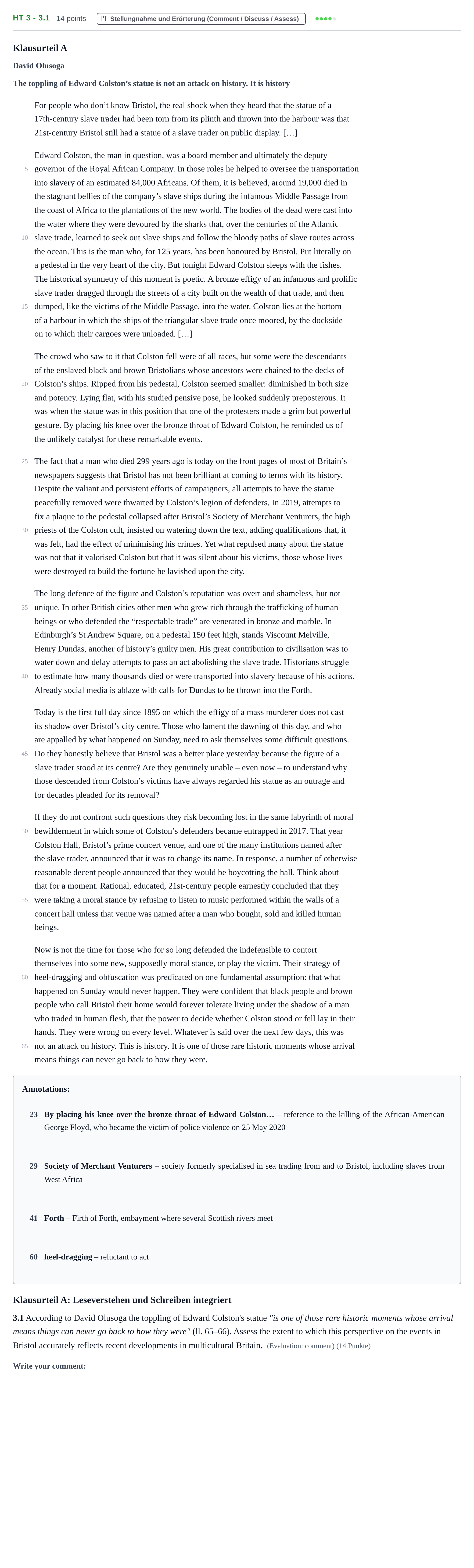
Klausurteil A
David Olusoga
The toppling of Edward Colston’s statue is not an attack on history. It is history
For people who don’t know Bristol, the real shock when they heard that the statue of a
17th-century slave trader had been torn from its plinth and thrown into the harbour was that
21st-century Bristol still had a statue of a slave trader on public display. […]
Edward Colston, the man in question, was a board member and ultimately the deputy
5 governor of the Royal African Company. In those roles he helped to oversee the transportation
into slavery of an estimated 84,000 Africans. Of them, it is believed, around 19,000 died in
the stagnant bellies of the company’s slave ships during the infamous Middle Passage from
the coast of Africa to the plantations of the new world. The bodies of the dead were cast into
the water where they were devoured by the sharks that, over the centuries of the Atlantic
10 slave trade, learned to seek out slave ships and follow the bloody paths of slave routes across
the ocean. This is the man who, for 125 years, has been honoured by Bristol. Put literally on
a pedestal in the very heart of the city. But tonight Edward Colston sleeps with the fishes.
The historical symmetry of this moment is poetic. A bronze effigy of an infamous and prolific
slave trader dragged through the streets of a city built on the wealth of that trade, and then
15 dumped, like the victims of the Middle Passage, into the water. Colston lies at the bottom
of a harbour in which the ships of the triangular slave trade once moored, by the dockside
on to which their cargoes were unloaded. […]
The crowd who saw to it that Colston fell were of all races, but some were the descendants
of the enslaved black and brown Bristolians whose ancestors were chained to the decks of
20 Colston’s ships. Ripped from his pedestal, Colston seemed smaller: diminished in both size
and potency. Lying flat, with his studied pensive pose, he looked suddenly preposterous. It
was when the statue was in this position that one of the protesters made a grim but powerful
gesture. By placing his knee over the bronze throat of Edward Colston, he reminded us of
the unlikely catalyst for these remarkable events.
25 The fact that a man who died 299 years ago is today on the front pages of most of Britain’s
newspapers suggests that Bristol has not been brilliant at coming to terms with its history.
Despite the valiant and persistent efforts of campaigners, all attempts to have the statue
peacefully removed were thwarted by Colston’s legion of defenders. In 2019, attempts to
fix a plaque to the pedestal collapsed after Bristol’s Society of Merchant Venturers, the high
30 priests of the Colston cult, insisted on watering down the text, adding qualifications that, it
was felt, had the effect of minimising his crimes. Yet what repulsed many about the statue
was not that it valorised Colston but that it was silent about his victims, those whose lives
were destroyed to build the fortune he lavished upon the city.
The long defence of the figure and Colston’s reputation was overt and shameless, but not
35 unique. In other British cities other men who grew rich through the trafficking of human
beings or who defended the “respectable trade” are venerated in bronze and marble. In
Edinburgh’s St Andrew Square, on a pedestal 150 feet high, stands Viscount Melville,
Henry Dundas, another of history’s guilty men. His great contribution to civilisation was to
water down and delay attempts to pass an act abolishing the slave trade. Historians struggle
40 to estimate how many thousands died or were transported into slavery because of his actions.
Already social media is ablaze with calls for Dundas to be thrown into the Forth.
Today is the first full day since 1895 on which the effigy of a mass murderer does not cast
its shadow over Bristol’s city centre. Those who lament the dawning of this day, and who
are appalled by what happened on Sunday, need to ask themselves some difficult questions.
45 Do they honestly believe that Bristol was a better place yesterday because the figure of a
slave trader stood at its centre? Are they genuinely unable – even now – to understand why
those descended from Colston’s victims have always regarded his statue as an outrage and
for decades pleaded for its removal?
If they do not confront such questions they risk becoming lost in the same labyrinth of moral
50 bewilderment in which some of Colston’s defenders became entrapped in 2017. That year
Colston Hall, Bristol’s prime concert venue, and one of the many institutions named after
the slave trader, announced that it was to change its name. In response, a number of otherwise
reasonable decent people announced that they would be boycotting the hall. Think about
that for a moment. Rational, educated, 21st-century people earnestly concluded that they
55 were taking a moral stance by refusing to listen to music performed within the walls of a
concert hall unless that venue was named after a man who bought, sold and killed human
beings.
Now is not the time for those who for so long defended the indefensible to contort
themselves into some new, supposedly moral stance, or play the victim. Their strategy of
60 heel-dragging and obfuscation was predicated on one fundamental assumption: that what
happened on Sunday would never happen. They were confident that black people and brown
people who call Bristol their home would forever tolerate living under the shadow of a man
who traded in human flesh, that the power to decide whether Colston stood or fell lay in their
hands. They were wrong on every level. Whatever is said over the next few days, this was
65 not an attack on history. This is history. It is one of those rare historic moments whose arrival
means things can never go back to how they were.
Annotations:
23 By placing his knee over the bronze throat of Edward Colston… – reference to the killing of the African-American George Floyd, who became the victim of police violence on 25 May 2020
29 Society of Merchant Venturers – society formerly specialised in sea trading from and to Bristol, including slaves from West Africa
41 Forth – Firth of Forth, embayment where several Scottish rivers meet
60 heel-dragging – reluctant to act
Klausurteil A: Leseverstehen und Schreiben integriert
3.1 According to David Olusoga the toppling of Edward Colston's statue "is one of those rare historic moments whose arrival means things can never go back to how they were" (ll. 65–66). Assess the extent to which this perspective on the events in Bristol accurately reflects recent developments in multicultural Britain.
(Evaluation: comment) (14 Punkte)
Lösung
Nach den offiziellen Korrekturhinweisen
3.1 Assess the extent to which this perspective on the events in Bristol accurately reflects recent developments in multicultural Britain.
Lösung: An adequate evaluation critically assesses Olusoga's claim of an irrevocable turning point: - Arguments supporting Olusoga's view: Growing empowerment, self-confidence, and civic activism among ethnic minorities; widespread public debate re-evaluating the British Empire and colonial iconography; reforms in school curricula, museum curation, and public institutions; increased political and media representation of diversity. - Counterarguments/Limitations: Persistent structural and institutional racism; resistance from conservative politicians and traditionalist segments defending historical monuments; nationalist and isolationist currents (e.g. post-Brexit debates); social inequality and lack of upward mobility for minority groups. - Conclusion: A well-reasoned and balanced judgment concluding whether the event signifies a fundamental systemic transformation or primarily a symbolic milestone within an ongoing, polarized struggle for equality in multicultural Britain.
Die ausführliche Erklärung Schritt für Schritt (mit KI) gibt es mit Premium. Premium
Löse sie direkt hier: automatische Korrektur, Hinweise und Lösung Schritt für Schritt.
‹ Aufgabe HT 2 - 3.1 · LK · Haupttermin 2021 · Aufgabe HT 1 - Aufgabe 3.1 · LK · Haupttermin · Weiterbildungskolleg 2021 ›
Mehr Aufgaben zu Stellungnahme und Erörterung (Comment / Discuss / Assess)
- Aufgabe NT 3 - Aufgabe 3.1 · GK · Nachtermin · Weiterbildungskolleg 2021
- Aufgabe 3.1 · LK · Choudhury: The Epic City. The World 2021
- Aufgabe 3.1 · LK · Cohen: Nelson Mandela’s Stolen Spoo 2021
- Aufgabe HT 1 - 3.1 · LK · Haupttermin 2021
- Aufgabe HT 2 - 3.1 · LK · Haupttermin 2021
- Aufgabe HT 1 - Aufgabe 3.1 · LK · Haupttermin · Weiterbildungskolleg 2021
- Aufgabe HT 2 - Aufgabe 3.1 · LK · Haupttermin · Weiterbildungskolleg 2021
- Aufgabe HT 3 - Aufgabe 3.1 · LK · Haupttermin · Weiterbildungskolleg 2021
- Aufgabe NT 1 - Aufgabe 3.1 · LK · Nachtermin 2021
- Aufgabe NT 2 - Aufgabe 3.1 · LK · Nachtermin 2021